September 10 · Menodora, Metrodora, and Nymphodora
Share
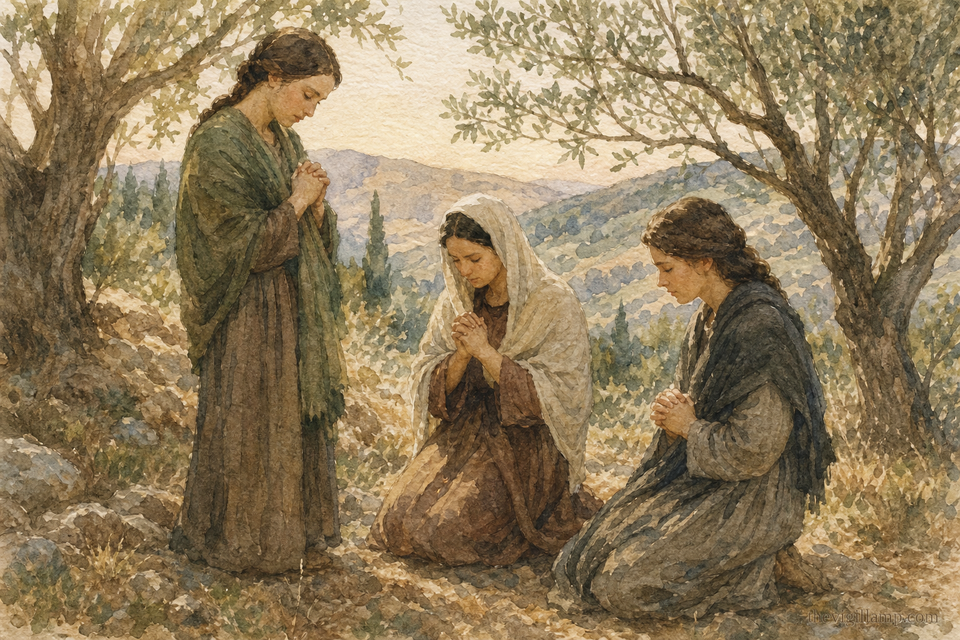
Three sisters in the Bithynia wilderness, remaining together at prayer. No extra speech invented

Afterfeast of the Nativity of the Most Holy Theotokos

Holy Virgins-Martyrs Menodora, Metrodora, and Nymphodora at Nicomedia
✦ ✦ ✦
Before you begin
Today's Vigil is for your family, not the other way around. If anything feels like too much, that's okay. Do the parts your family loves, and work your way up to the whole Vigil in one sitting.
Movement One
Light the Lamp
Do together: Light your lamp or a candle. Then say: "Today the Church keeps the Afterfeast of the Nativity of the Most Holy Theotokos, and remembers the Holy Virgins-Martyrs Menodora, Metrodora, and Nymphodora."
We begin the way the Church begins any new work
“O Lord Jesus Christ, the only-begotten Son of the eternal Father, Thou hast said, 'Without me you can do nothing.' In faith I embrace Thy words, O Lord, and bow before Thy goodness. Help me to complete the work I am about to begin for Thine own glory: in the Name of the Father, and of the Son, and of the Holy Spirit. Amen.”
Then all together:
“Through the prayers of our holy fathers,
O Lord Jesus Christ our God, have mercy on us.”
The Orthodox prayer before beginning any work, offered for our family and for yours, each time we begin again.
Movement Two
Read the Icon
Before we hear their story, let's look at how the Church has always shown these three sisters, and learn to read what this icon is telling us.
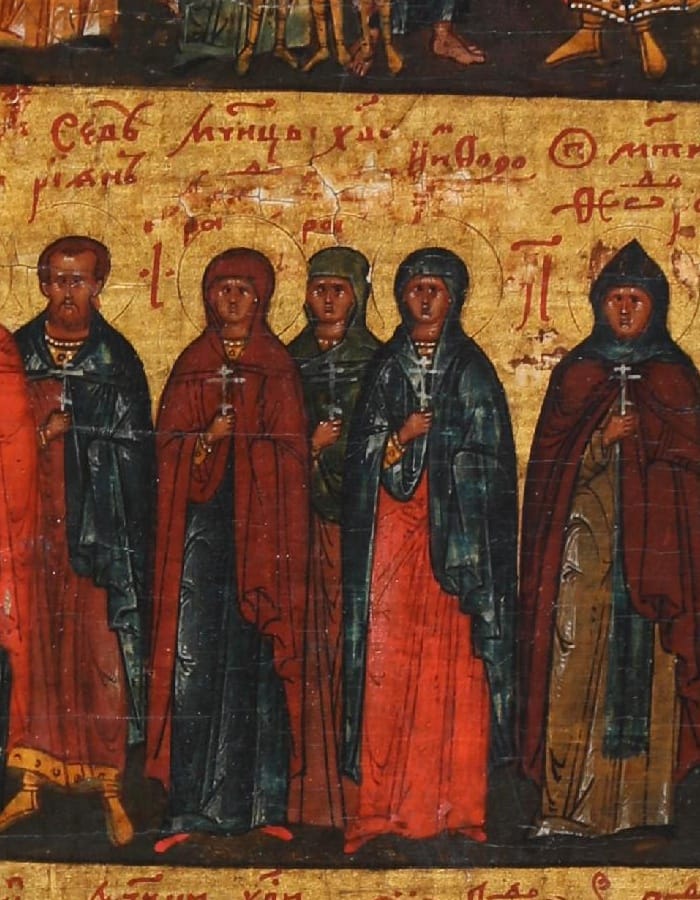
Holy Virgins-Martyrs Menodora, Metrodora, and Nymphodora · detail within a September Menaion icon · Central Russia, first quarter of the seventeenth century · Museum of Christian Art "Church-Archaeological Cabinet"
What are we looking at?
An icon isn't a photograph, and it isn't a painting to admire. It's a window. Everything in it is there to teach us something true about the saints.
The whole month. This is a calendar icon, called a Menaion. Across four long rows, many saints and feasts of September stand together on a gold ground. Their days form one shared procession. Two days ago the Church kept the Nativity of the Theotokos on this same board. Today we rest our eyes on three sisters.
The gold behind them. It is worn and cracked. A thin dark line of age runs down through the gold. Not a sky, not a room. Heaven's own light. The saints stand where God's light fills everything.
The three who will not come apart. Look in the second row. Three women stand shoulder to shoulder, so close their cloaks almost touch. The one in the middle stands a little behind the other two. The Church is not showing three strangers who happened to meet. She is showing a house that stayed together.
Their three small crosses. Each sister holds a thin white cross in her right hand, close against her chest. This is the Church's way of naming a martyr — someone who would not let go of Christ. They are not shown with swords. They are not shown falling. On this panel they stand.
Their clothes. The sister on the left wears a deep red cloak over a dark garment. The sister in the middle wears a dark green cloak. The sister on the right wears a dark blue cloak over a bright red garment. We will not invent which painted color belongs to which name. The icon has already told us the one thing we need: they are three, and they are one company.
Their faces. Large dark eyes. Quiet mouths. They look straight toward us. The gold is old. The faces are still at peace.
The name. Fine red Church Slavonic writing runs above them. The word for holy women-martyrs can still be read. On the right, part of the name Nymphodora can still be read. The rest of the letters have grown thin. We will not invent them. Every icon means to name its saints. The Church has already named these three: Menodora, Metrodora, and Nymphodora.
The neighbors on the board. To their left the calendar still holds Joachim and Anna, and the martyr Severian. To their right stands another holy woman. We rest our eyes on the three sisters, and we do not pretend the rest of September is not there.
Anonymous Russian icon painter, Menaion: September, first quarter of the seventeenth century, tempera, gesso, and gilding on wood; Museum of Christian Art "Church-Archaeological Cabinet," inventory MMDA "TsAK" KP-205. Public domain. Image via Wikimedia Commons, from christianmuseum.ru. The day's own miniature in the Menologion of Basil II was inspected: it is a beating scene and is not shown to the family. Modern OCA files were not used.
The Readings   Movement Three
The Scripture the Church appoints for this day. Open your Bible at home and read the passages aloud together, then listen for these words echoing through the story and the rest of your day.
A Psalm to begin · Psalm 132 (133) : 1
“See now! what is so good, or what so pleasant, as for brethren to dwell together?”
The Septuagint (Brenton, 1851), the Old Testament of the Orthodox Church. In ordinary English Bibles this is Psalm 133:1. This verse is chosen for prayer today; it is not a separate lectionary appointment.
The Epistle · Galatians 3 : 23–4 : 5
“For as many of you as have been baptized into Christ have put on Christ. There is neither Jew nor Greek, there is neither bond nor free, there is neither male nor female: for ye are all one in Christ Jesus.”
Open your Bible and read the full passage together. Text: King James Version (public domain).
The Gospel · Mark 6 : 30–45
“And he said unto them, Come ye yourselves apart into a desert place, and rest a while.”
Open your Bible and read the full passage together. Text: King James Version (public domain).
These are the weekday readings appointed by the Orthodox Church in America for Thursday, September 10, 2026. The OCA daily page and the September monthly lectionary list no separate Afterfeast pair and no saint pair for Menodora, Metrodora, and Nymphodora. The Theotokos feast pair — Philippians 2:5–11 and Luke 10:38–42; 11:27–28 — is appointed on September 8 and again on September 12, not today. This edition therefore uses the appointed weekday pair.
audio-thumbnail
Menodora, Metrodora, and Nymphodora · Read aloud
0:00
/541.727347
Movement Four
The Story

The joy is still in the house.

Two days ago the Church opened the door. She kept a Great Feast. She sang that a girl-child had been born, and her name is Mary. Yesterday she gathered the parents.

Today is not that day again.

Today is the Afterfeast. The hymns of the birth are still being sung. And today the Church does another thing she loves to do while a Great Feast is still in the room.

She remembers three sisters who would not come apart.

The Church remembers more than one name on the tenth of September. She remembers Venerable Paul the Obedient of the Kiev Caves, and Blessed Prince Andrew, in monasticism Joasaph, and the Holy Apostles of the Seventy Apelles, Luke, and Clement, and other holy names. Those are true days. We will not tell those whole lives this morning.

This morning she asks us to look at the three.

Their names are Menodora, Metrodora, and Nymphodora. The Church calls them holy virgins and martyrs. They were sisters from Bithynia, in Asia Minor. The years the Church gives are 305 to 311, in the days of the emperor Maximian.

Do you hear what she is already singing for them? "Let all who rejoice at their triumph honor these three virgin martyrs, who are united to God as sisters."

That is today's word. Not three strangers. Sisters.

They were distinguished for their special piety. They wanted to preserve their virginity and avoid worldly associations. They chose a solitary place for themselves in the wilderness, and there they spent their lives in prayer.
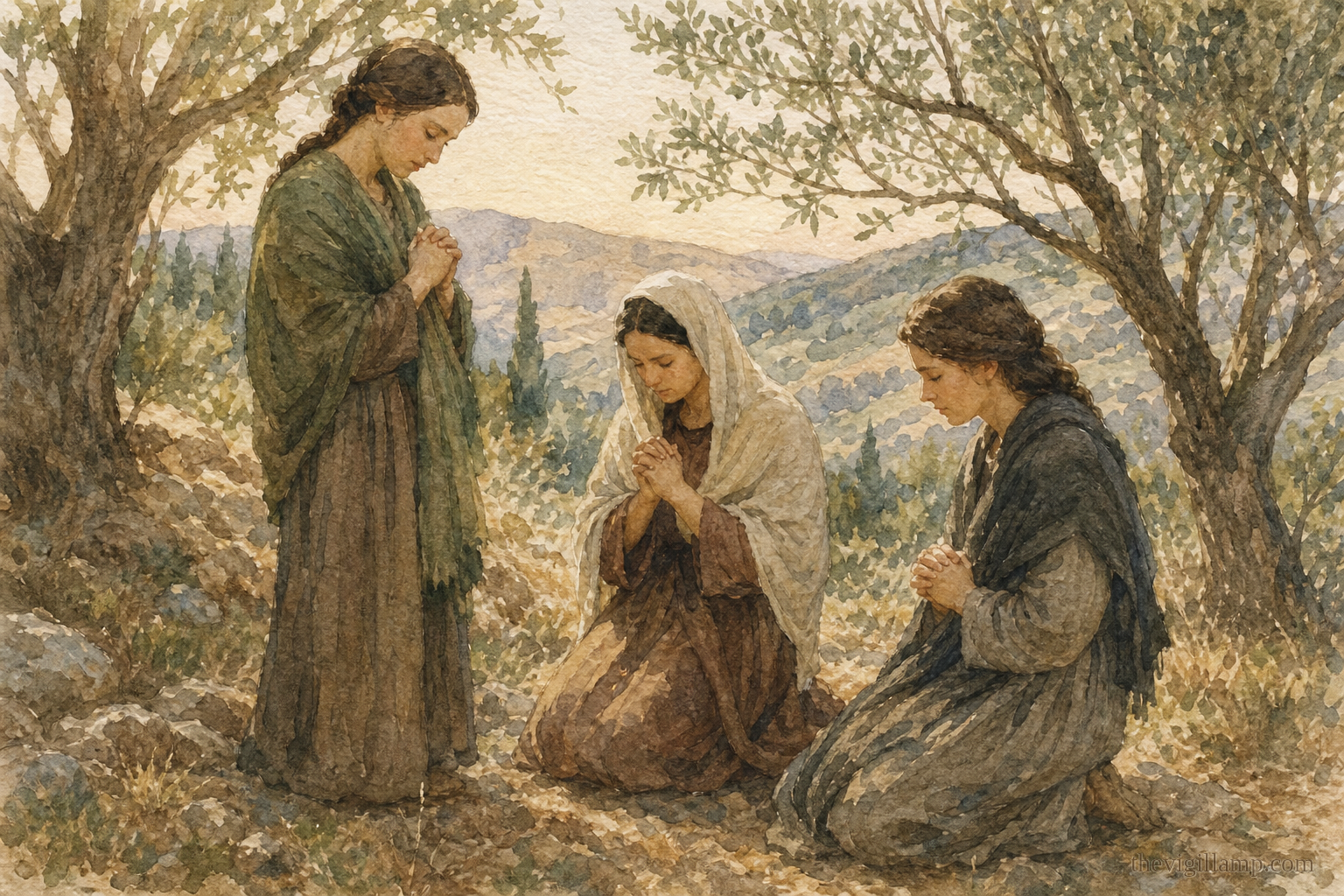
Three sisters in the Bithynia wilderness, remaining together at prayer. No extra speech invented

They did not go into the wild to be famous. They went so they could belong to Christ, and to one another, without the city pulling them apart.

Reports of the holy life of the virgins soon spread, since healings of the sick began to occur through their prayers. People found the quiet place. The sisters had wanted solitude. God let their prayer become a help.

The region of Bithynia was governed at that time by a man named Frontonus. He ordered that the sisters be arrested and brought before him.
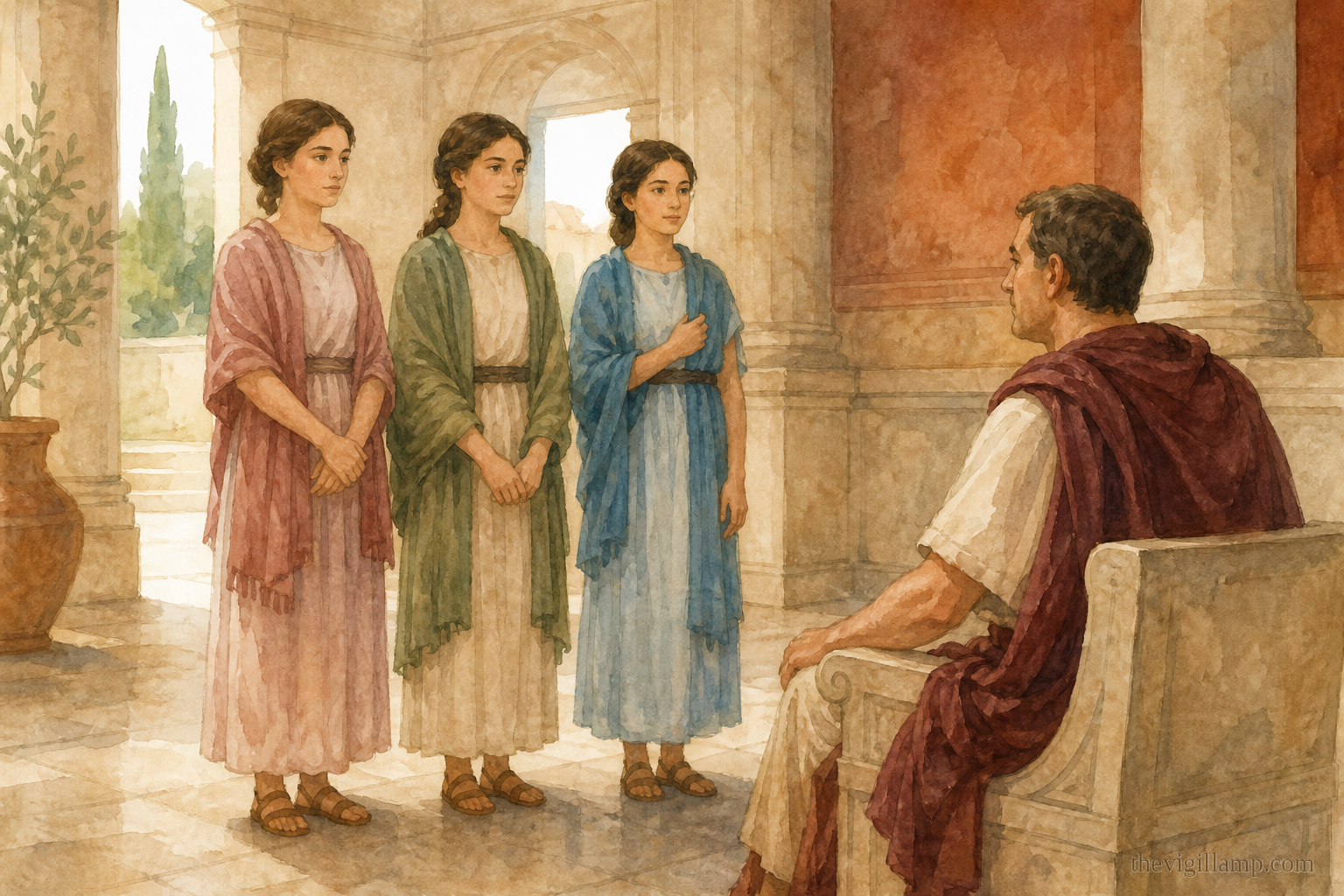
The three sisters standing together before the governor Frontonus. No extra speech invented

At first he tried to persuade them to renounce Christ. He promised great honors and rewards.

The holy sisters steadfastly confessed their faith before him. They rejected all his suggestions. They told him that they did not value the temporal things of this world, and that they were prepared to die for their Heavenly Bridegroom, for death would be their gateway to eternal life.

Those are the Church's words. We will not invent others.

Frontonus flew into a rage. He took out his wrath first on Saint Menodora, the eldest sister. A herald urged her to offer sacrifice to the gods.

We will not linger on the manner of her sufferings. The Church knows them, and that is enough for us this morning.

The saint bravely endured, and she cried out the words the Church has kept:

"Sacrifice? Can't you see that I am offering myself as a sacrifice to my God?"

Then the martyr cried out once more:

"Lord Jesus Christ, joy of my heart, my hope, receive my soul in peace."

With these words she gave up her soul to God, and went to her Heavenly Bridegroom.
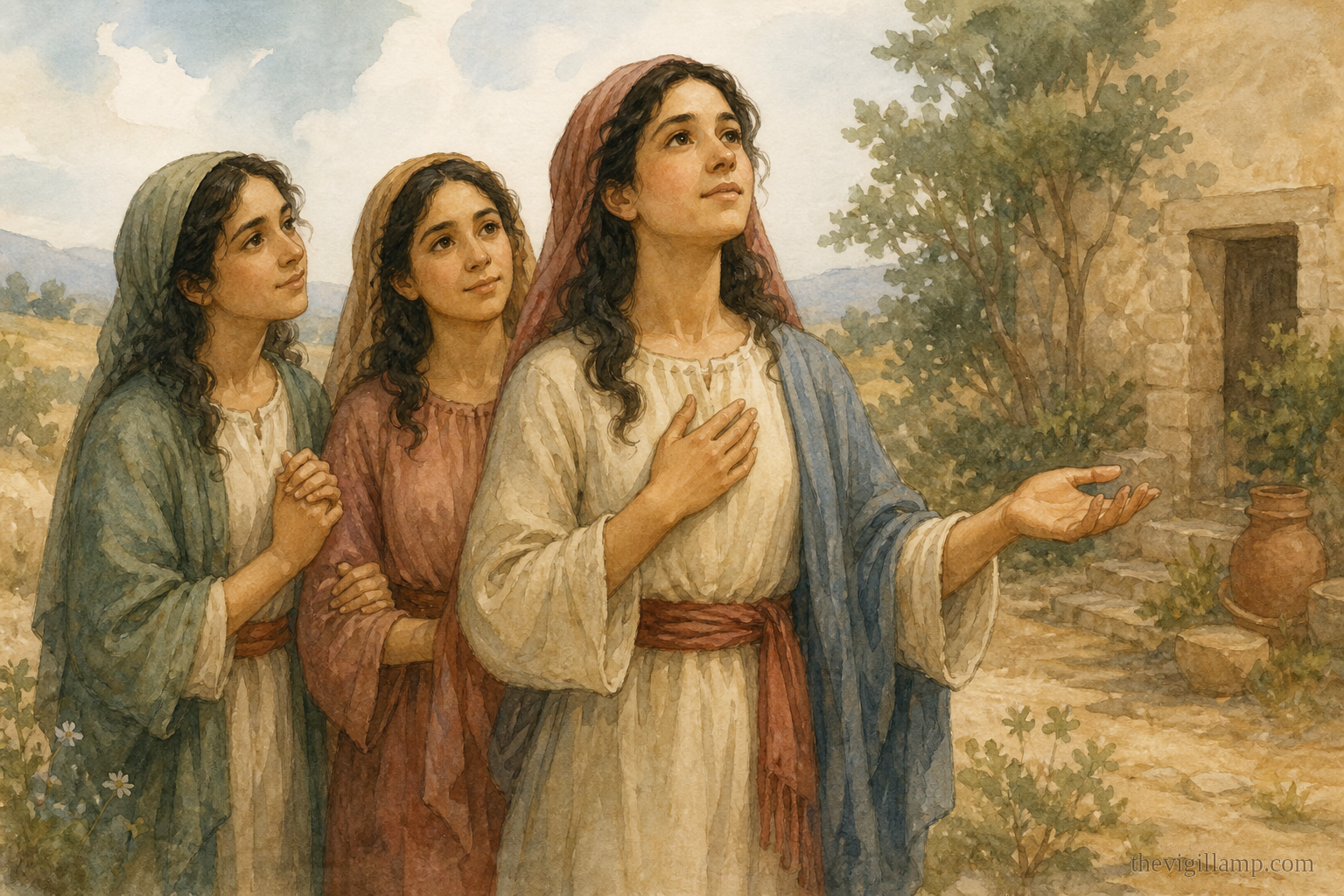
Menodora, the eldest, offering herself to God; the Church keeps her own words. No extra speech invented

Four days later they brought the two younger sisters, Metrodora and Nymphodora, to the court. They showed them that their older sister had already gone to Christ. The governor hoped the sight would frighten them.

The virgins wept over her.

They remained steadfast.

Do you hear that? They wept. Love does not make a person hard. And they would not turn. Love does not make a person leave.

Then Saint Metrodora was made to suffer. She died crying out to her beloved Lord Jesus Christ with her last breath. We will not invent that cry. The Church has told us to whom she called.

Then they turned to the third sister, Nymphodora. Before her were the two who had already gone. Frontonus hoped that this sight would intimidate the young virgin. Pretending that he was charmed by her youth and beauty, he urged her to worship the pagan gods, promising great rewards and honors.

Saint Nymphodora scoffed at his words.

She shared the fate of her older sisters.
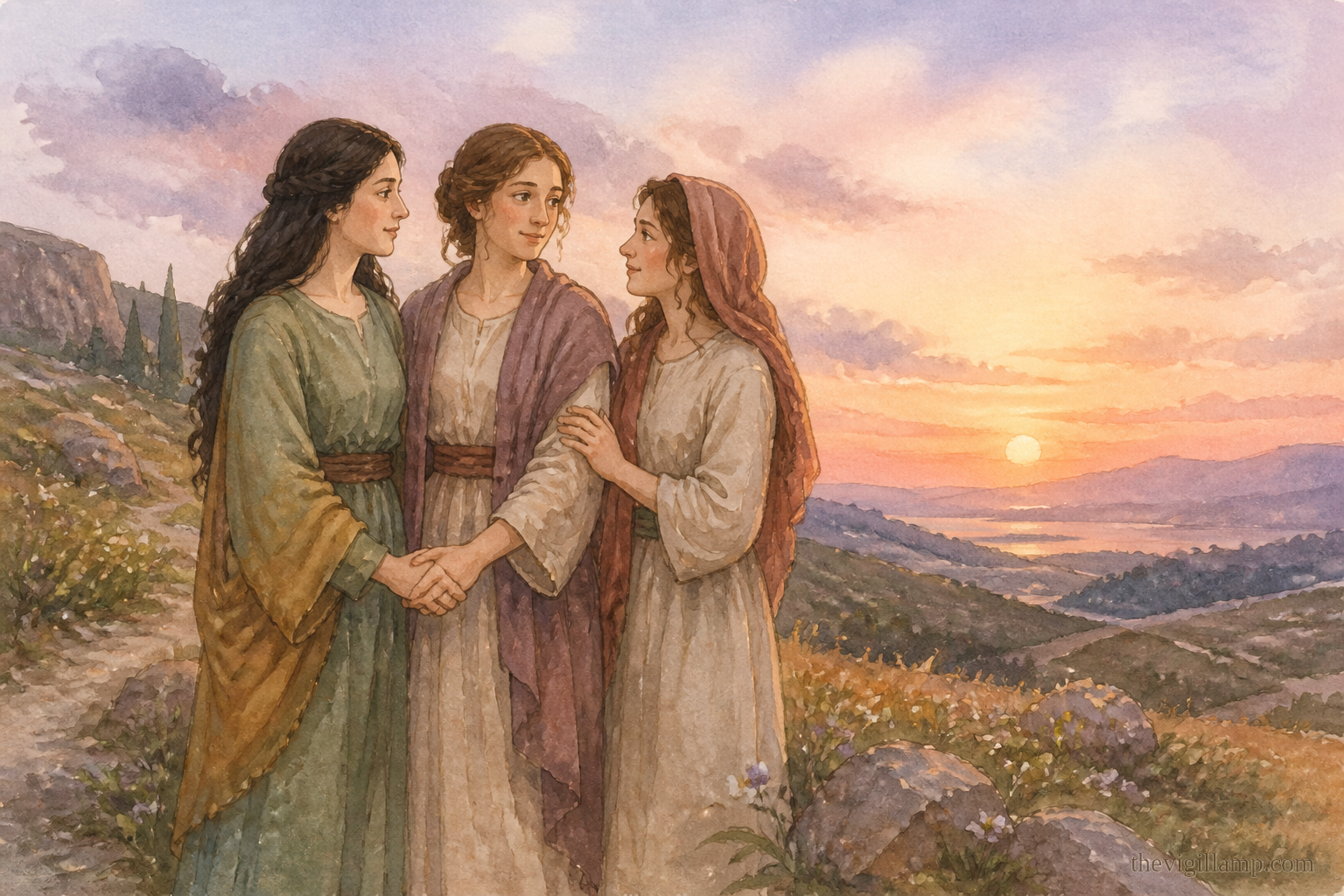
Metrodora and Nymphodora remaining with their sister; the three stay together to the end. No extra speech invented

The Church says it this way: three virgins confessed the unoriginate Trinity, and for this reason were slain, following the way of the Lamb who was slain.

We will not stay with the fire they meant to make of their bodies. We only say what the Church says: a heavy rain extinguished that fire, and lightning struck down Frontonus and his servant. Christians took up the bodies of the holy sisters and reverently buried them at the Warm Springs at Pythias, in Bithynia.

One wilderness. One confession. They were not parted.

Do you hear what the Church is singing now? Not only that they were brave. She is singing that they loved each other as sisters.

"Invincible in your struggles for the Holy Trinity, and through your love for each other as sisters, you defeated the foe of your spiritual life."

And again: "Menodora, Metrodora, and Nymphodora, who were in all things courageous; they ever pray to the Trinity for us."

The word we heard this morning is a weekday word, not a saint pair and not an afterfeast pair. "Come ye yourselves apart into a desert place, and rest a while." The Lord sent His own into a quiet place. These three chose a solitary place in the wilderness, and they stayed.

And the Epistle says, "there is neither male nor female: for ye are all one in Christ Jesus." Three sisters. One faith. One offering. The Church will not let us tell them as if they came one by one.

The same reading has another word, because this is still the Afterfeast: "But when the fulness of the time was come, God sent forth his Son, made of a woman, made under the law." Two days ago the Church named that woman as a child. The joy is still in the house. The three sisters belong to the same Lord who took flesh from her.

The psalm we held in the hand is not a lectionary appointment. It is a word that already knows how to stay: "See now! what is so good, or what so pleasant, as for brethren to dwell together?"

That is why the Church will not let the Afterfeast stand without these three. While she is still singing the birth, she names a house that would not come apart.

And today, so many hundreds of years later, on the Afterfeast, we say their names once more, out loud, together — holy virgins-martyrs Menodora, Metrodora, and Nymphodora — and they are praying for us still.

Movement Five
The Prayer
Troparion of the Holy Martyrs · Tone 4
O Holy Martyrs,
you wisely exchanged horrible torture and bitter death for Eternal Life!
Three virgins, you confessed the unoriginate Trinity at an evil council,
and for this reason were slain by the sword,
following the way of the Lamb who was slain!
Now ever pray for us
Who commemorate your holy memory!
Troparion of the Holy Martyrs · Tone 1
Let all who rejoice at their triumph honor these three virgin martyrs,
who are united to God as sisters and who pour forth fair streams of grace:
Menodora, Metrodora, and Nymphodora,
who were in all things courageous;
they ever pray to the Trinity for us.
Kontakion of the Holy Martyrs · Tone 4
Invincible in your struggles for the Holy Trinity,
and through your love for each other as sisters,
you defeated the foe of your spiritual life,
and with the five virgins, entered victoriously into the Heavenly Mansions
where you ever rejoice with the angels in the presence of the King of All!
Troparion of the Afterfeast · Tone 4
Your Nativity, O Virgin,
has proclaimed joy to the whole universe!
The Sun of Righteousness, Christ our God,
has shone from You, O Theotokos!
By annulling the curse,
He bestowed a blessing.
By destroying death, He has granted us eternal Life.
Kontakion of the Afterfeast · Tone 4
By Your Nativity, O Most Pure Virgin,
Joachim and Anna are freed from barrenness;
Adam and Eve, from the corruption of death.
And we, your people, freed from the guilt of sin, celebrate and sing to you:
The barren woman gives birth to the Theotokos, the nourisher of our life!
The two troparia and the kontakion of the holy virgins-martyrs, and the troparion and kontakion of the Afterfeast, appointed by the Orthodox Church in America on the September 10 hymn pages. Wording is exact; slash marks were converted to line breaks only. These are today's appointed hymns. They are not the Forefeast hymns of September 7. The Afterfeast pair is the feast's own hymn, still appointed on this afterfeast; it is not printed as if September 8 had come again as a second full feast. Hymns for Paul the Obedient, Joasaph, the Apostles of the Seventy, Barypsabas, and the other same-day names are not printed here.
Movement Six
Let's Talk About It Together
Talk about it:
The three sisters went into the wilderness so they could stay together with God. When does our family need a quiet place — not to hide, but to stay?
They wept for Menodora, and they would not turn away. What does it mean to love someone and still refuse to leave the good thing you share?
The Church sings that they were united to God as sisters, and in all things courageous. What is one hard, good thing our house can do together this week — not each alone, but as a family?
Movement Seven
Do This Together
Do this together   Any time of day
They Remained Together
  1. Sit three together if you can — or two, or the whole house in one little cluster. Today the Church remembers sisters who would not come apart. This is not yesterday's gathering of the parents, and it is not the Great Feast's little house of joy. It is a staying.
  2. Sit still together for a slow count of ten. No talking. The sisters chose a solitary place. The hard part is not the words. The hard part is remaining.
  3. Then one child says, slowly, their own day's shout: "Let all who rejoice at their triumph honor these three virgin martyrs, who are united to God as sisters."
  4. That child does one small, real good work right away: clear a plate, help a little brother, say something kind. They stayed so they could belong to Christ. We can be a little help in this room.
  5. Take turns. When everyone has had a turn, sit together and each name one person you want to stay with this week — a sister, a brother, a friend, someone it would be easier to leave. Write those names on scraps of paper and keep them under the lamp until next Sunday.
Little ones (2–4): help them sit still beside you and say "thank You, God" while you count to five, then help them say "Menodora, Metrodora, and Nymphodora." · Make it stick: say the psalm together each night this week — "See now! what is so good, or what so pleasant, as for brethren to dwell together?"
Movement Eight
Go in Peace
Go in Peace
Say the names together:
“Holy Virgins-Martyrs Menodora, Metrodora, and Nymphodora,
pray to God for us.
Most Holy Theotokos, save us.”
And close, as the Church always closes, with the Lord's Prayer:
Our Father, Who art in heaven, hallowed be Thy Name. Thy Kingdom come, Thy will be done,
on earth as it is in heaven. Give us this day our daily bread,
and forgive us our trespasses, as we forgive those who trespass against us; and lead us not into temptation,
but deliver us from the evil one. Amen.
Do together: Put out the lamp, or leave it burning a while. The lamp keeps watch until tomorrow. "Glory to God for all things. Amen."
A note on our storytellingEvery edition of The Vigil Lamp is an original retelling. The saints are real, and the names, places, events, and directly quoted words in this edition are drawn from the Orthodox Church in America's traditional account of the Holy Virgins Menodora, Metrodora, and Nymphodora, from the Church's appointed afterfeast and saint hymns and weekday readings, and from the King James Version of Galatians 3–4 and Mark 6. The wilderness, the arrest, the confession, Menodora's two kept sentences, the four days, the younger sisters remaining, the rain, and the burial at the Warm Springs are told as the Church's tradition, without invented detail. No invented historical dialogue is presented as fact. The words of narration are our own, written to make a true story vivid and a joy for families to read aloud together.