Today's Vigil is for your family, not the other way around. If anything feels like too much, that's okay. Do the parts your family loves, and work your way up to the whole Vigil in one sitting.
Movement One
Light the Lamp
Do together: Light your lamp or a candle. Then say: "Today the Church remembers Hieromartyr Phocas, Bishop of Sinope, and the Holy Prophet Jonah."
We begin the way the Church begins any new work
“O Lord Jesus Christ, the only-begotten Son of the eternal Father, Thou hast said, 'Without me you can do nothing.' In faith I embrace Thy words, O Lord, and bow before Thy goodness. Help me to complete the work I am about to begin for Thine own glory: in the Name of the Father, and of the Son, and of the Holy Spirit. Amen.”
Then all together:
“Through the prayers of our holy fathers, O Lord Jesus Christ our God, have mercy on us.”
The Orthodox prayer before beginning any work, offered for our family and for yours, each time we begin again.
Movement Two
Read the Icon
Before we hear his story, let's look at how the Church has always shown him, and learn to read what this icon is telling us.
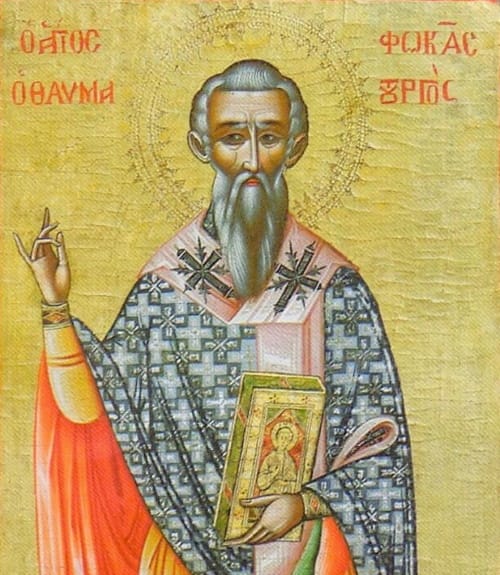
Hieromartyr Phocas, Bishop of Sinope · the Wonderworker · traditional Cretan panel, sixteenth to eighteenth century · public domain
What are we looking at?
An icon isn't a photograph, and it isn't a painting to admire. It's a window. Everything in it is there to teach us something true about the saint.
The gold behind him. Not a sky over the Black Sea. Not a room in Sinope. Heaven's own light. The saint stands where God's light fills everything. The gold is old. It is cracked. The light is still there.
Phocas, facing us. He is shown from the chest up, an older man. A high forehead. Thin grey hair. A long pointed grey beard. A thin mustache. Large quiet eyes. A golden halo around his head, marked with little dotted rings. He is not falling. He is not hiding. On this panel he stands, and he blesses.
His bishop's clothes. A pale robe is covered with many small dark crosses — the Church's way of dressing a bishop for the holy work. Across his shoulders a wide white band hangs down, marked with large black crosses. That band is the omophorion, the shepherd's stole. These are not a gardener's clothes. They are the clothes of a man set apart to keep a city, and to keep the word.
His two hands. The right is raised in blessing, the fingers set the way a bishop blesses. The left holds a thick Gospel book against his chest. The cover is green and gold. In the middle of it a small image of Christ. The page-edges are red. Even now the Church will not let us see him empty-handed. One hand blesses. One hand keeps the Good News close.
The name. Red Greek letters stand in the gold: Ο ΑΓΙΟΣ — the Saint. Ο ΘΑΥΜΑΤΟΥΡΓΟΣ — the Wonderworker. ΦΩΚΑΣ — Phocas. ΣΙΝΩΠΗΣ — of Sinope. Every icon names its saint, so you always know whose face you're looking at. We will not invent other letters.
This is not yesterday's apostle. This is the bishop.
Unknown Cretan iconographer, Saint Phokas of Sinope, traditional panel, sixteenth to eighteenth century. Public domain. Image via Wikimedia Commons. The day's own 1903–1911 Chet'i-Minei standing print of Hieromartyr Phocas was inspected and is held as unused backup. A seventeenth-century TsAK September Menaion figure labeled in the September 22 stretch was inspected and is held as unused backup. The Menologion of Basil II folio for this date is a sword scene of the other Phocas and is not shown. Modern OCA files were not used.
The ReadingsMovement Three
The Scripture the Church appoints for this day. Open your Bible at home and read the passages aloud together, then listen for these words echoing through the saint's story and the rest of your day.
A Psalm to begin · Psalm 36 (37) : 6
“And he shall bring forth thy righteousness as the light, and thy judgment as the noon-day.”
The Septuagint (Brenton, 1851), the Old Testament of the Orthodox Church. In ordinary English Bibles this is Psalm 37:6. This verse is chosen for prayer today; it is not a separate lectionary appointment.
The Epistle · Ephesians 2 : 19–3 : 7
“And are built upon the foundation of the apostles and prophets, Jesus Christ himself being the chief corner stone.”
Open your Bible and read the full passage together. Text: King James Version (public domain).
The Gospel · Luke 3 : 23–4 : 1
“And Jesus being full of the Holy Ghost returned from Jordan, and was led by the Spirit into the wilderness.”
Open your Bible and read the full passage together. Text: King James Version (public domain).
These are the readings appointed by the Orthodox Church in America for Tuesday, September 22, 2026. The monthly lectionary lists only this pair — Ephesians 2:19–3:7 and Luke 3:23–4:1 — with no feast label, no Phocas label, and no Jonah label. No separate saint pair is listed for the Hieromartyr, and no separate pair is listed for the Prophet. This edition carries the appointed weekday pair.
Listen to today's story, read aloud · coming soon
Movement Four
The Story
Yesterday the Church kept the last full hour of the Cross, and she named an apostle. Today is not that day again.
Today she names a bishop.
His name is Phocas. Families may also hear Phokas, or Phokás. On this page those names are one man: Hieromartyr Phocas, Bishop of Sinope.
The Church remembers more than one name on the twenty-second of September. She remembers the Holy Prophet Jonah. She remembers Saint Jonah the Presbyter. She remembers Venerable Jonah of Yashezersk. She remembers Saint Peter the Tax-Collector. And she remembers other holy names. Those are true days. We will not tell those whole lives this morning.
She also remembers, on this same morning, another man from the same city. His name is Martyr Phokas the Gardener of Sinope. He is not this bishop. He kept a garden by the sea, and he fed the poor from it. We will say his name once, so the two Phocases are not made into one man. Then we will look at the bishop.
Do you hear what she is already singing for him? "By sharing in the ways of the Apostles, you became a successor to their throne." "Hieromartyr Phocas, entreat Christ God to save our souls."
That is today's word. Not a man who kept the Name in a locked room. A bishop who stood in the apostles' way, and would not step out of it.
Long ago, in the city of Sinope, on the southern shore of the Black Sea, there lived a man named Pamphilus, and his wife Maria. They were the parents of Phocas.
From his youth he led a virtuous Christian life. The Church remembers that the grace of the Holy Spirit was with him even then. When he was grown, the people of his own city made him their bishop.
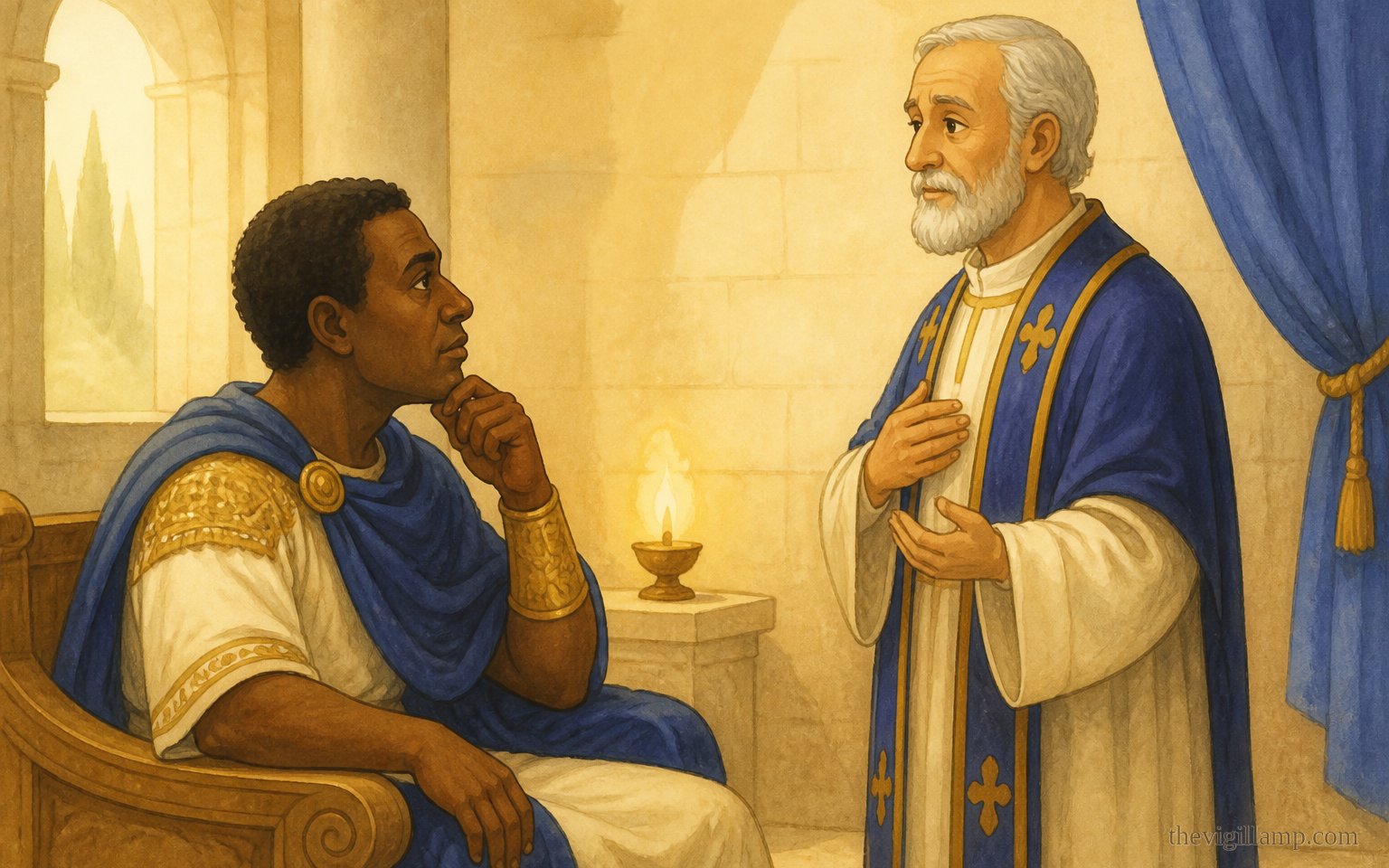
He did not sit down and keep the throne for himself. He taught them by his word. He taught them by his life. He converted many pagans to faith in Christ. People who had bowed to cold idols learned the Name of the living God, because a bishop in Sinope would not stop speaking it.
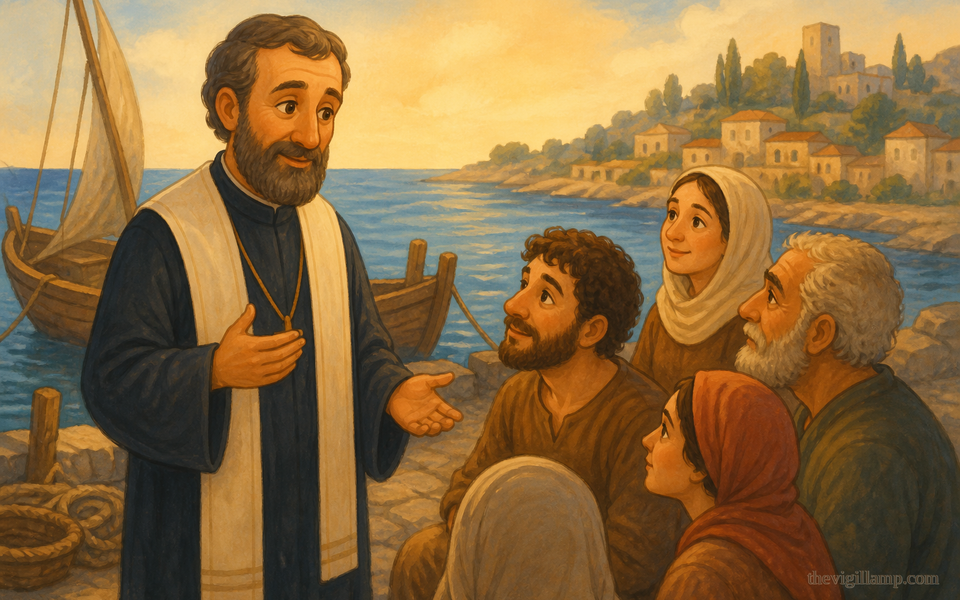
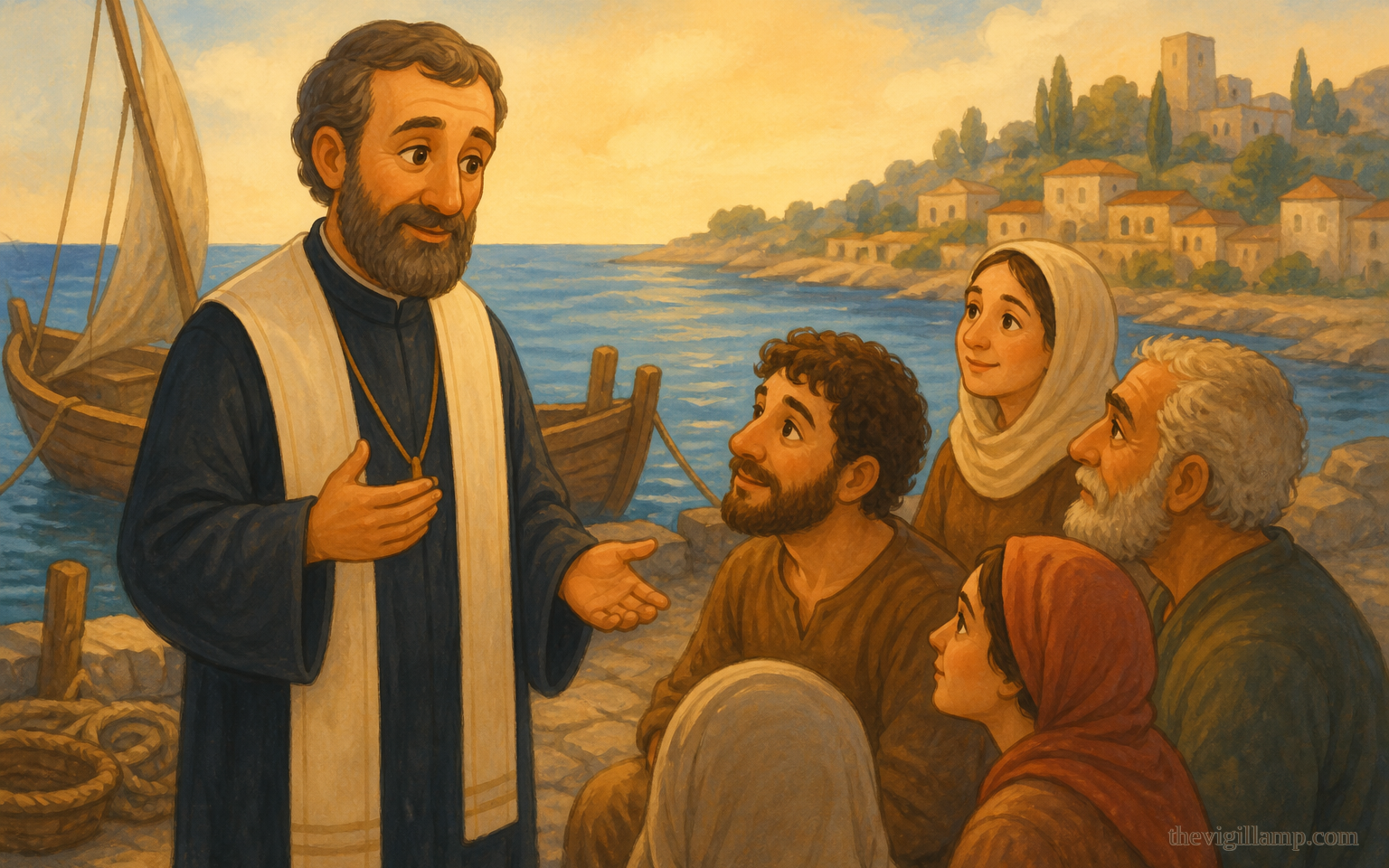
Phocas as Bishop of Sinope, converting pagans to Christ. No extra speech invented
The hard-hearted pagans were filled with rage.
Then the Lord showed Phocas what was coming.
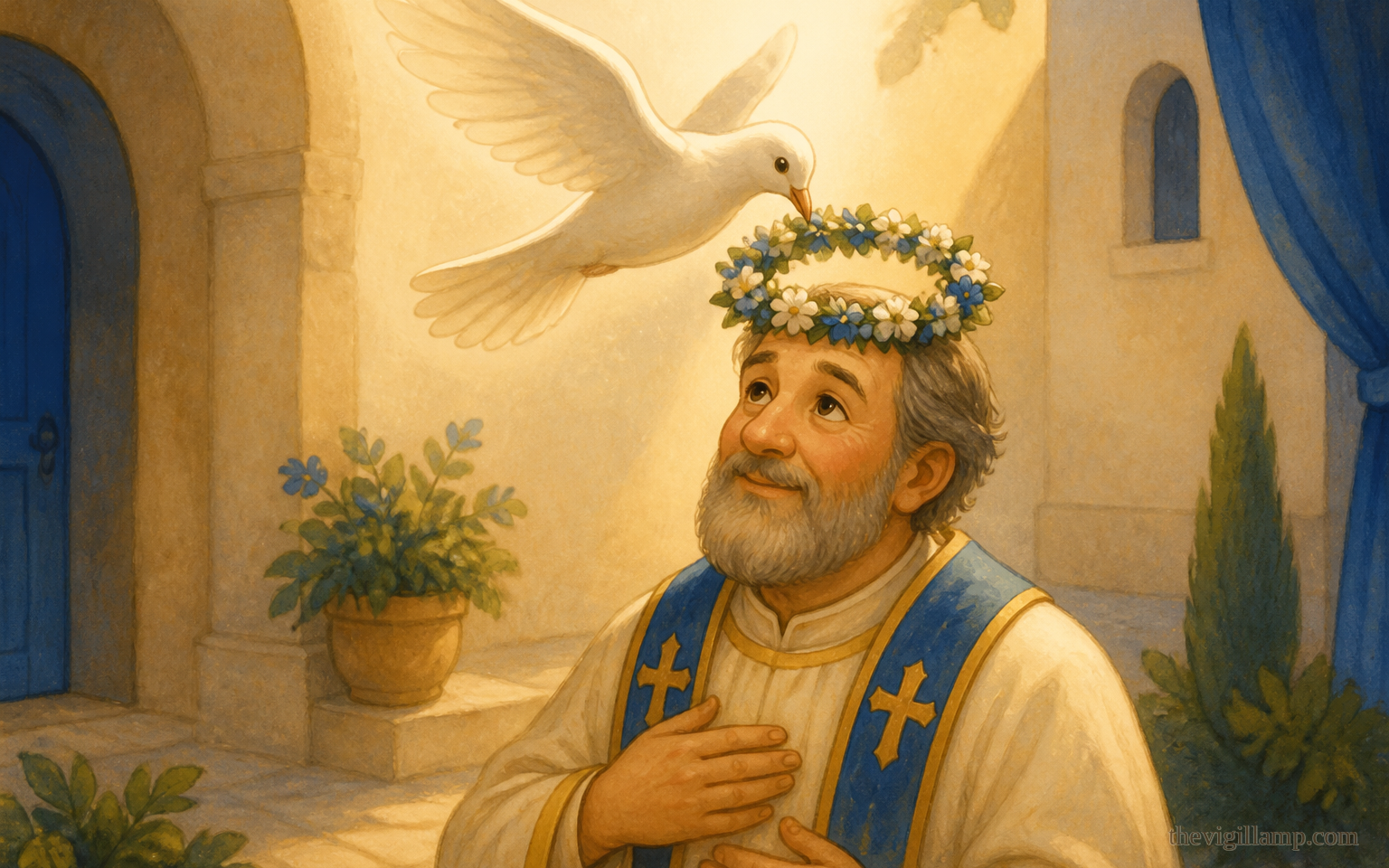
A white dove flew down from heaven. In its beak it carried a wreath of flowers. It laid that wreath on his head. And a voice said the words the Church still keeps:
"Your cup is already filled; you must drink it."
Phocas understood. He was soon to suffer for Christ. He was not afraid. He made himself ready, with thanks to God.
A white dove from heaven laying a wreath of flowers on Phocas's head. The Church's vision words only. No extra speech invented
It was the time of a persecution against Christians, under the emperor Trajan.
The governor's name was Africanus. He took Phocas and demanded that the saint renounce Christ. He pressed him a long time to offer sacrifice to the idols.
Phocas would not.
He would not give to the work of men's hands the honor that belongs to the one God. He would rather offer himself.
They hurt him. The Church knows that, and that is enough for us this morning. We will not linger on the wounds. He stayed. He called on the Name of Jesus Christ, and he would not bow.
Governor Africanus; Phocas will not renounce Christ. No extra speech invented
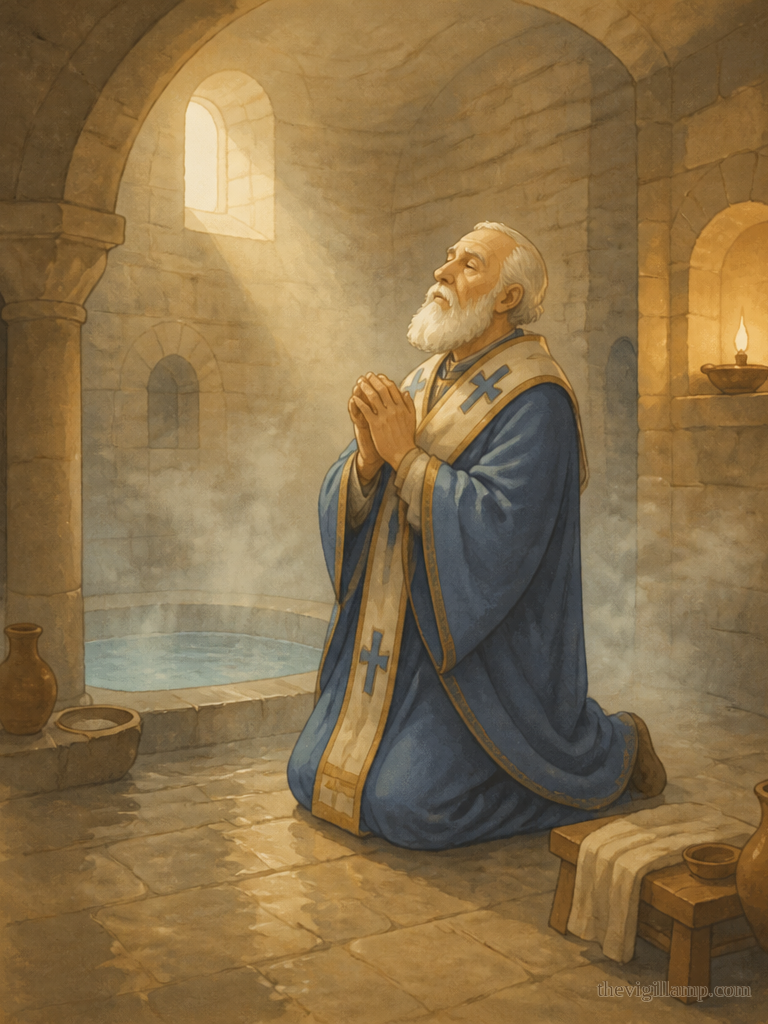
After the torture they enclosed him in a hot bath — a bath-house they had made terribly hot.
There, praying, he gave his soul into God's hands.
It was the year 117.
His holy body was buried with honor by the faithful. In the year 404 his relics were taken from Sinope to Constantinople. The Church keeps that carrying on the twenty-second of July.
The Church still asks his prayers as a defender against fires, and as a helper of those in danger of drowning. We will not invent the nights at sea. We will let the Church keep that asking.
The hot bath-house; praying, Phocas gives his soul to God. No gore. No extra speech invented
Do you hear what the Church is singing now? "The Master has established you as a resplendent sun shining on all the faithful." "He has accepted your life, faith and contest as myrrh, O glorious Martyr Phocas, for he is rich in mercy."
The word we heard this morning is the weekday word the Church appointed for this Tuesday. "And are built upon the foundation of the apostles and prophets, Jesus Christ himself being the chief corner stone." Phocas stood on that foundation. He was a successor to the apostles' throne. On this same morning she also names the Holy Prophet Jonah — not to tell his whole book this morning, only to set a prophet beside a bishop on the one cornerstone.
And the Gospel says that Jesus, being full of the Holy Ghost, was led by the Spirit into the wilderness. The same Spirit was with Phocas from his youth. The Spirit did not leave him when the cup was set in his hands.
The psalm we held in the hand is not a lectionary appointment. It is a word that already knows a righteous man brought into the light: "And he shall bring forth thy righteousness as the light, and thy judgment as the noon-day."
Sinope heard him. The pagans heard him. A wreath came down, and he drank the cup. The sun the Master set over the faithful did not go out in the heat.
That is why the Church will not let this Tuesday stand without this bishop. She names a man who converted many, who would not renounce Christ, and who prayed his way home.
And today, so many hundreds of years later, we say his name once more, out loud, together — Holy Hieromartyr Phocas, Bishop of Sinope — and he is praying for us still.
Movement Five
The Prayer
Troparion of Saint Phocas · Tone 4
By sharing in the ways of the Apostles, you became a successor to their throne. Through the practice of virtue, you found the way to divine contemplation, O inspired one of God; by teaching the word of truth without error, you defended the Faith, even to the shedding of your blood. Hieromartyr Phocas, entreat Christ God to save our souls.
Kontakion of Saint Phocas · Tone 2
The Master has established you as a resplendent sun shining on all the faithful. He has accepted your life, faith and contest as myrrh, O glorious Martyr Phocas, for he is rich in mercy!
Troparion of the Holy Prophet Jonah · Tone 2
We celebrate the memory of Your prophet Jonah, O Lord; through him we entreat You, save our souls.
Kontakion of the Holy Prophet Jonah · Tone 4
Enlightened by the Spirit, your pure heart became the dwelling place of most splendid prophecy; for you saw things far off as if they were near. Therefore, we honor you, blessed and glorious Prophet Jonah.
The troparion and kontakion of Hieromartyr Phocas, and the troparion and kontakion of the Holy Prophet Jonah, appointed by the Orthodox Church in America on the September 22 hymn pages. Wording is exact; slash marks were converted to line breaks only. Hymns for Martyr Phokas the Gardener, Saint Jonah the Presbyter, Venerable Jonah of Yashezersk, Saint Peter the Tax-Collector, and the other same-day names are not printed here.
Movement Six
Let's Talk About It Together
Talk about it:
The dove laid a wreath on Phocas's head, and a voice said his cup was already filled. What is one hard true thing our family may be asked to do this week — a thing we would rather put down?
He would not renounce Christ, not even when a governor told him to. Where do we need to stay true, even if it is only a small staying — a kindness, a word, a refusal to pretend?
The Church calls him a resplendent sun shining on all the faithful. Who in our house, or near it, needs a little of that light from us today?
Movement Seven
Do This Together
Do this togetherAny time of day
The Resplendent Sun
Stand near the lamp, or near a window if the morning is in the room. Today the Church remembers a bishop she calls a resplendent sun. This is not yesterday's apostle. It is a bishop who would not put the Name down.
Stand still together for a slow count of ten. No talking. Phocas kept the faith when the cup was set in his hands. The hard part is not the words. The hard part is remaining.
Then one child says, slowly, the Church's own shout: "The Master has established you as a resplendent sun shining on all the faithful."
That child does one small, real good work right away: clear a plate, help a little brother, say something kind. He shone so other people could see. We can keep one true light in this room.
Take turns. When everyone has had a turn, sit together and each name one light you want to keep this week — a verse, a kindness you have been putting off, a hard true thing you will not put down. Write those words on scraps of paper and keep them under the lamp until next Sunday.
Little ones (2–4): help them stand still and say "thank You, God" while you count to five, then help them say "Phocas." · Make it stick: say the psalm together each night this week — "And he shall bring forth thy righteousness as the light, and thy judgment as the noon-day."
“Holy Hieromartyr Phocas, pray to God for us. Holy Prophet Jonah, pray to God for us.”
And close, as the Church always closes, with the Lord's Prayer:
Our Father, Who art in heaven, hallowed be Thy Name. Thy Kingdom come, Thy will be done, on earth as it is in heaven. Give us this day our daily bread, and forgive us our trespasses, as we forgive those who trespass against us; and lead us not into temptation, but deliver us from the evil one. Amen.
Do together: Put out the lamp, or leave it burning a while. The lamp keeps watch until tomorrow. "Glory to God for all things. Amen."
A note on our storytellingEvery edition of The Vigil Lamp is an original retelling. The saints are real, and the names, places, events, and directly quoted words in this edition are drawn from the Orthodox Church in America's traditional account of Hieromartyr Phocas, Bishop of Sinope, from the public-domain life in Saint Dimitry of Rostov, from the Church's appointed hymns and weekday readings, and from the King James Version of Ephesians 2 and Luke 3–4. The youth in Sinope, the parents Pamphilus and Maria, the episcopate, the converting of pagans, the dove and the wreath, the governor Africanus, the confession under Trajan, the hot bath-house, the year 117, the carrying of the relics, and the naming of the Prophet Jonah and of Martyr Phokas the Gardener are told as the Church's tradition, without invented detail. No invented historical dialogue is presented as fact. The words of narration are our own, written to make a true story vivid and a joy for families to read aloud together.