Conception of the Honorable Glorious Prophet, Forerunner and Baptist John
✦ ✦ ✦
Before you begin
Today's Vigil is for your family, not the other way around. If anything feels like too much, that's okay. Do the parts your family loves, and work your way up to the whole Vigil in one sitting.
Movement One
Light the Lamp
Do together: Light your lamp or a candle. Then say: "Today the Church keeps the Conception of the Honorable Glorious Prophet, Forerunner and Baptist John."
We begin the way the Church begins any new work
“O Lord Jesus Christ, the only-begotten Son of the eternal Father, Thou hast said, 'Without me you can do nothing.' In faith I embrace Thy words, O Lord, and bow before Thy goodness. Help me to complete the work I am about to begin for Thine own glory: in the Name of the Father, and of the Son, and of the Holy Spirit. Amen.”
Then all together:
“Through the prayers of our holy fathers, O Lord Jesus Christ our God, have mercy on us.”
The Orthodox prayer before beginning any work, offered for our family and for yours, each time we begin again.
Movement Two
Read the Icon
Before we hear today's story, let's look at how the Church has always shown this beginning, and learn to read what the icon is telling us.
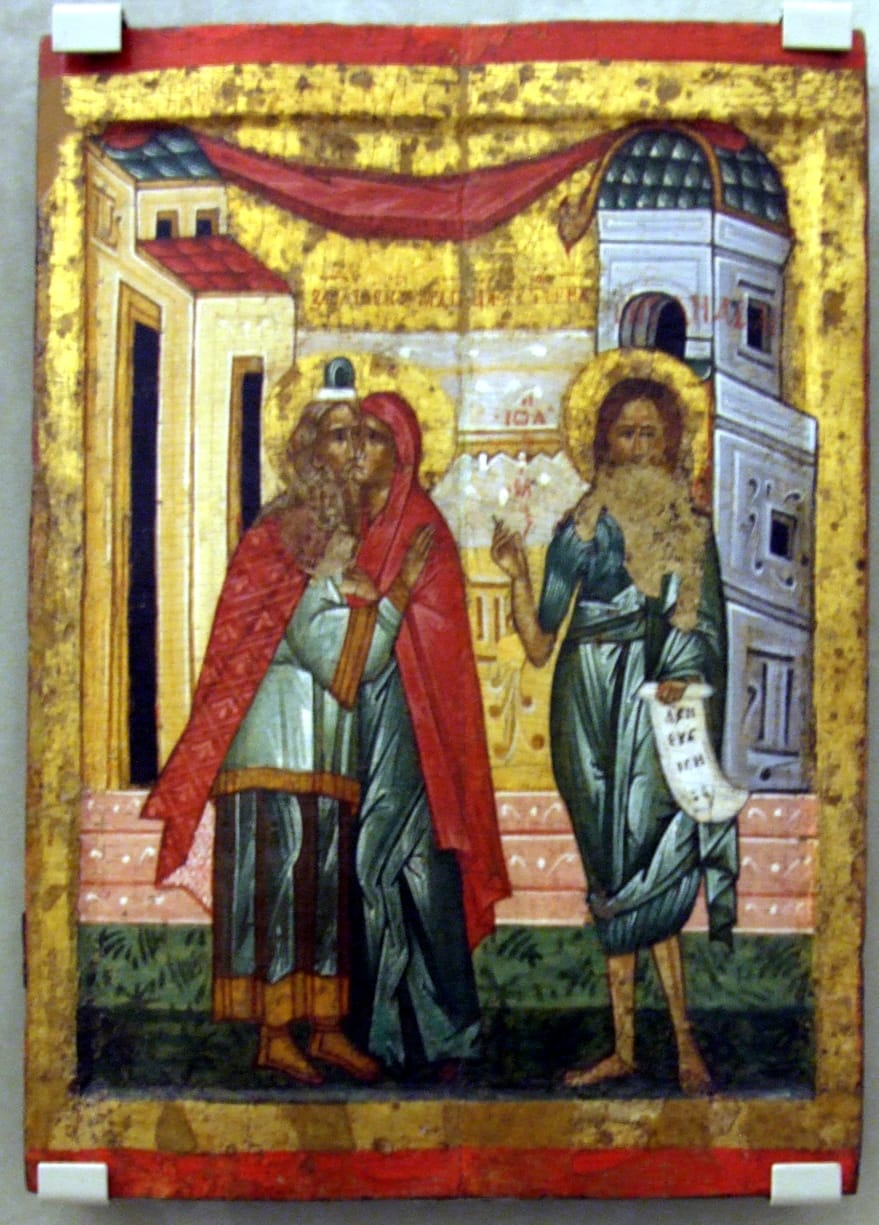
The Conception of John the Forerunner — the Meeting of Zachariah and Elizabeth · Novgorod, second half of the fifteenth century · Central Museum of Old Russian Culture and Art named after Andrei Rublev
What are we looking at?
An icon isn't a photograph, and it isn't a painting to admire. It's a window. Everything in it is there to teach us something true about this feast.
The gold behind them. It is worn and mottled with age. Not a sky over Judea. Not a street in Jerusalem. Heaven's own light. The saints stand where God's light fills everything.
The two buildings, and the red cloth. A pale house with a red roof stands on the left. A white building with a dark roof stands on the right. A long red cloth is draped from one to the other. The Church paints that cloth when she wants us to know the scene belongs indoors — in a house, in a holy place — even though the gold is all around.
Zachariah, on our left. Look for the older man with the long grey-brown hair and the full beard. A small cap sits on his head. He wears a pale blue-green tunic and a bright red cloak with a little pattern on it. Brown boots are on his feet. A thin gold halo is around his head. He is leaning in.
Elizabeth, close beside him. A deep red veil covers her head and shoulders. Under it a dark dress falls in heavy folds. She has a gold halo too. The two of them meet face to face, cheek to cheek, in a standing embrace. The Church paints a holy meeting like this when a long wait is over and a child has been given.
Their grown son, on our right. A third figure stands a little apart, barefoot, in a dark green garment, holding an unrolled white scroll. His right hand is raised. The Church's name for this old panel is the Conception of John the Forerunner. Today that name is the feast. We look at the beginning — the meeting that means a child has been promised — and we do not pretend the grown Forerunner is not already standing in the same gold. This beginning was always meant to go before the Lord.
The name. Faint red letters are still painted in the gold. Time has made them hard to read. We will not invent them. Catalogs name the panel. Every icon means to name what it shows. Even when the paint is thin, the feast and the face belong together.
This is not the September morning when the Church kept the whole house of Zachariah and Elizabeth. This is the Conception. The promise. The start.
Anonymous Novgorod icon painter, Conception of John the Forerunner (the Meeting of Zachariah and Elizabeth), second half of the fifteenth century, tempera on limewood, 68.5 × 49 cm; Central Museum of Old Russian Culture and Art named after Andrei Rublev, Moscow, inv. КП 30; from the Church of the Ascension, Novokotovo. Public domain. Image via Wikimedia Commons. This is the Church's old feast-type of the Conception. The seventeenth-century TsAK September Menaion miniature for this date, and the Menologion of Basil II folio of the Annunciation to Zachariah, were inspected and are held as unused backups. Modern OCA files were not used.
The ReadingsMovement Three
The Scripture the Church appoints for this day. Open your Bible at home and read the passages aloud together, then listen for these words echoing through the feast and the rest of your day.
A Psalm to begin · Psalm 131 (132) : 17
“There will I cause to spring up a horn to David: I have prepared a lamp for mine anointed.”
The Septuagint (Brenton, 1851), the Old Testament of the Orthodox Church. In ordinary English Bibles this is Psalm 132:17. This verse is chosen for prayer today; it is not a separate lectionary appointment.
The Epistle · Galatians 4 : 22–31
“For it is written, Rejoice, thou barren that bearest not; break forth and cry, thou that travailest not: for the desolate hath many more children than she which hath an husband. Now we, brethren, as Isaac was, are the children of promise.”
Open your Bible and read the full passage together. Text: King James Version (public domain).
The Gospel · Luke 1 : 5–25
“Fear not, Zacharias: for thy prayer is heard; and thy wife Elisabeth shall bear thee a son, and thou shalt call his name John.”
Open your Bible and read the full passage together. Text: King James Version (public domain).
These are the feast readings appointed by the Orthodox Church in America for the Conception of the Forerunner on Wednesday, September 23, 2026. The same day's weekday pair is Ephesians 3:8–21 and Luke 4:1–15. This edition carries the feast pair.
Listen to today's story, read aloud · coming soon
Movement Four
The Story
Eighteen days ago the Church remembered the Holy Prophet Zachariah and the Righteous Elizabeth — the old priest and his wife, the house that waited, the son God gave them.
Today is not that day again.
Today she keeps the Conception of the Honorable Glorious Prophet, Forerunner and Baptist John. Not the whole life. The promise. The beginning of his life.
The Church remembers more than one name on the twenty-third of September. She remembers Saints Xanthippi and Polyxeni of Spain. She remembers the Virgin Martyr Irais of Alexandria. She remembers the Martyrs Andrew and John, and John's children Peter and Antonius. She remembers the Slovenka Icon of the Mother of God. Those are true days. We will not tell those whole lives this morning.
This morning she keeps a beginning.
Long before Bethlehem, the holy Prophet Malachi said that before the Messiah was born, His Forerunner would appear, and would show that He was coming. The Jews, waiting for the Messiah, were waiting for that Forerunner too. A people cannot meet the Lord if no one has gone first to make them ready.
Do you hear what she is already singing for this morning? "Be glad, O barren one who has not given birth until now, for behold, you have conceived the lamp of the Sun." "The Prophet of the Most High is about to be born."
That is today's word. Not the naming. Not the wilderness. A child promised. A lamp prepared.
In a city of the hills of Judea, in the land of Palestine, lived the righteous priest Saint Zachariah and his wife Saint Elizabeth. They kept the commandments of the Lord. They prayed. And they had no child. They were old. Among their people a house without a child felt like a house God had forgotten. They had not forgotten Him. They prayed unceasingly that He would grant them a child.
Then it was Zachariah's turn to serve.
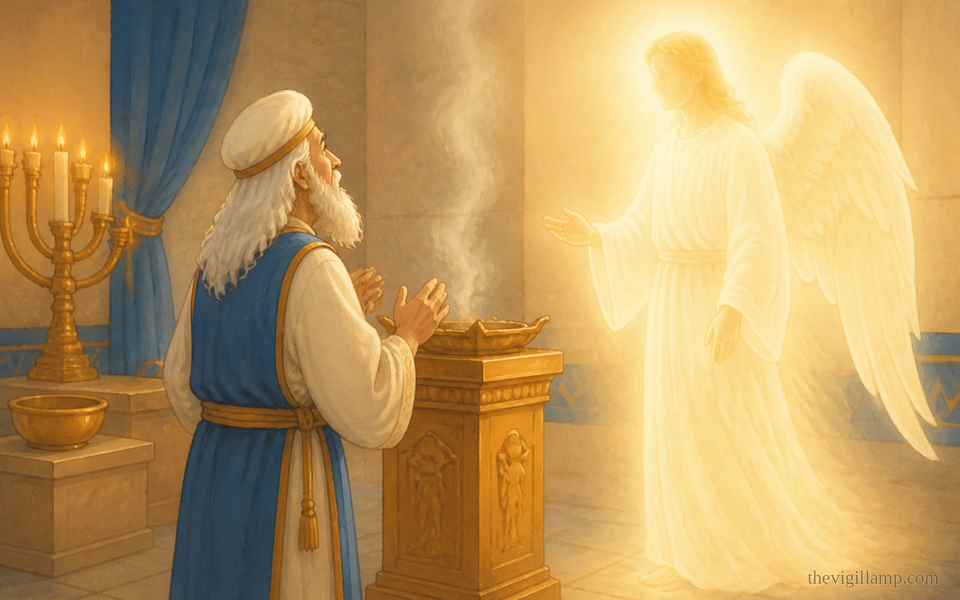
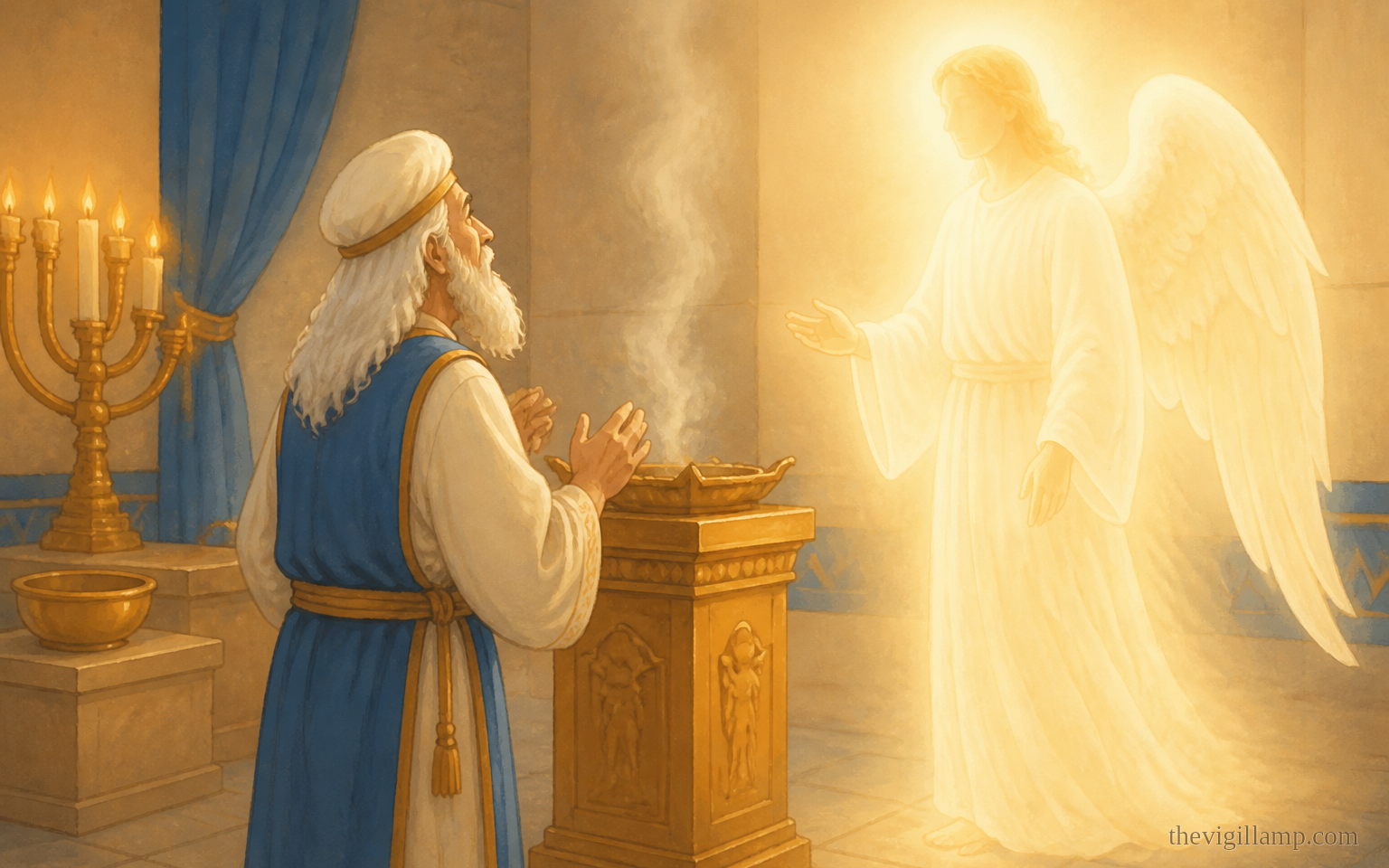
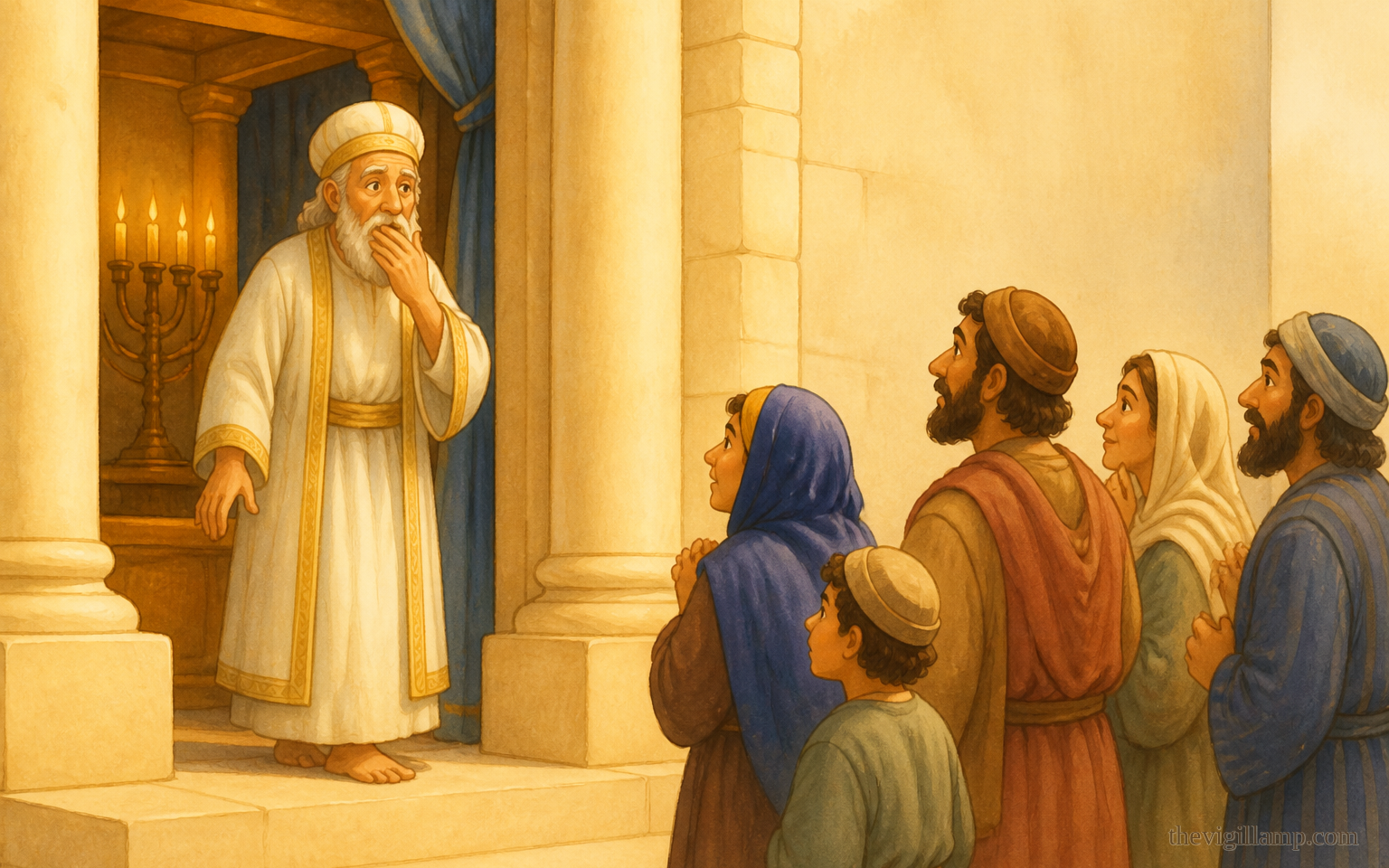
His lot was to burn incense in the Temple of the Lord. He went behind the veil of the Sanctuary. The people stood outside, praying. And there appeared unto him an angel of the Lord, standing on the right side of the altar of incense.
When Zachariah saw him, he was troubled, and fear fell upon him.
The angel standing at the right side of the altar of incense; Zachariah before him. No extra speech in the scene
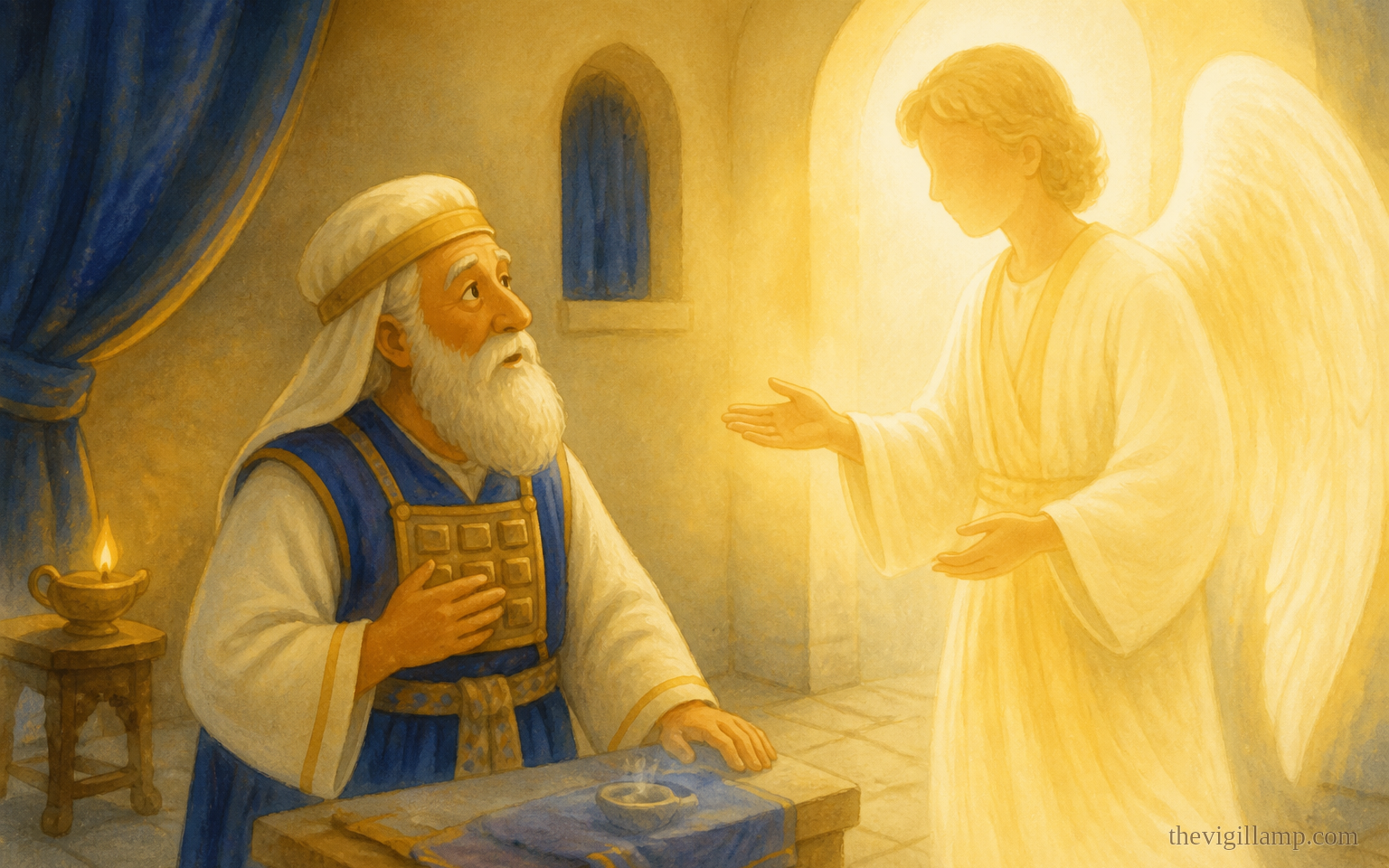
"Fear not, Zacharias," the angel said, "for thy prayer is heard; and thy wife Elisabeth shall bear thee a son, and thou shalt call his name John."
He would be great in the sight of the Lord. He would be filled with the Holy Ghost from his mother's womb. Many of the children of Israel would he turn to the Lord their God. He would go before Him in the spirit and power of Elias, to make ready a people prepared for the Lord.
Gabriel speaking the promise: a son, and his name John. Luke's words only. No extra speech invented
Zachariah looked at the angel. He looked at his own old age.
"Whereby shall I know this?" he said. "For I am an old man, and my wife well stricken in years."
Those are Luke's words. We will not invent others.
"I am Gabriel," the angel said, "that stand in the presence of God; and am sent to speak unto thee, and to shew thee these glad tidings. And, behold, thou shalt be dumb, and not able to speak, until the day that these things shall be performed, because thou believest not my words, which shall be fulfilled in their season."
The people waited. They marvelled that he tarried so long. When he came out he was supposed to bless them. He could not speak. He beckoned to them, and remained speechless. They understood he had seen a vision.
Zachariah coming out of the Sanctuary speechless; the people waiting. No extra speech invented
When the days of his service were finished, he went home.
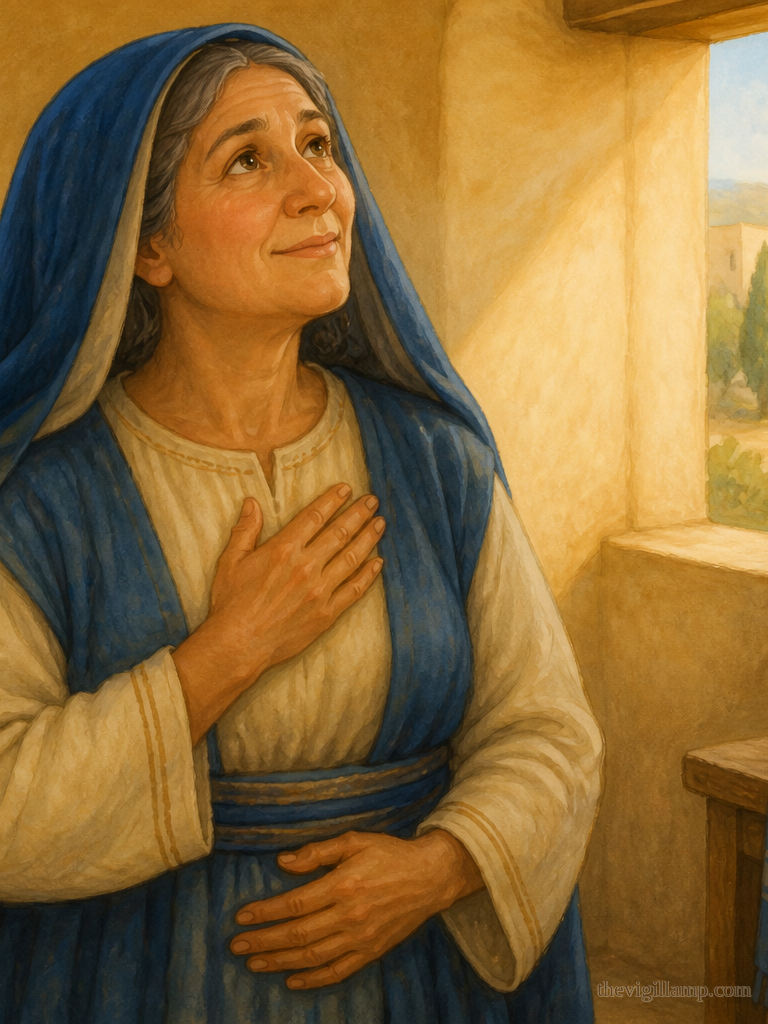
After those days Elizabeth conceived. God gave her a child. The barren one was not forgotten. She hid herself five months, saying, "Thus hath the Lord dealt with me in the days wherein he looked on me, to take away my reproach among men."
Elizabeth, the barren one, given a child; the promise begun. No extra action invented. No later scenes
That is as far as this morning goes.
The Church already kept the rest of that house — the greeting, the writing of the name, the hiding in the hills — on the fifth of September. We will not tell that life again this morning. We will stay where the feast stays. A prayer was heard. A son was promised. His name would be John. The lamp of the Sun had been conceived, and the Prophet of the Most High was about to be born.
The word we heard this morning is the feast's own word, appointed for this Wednesday. "Rejoice, thou barren that bearest not… Now we, brethren, as Isaac was, are the children of promise." Elizabeth had waited past the years when a house expects a child. God kept the word anyway. The son He gave was a child of promise, the way Isaac was — given, not earned.
And the Gospel is the story itself. Luke tells the incense, the angel, the silence, and the beginning. We do not have to look somewhere else for today's reading. The Church set the beginning of John's life in our ears this morning, and then she sang it.
The psalm we held in the hand is not a lectionary appointment. It is a word that already knows a lamp prepared: "There will I cause to spring up a horn to David: I have prepared a lamp for mine anointed." The troparion calls John the lamp of the Sun. He does not shine instead of Christ. He goes first, so the people can see the Light when the Light comes.
That is why the Church will not let this Wednesday stand without this Conception. She names the Forerunner at the first moment of his life, because the world had been waiting for someone to go before the Lord.
And today, so many hundreds of years later, we say his name once more, out loud, together — Holy Glorious Prophet, Forerunner and Baptist John — and he is praying for us still.
Movement Five
The Prayer
Troparion of the Conception of the Forerunner · Tone 4
Be glad, O barren one who has not given birth until now, for behold, you have conceived the lamp of the Sun, and He shall enlighten all the earth, which is afflicted with blindness. Dance, O Zachariah, and cry out with boldness: The Prophet of the Most High is about to be born.
Kontakion of the Conception of the Forerunner · Tone 1
The great and renowned Zachariah rejoices radiantly, and exults with his wife Elizabeth; for worthily does she conceive John the Baptist, whom the Archangel announced joyously, and men honor as an initiate of grace.
The troparion and kontakion appointed by the Orthodox Church in America on the September 23 page of the Conception of the Honorable Glorious Prophet, Forerunner and Baptist John. Wording is exact; slash marks were converted to line breaks only. Hymns for Saints Xanthippi and Polyxeni, Virgin Martyr Irais, and the Martyrs Andrew, John, Peter, and Antonius are not printed here.
Movement Six
Let's Talk About It Together
Talk about it:
The Church already remembered Zachariah and Elizabeth. Today she keeps only the beginning — a child promised. Why does God start His great works with a word, before anyone can see the child?
Zachariah could not speak, and the people waited outside the Sanctuary. When is waiting itself a kind of prayer in our house?
John is called the lamp of the Sun. He does not shine instead of Christ. He goes first. Who in our family, or near us, needs us to go first this week — to make a way ready, or to keep a light on?
Movement Seven
Do This Together
Do this togetherAny time of day
The Lamp of the Sun
Stand near the family lamp. Today the Church calls John the lamp of the Sun — the one who goes before the Light, not the Light Himself.
Sit still together for a slow count of ten. No talking. The people waited outside while Zachariah was in the Sanctuary. The hard part is not the words. The hard part is remaining.
Then one child says, slowly, the Church's own line: "The Prophet of the Most High is about to be born."
That child does one small, real good work right away: clear a plate, help a little brother, say something kind. A Forerunner goes first so other people can meet the Lord. We can keep one true beginning in this room.
Take turns. When everyone has had a turn, sit together and each name one promise of God you want to remember this week — a word He has already spoken, not a wish we made up. Write those words on scraps of paper and keep them under the lamp until next Sunday.
Little ones (2–4): help them sit still and say "thank You, God" while you count to five, then help them say "John." · Make it stick: say the psalm together each night this week — "I have prepared a lamp for mine anointed."
“Holy Glorious Prophet, Forerunner and Baptist John, pray to God for us. Holy Prophet Zachariah, and Righteous Elizabeth, pray to God for us.”
And close, as the Church always closes, with the Lord's Prayer:
Our Father, Who art in heaven, hallowed be Thy Name. Thy Kingdom come, Thy will be done, on earth as it is in heaven. Give us this day our daily bread, and forgive us our trespasses, as we forgive those who trespass against us; and lead us not into temptation, but deliver us from the evil one. Amen.
Do together: Put out the lamp, or leave it burning a while. The lamp keeps watch until tomorrow. "Glory to God for all things. Amen."
A note on our storytellingEvery edition of The Vigil Lamp is an original retelling. The saints are real, and the names, places, events, and directly quoted words in this edition are drawn from the Gospel according to Luke, chapter 1, verses 5–25, in the King James Version, from the Orthodox Church in America's traditional account of the Conception of the Honorable Glorious Prophet, Forerunner and Baptist John, and from the Church's own appointed hymns and feast readings. The Malachi framing, the incense in the Temple, Gabriel's word, Zachariah's silence, and Elizabeth's being given a child are told as Luke and the Church tell them, without invented detail. No invented historical dialogue is presented as fact. The fifth of September is named only so this morning is not mistaken for that one. The words of narration are our own, written to make a true story vivid and a joy for families to read aloud together.