
September 5 · Zachariah and Elizabeth
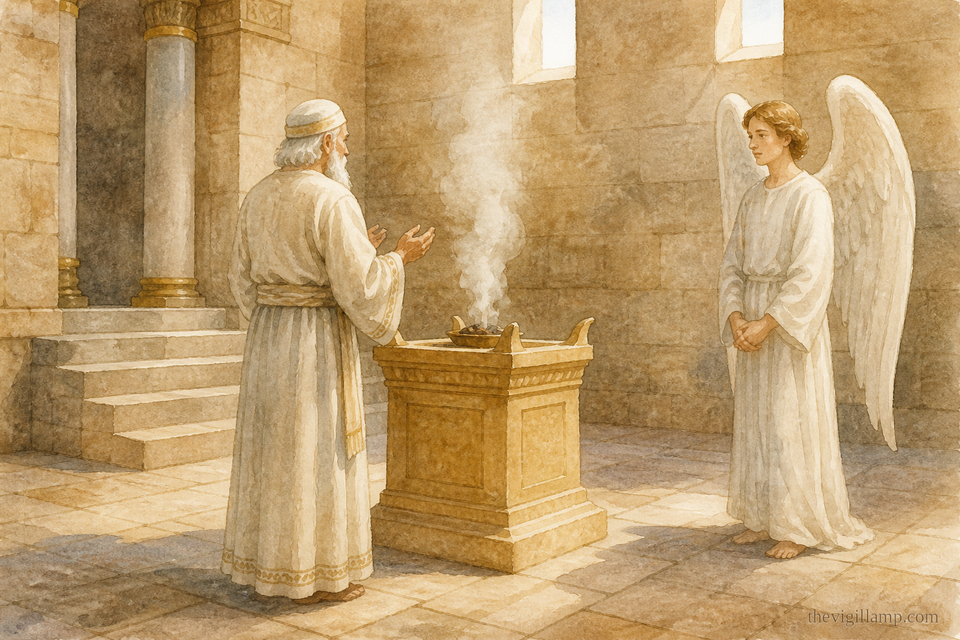
Holy Prophet Zachariah and Righteous Elizabeth
O Lord Jesus Christ our God, have mercy on us.”
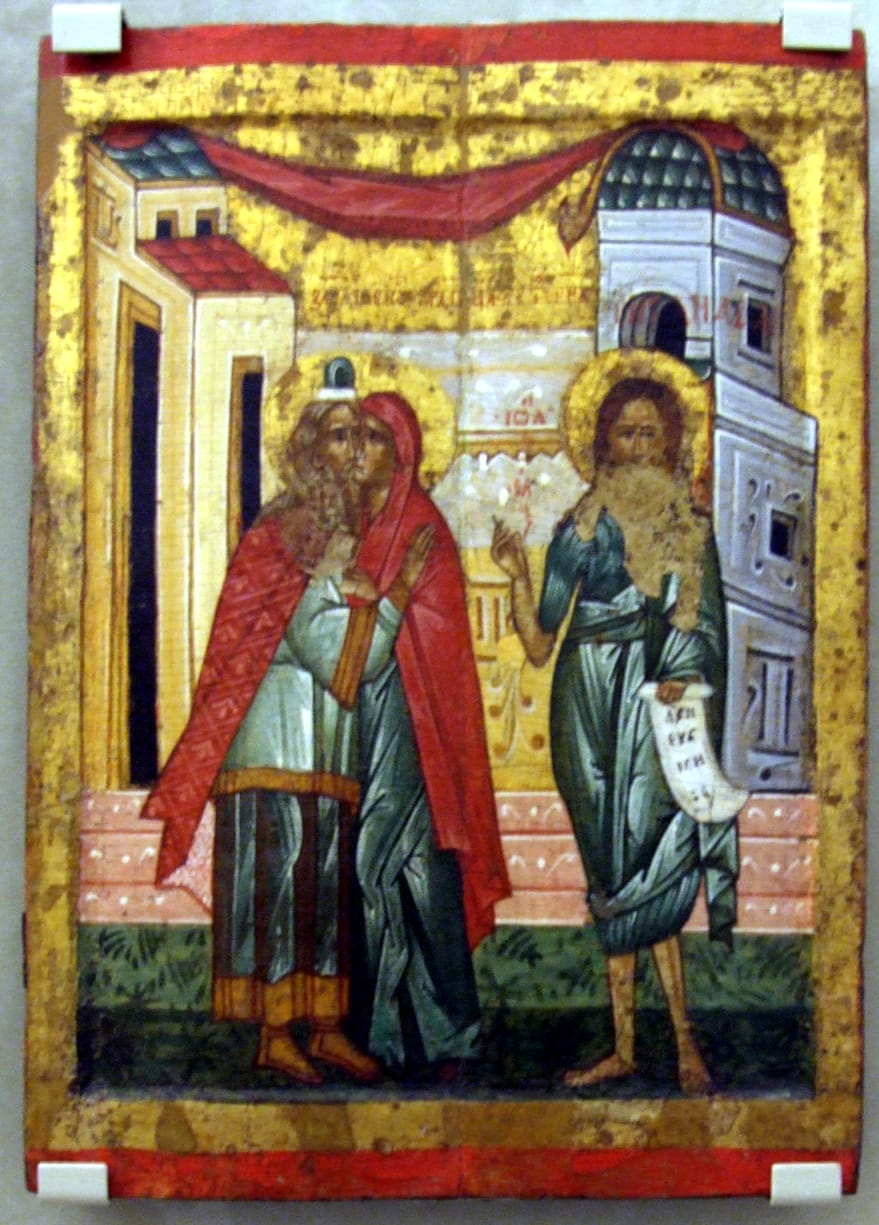
The Church remembers more than one Zachariah.
There is the prophet who wrote the book we call Zechariah — the Sickle-Seer, who saw the coming of Christ from far off, hundreds of years before Bethlehem. The Church keeps his day in February. Today is not his day.
Today she remembers the Holy Prophet Zachariah and the Righteous Elizabeth — a priest and his wife, old, childless, and faithful — and the son God promised them, the boy who would go before the Lord.
They were of the lineage of Aaron. Zachariah, son of Barach, served in the Temple in Jerusalem, of the priestly course of Abia. Elizabeth was of the daughters of Aaron. The Church also says she was the sister of Saint Anna, the mother of the Most Holy Theotokos. Luke says they were both righteous before God, walking in all the commandments and ordinances of the Lord, blameless. And they had no child. Elizabeth was barren, and they were both well stricken in years.
In those days a house without a child felt like a house God had forgotten. They had not forgotten Him.
Then it was Zachariah's turn to serve.
His lot was to burn incense in the Temple of the Lord. The people stood outside, praying. And there appeared unto him an angel of the Lord, standing on the right side of the altar of incense.
When Zachariah saw him, he was troubled, and fear fell upon him.
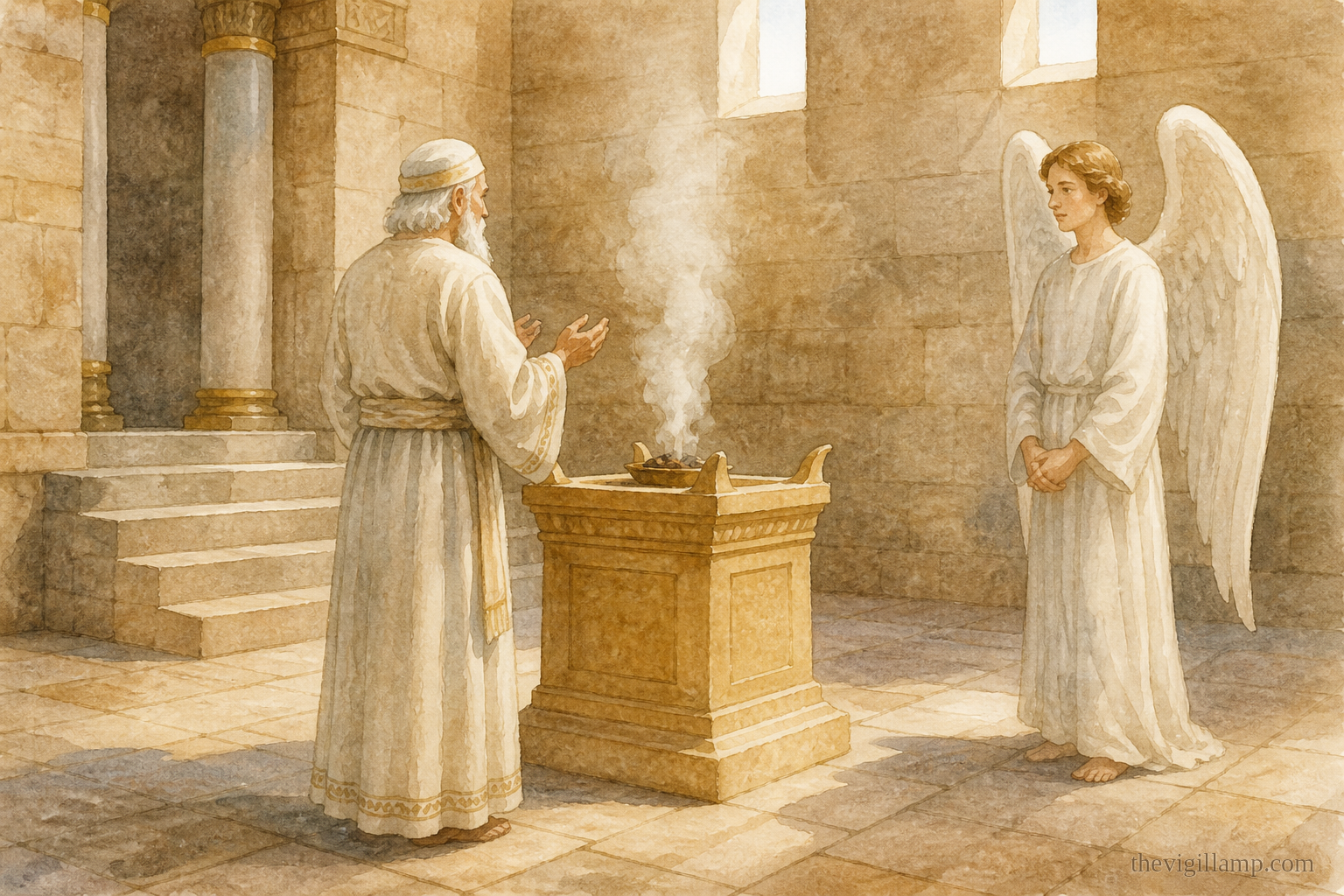
"Fear not, Zacharias," the angel said, "for thy prayer is heard; and thy wife Elisabeth shall bear thee a son, and thou shalt call his name John."
He would be great in the sight of the Lord. He would be filled with the Holy Ghost from his mother's womb. He would go before the Lord in the spirit and power of Elias, to make ready a people prepared for the Lord.
Zachariah looked at the angel. He looked at his own old age.
"Whereby shall I know this?" he said. "For I am an old man, and my wife well stricken in years."
Those are Luke's words. We will not invent others.
"I am Gabriel," the angel said, "that stand in the presence of God; and am sent to speak unto thee, and to shew thee these glad tidings. And, behold, thou shalt be dumb, and not able to speak, until the day that these things shall be performed, because thou believest not my words, which shall be fulfilled in their season."
The people waited. They marvelled that he tarried so long. When he came out he could not speak. He beckoned to them, and remained speechless. They understood he had seen a vision.
When the days of his service were finished, he went home.
After those days Elizabeth conceived. She hid herself five months, saying, "Thus hath the Lord dealt with me in the days wherein he looked on me, to take away my reproach among men."
In the sixth month the same angel was sent to a city of Galilee named Nazareth, to a virgin whose name was Mary. "Behold," he said to her, "thy cousin Elisabeth, she hath also conceived a son in her old age: and this is the sixth month with her, who was called barren. For with God nothing shall be impossible."
Mary arose and went with haste into the hill country, into a city of Juda, and entered into the house of Zachariah, and saluted Elizabeth.
When Elizabeth heard that greeting, the babe leaped in her womb, and she was filled with the Holy Ghost.
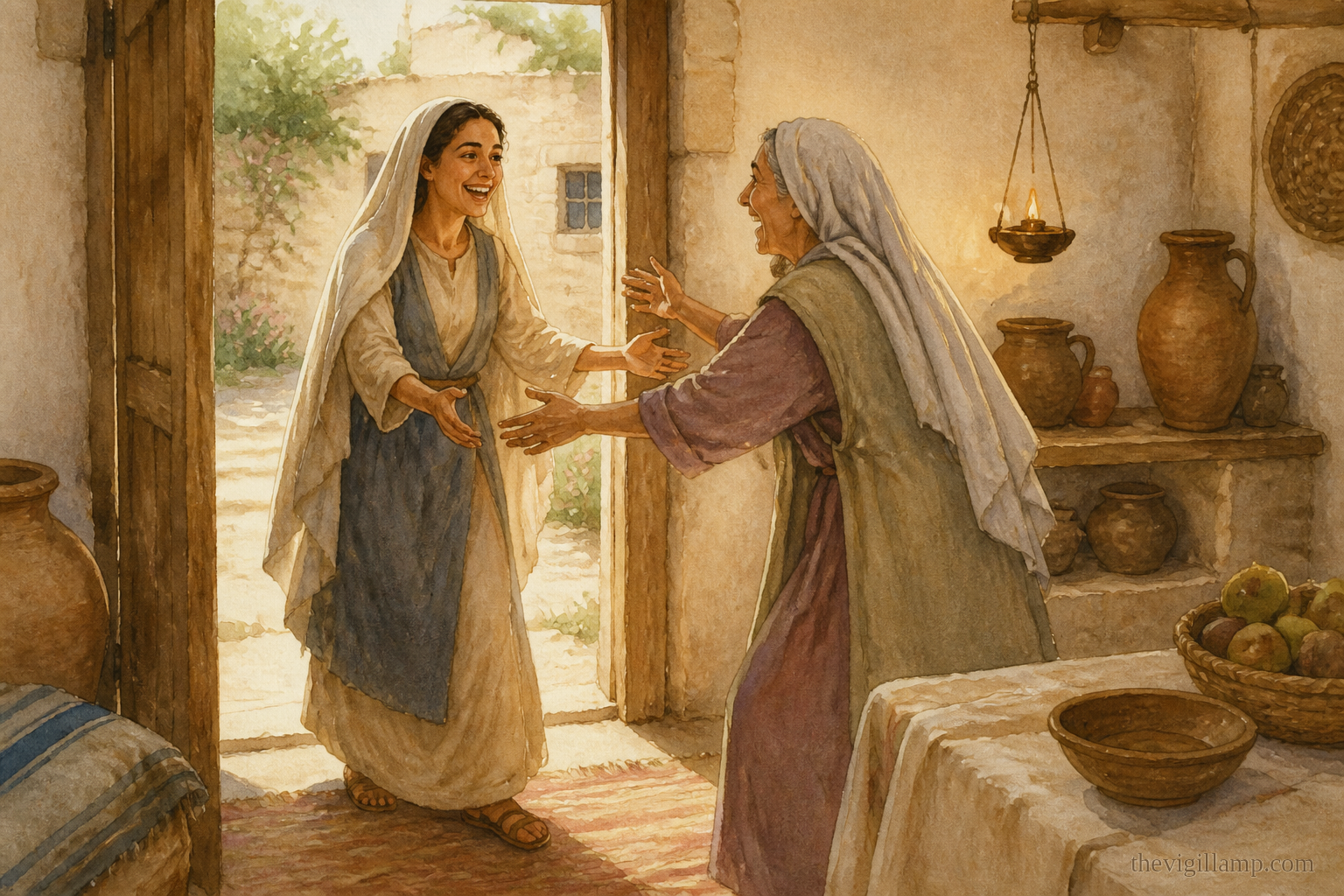
"Blessed art thou among women," Elizabeth said, "and blessed is the fruit of thy womb. And whence is this to me, that the mother of my Lord should come to me? For, lo, as soon as the voice of thy salutation sounded in mine ears, the babe leaped in my womb for joy. And blessed is she that believed: for there shall be a performance of those things which were told her from the Lord."
Do you hear what she called her? The mother of my Lord. The child in Mary's womb was Christ. The child in Elizabeth's womb leaped for joy, because the Promise the world had been waiting for had come under their roof.
Mary stayed about three months, and returned to her own house.
Then Elizabeth's full time came, and she brought forth a son. Her neighbors and her cousins heard how the Lord had shewed great mercy upon her, and they rejoiced with her.
On the eighth day they came to circumcise the child, and they called him Zacharias, after the name of his father.
"Not so," his mother said. "But he shall be called John."
"There is none of thy kindred that is called by this name," they said.
They made signs to his father, how he would have him called.
Zachariah asked for a writing table. He wrote, saying, "His name is John."
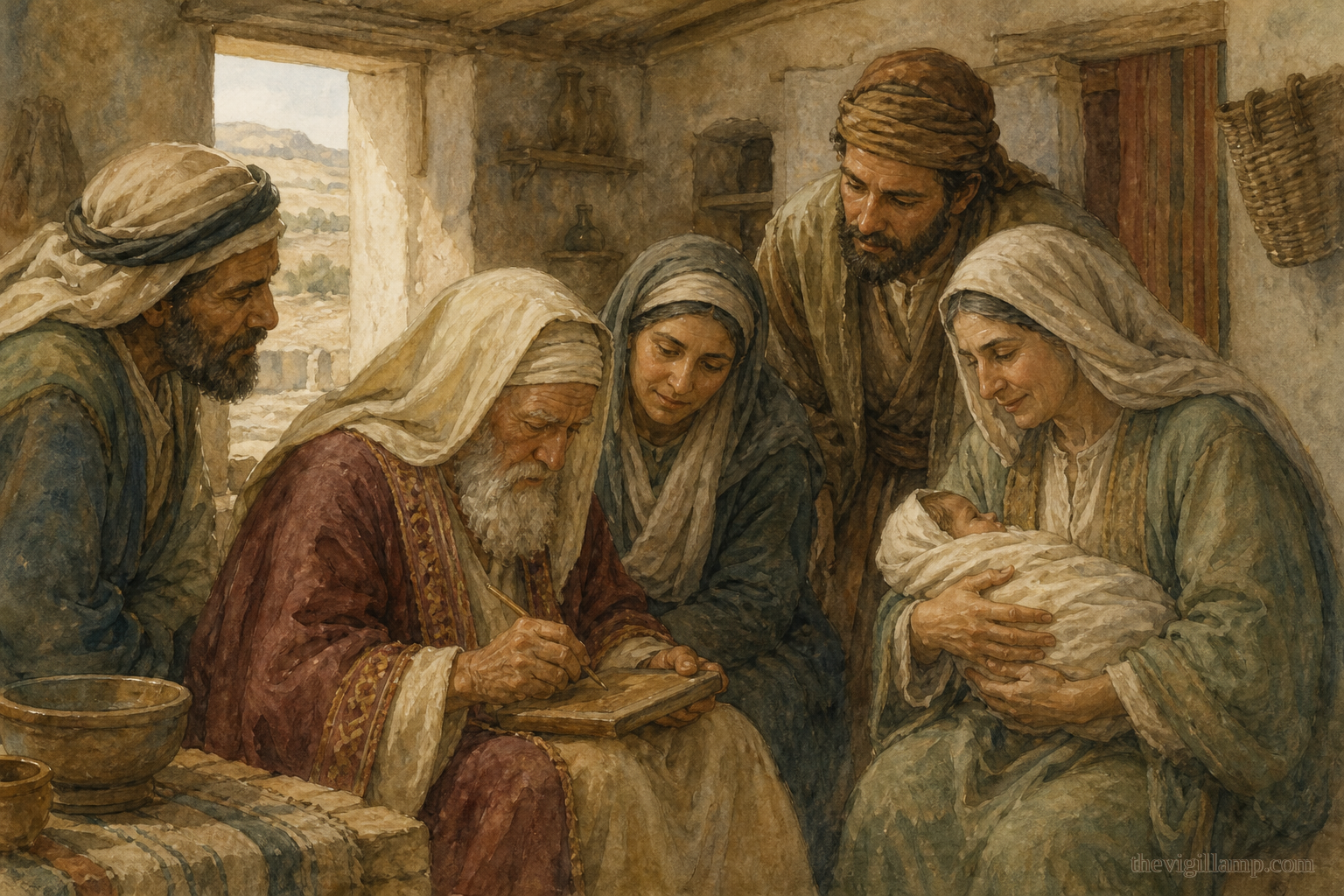
And they marvelled all.
His mouth was opened immediately, and his tongue loosed, and he spake, and praised God.
Filled with the Holy Ghost, he prophesied. He blessed the Lord God of Israel, who had visited and redeemed His people, and had raised up a horn of salvation in the house of His servant David — as He spake by the mouth of His holy prophets, to perform the mercy promised to the fathers, and to remember His holy covenant, the oath He sware to Abraham.
Then he spoke of the child.
"And thou, child, shalt be called the prophet of the Highest: for thou shalt go before the face of the Lord to prepare his ways… Through the tender mercy of our God; whereby the dayspring from on high hath visited us, to give light to them that sit in darkness and in the shadow of death, to guide our feet into the way of peace."
God had not forgotten the old promises. He had not forgotten Abraham. He had not forgotten this old priest and this old mother. He was keeping His word across the generations — all the way to the coming of Christ.
The child grew, and waxed strong in spirit.
When King Herod heard from the Magi about the birth of the Messiah, he decided to kill the infants of Bethlehem and the country round about. Herod knew about John's unusual birth. He wanted to kill him too, fearing that he was the foretold King of the Jews.
Elizabeth hid herself and the infant in the hills. The murderers searched everywhere. When she saw her pursuers, she began to implore God for their safety — and the hill opened up and concealed her and the infant from them.
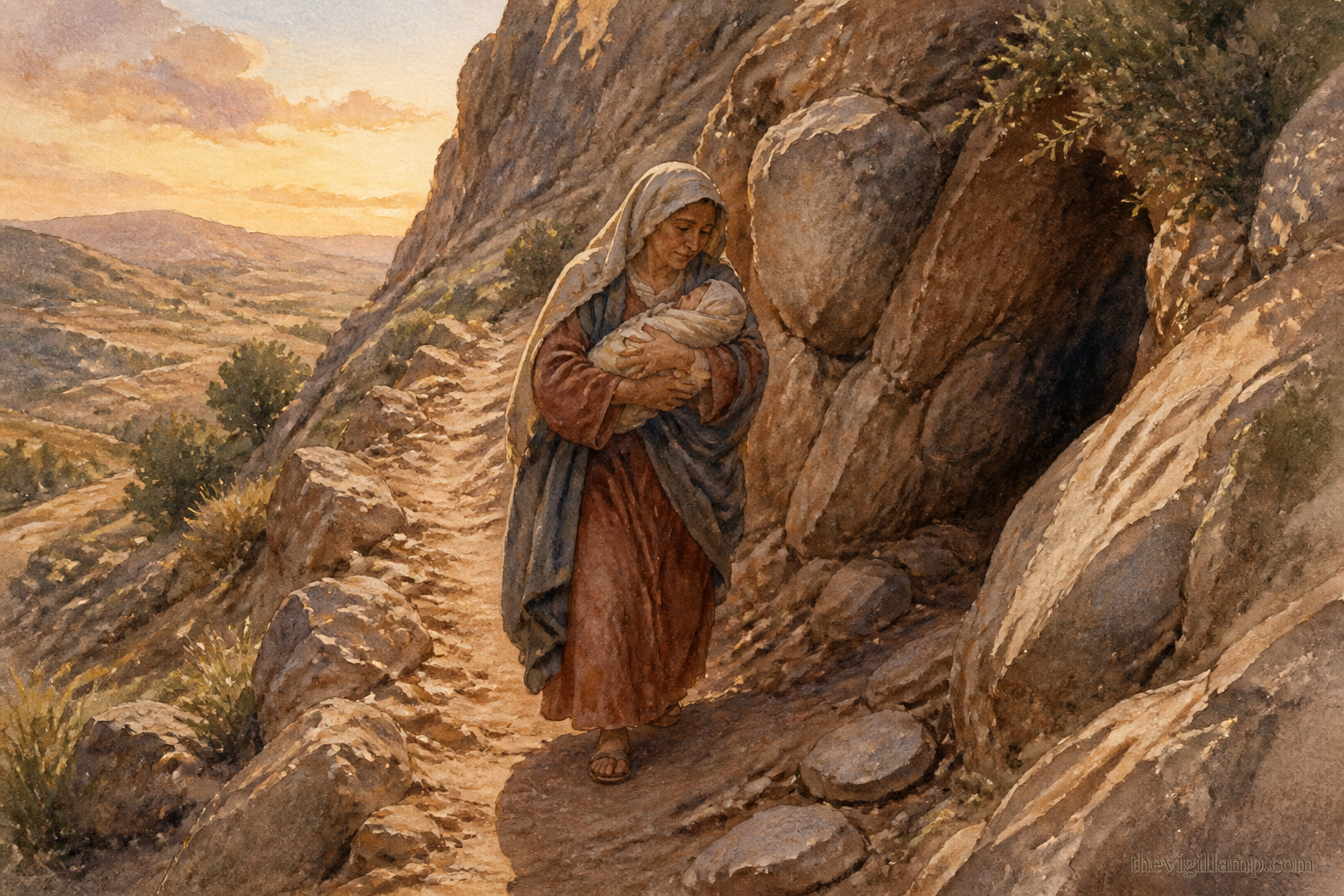
Those are the Church's words. We will not invent others.
In those same days Zachariah was taking his turn at the services in the Temple. Soldiers sent by Herod tried to learn from him where his son was. They could not. Then, by command of Herod, they murdered this holy prophet between the temple and the altar. The troparion says he was slain by the sword in the temple of God. We will not linger on the manner of his death. The Church knows his name, and that is enough for us this morning.
Elizabeth died forty days after her husband. Saint John, preserved by the Lord, dwelt in the wilderness until the day of his appearance to the nation of Israel.
The word we heard this morning is a weekday word, not a saint's own pair: "stewards of the mysteries of God… it is required in stewards, that a man be found faithful." Zachariah kept the Temple's holy things. Then God made him steward of a greater mystery — a son who would go before the Lord. And the Gospel says, "he that shall humble himself shall be exalted." Zachariah was made silent. Then his mouth was opened, and the first thing he did with his voice was bless the God who keeps His promises.
And today, so many hundreds of years later, we say their names once more, out loud, together — Holy Prophet Zachariah, and Righteous Elizabeth — and they are praying for us still.
together with them we pray to You: "Save our souls."
according to the Law of God you offered whole-burnt offerings in a sacred manner, wise Zachariah.
You became a luminary and a seer of the mysteries,
bearing within yourself the signs of grace, all-wise one.
Slain by the sword in the temple of God, O prophet of Christ,
intercede together with the Forerunner
that our souls may be saved.
and parent of the Forerunner,
has prepared a banquet to his memory to nourish the faithful,
mixing the drink of righteousness.
Therefore we praise him as a divine initiate of the grace of God.
- Give everyone a scrap of paper and a pencil — a little "tablet," the way Zachariah asked for a writing table.
- Sit still together for a slow count of ten. No talking. Zachariah had to wait in silence before his mouth was opened.
- Then one child writes, slowly, the words he wrote: "His name is John."
- That child reads the words out loud, and then does one small, real good work right away: clear a plate, help a little brother, say something kind. Zachariah's first words were a blessing. Ours can be a kindness.
- Take turns. When everyone has had a turn, sit together and each name one promise of God you want to remember this week — a word He has already spoken, not a wish we made up. Write those words on the papers and keep them under the lamp until next Sunday.


and Righteous Elizabeth,
pray to God for us.”
on earth as it is in heaven. Give us this day our daily bread,
and forgive us our trespasses, as we forgive those who trespass against us; and lead us not into temptation,
but deliver us from the evil one. Amen.