September 4 · Gorazd of Prague

Share
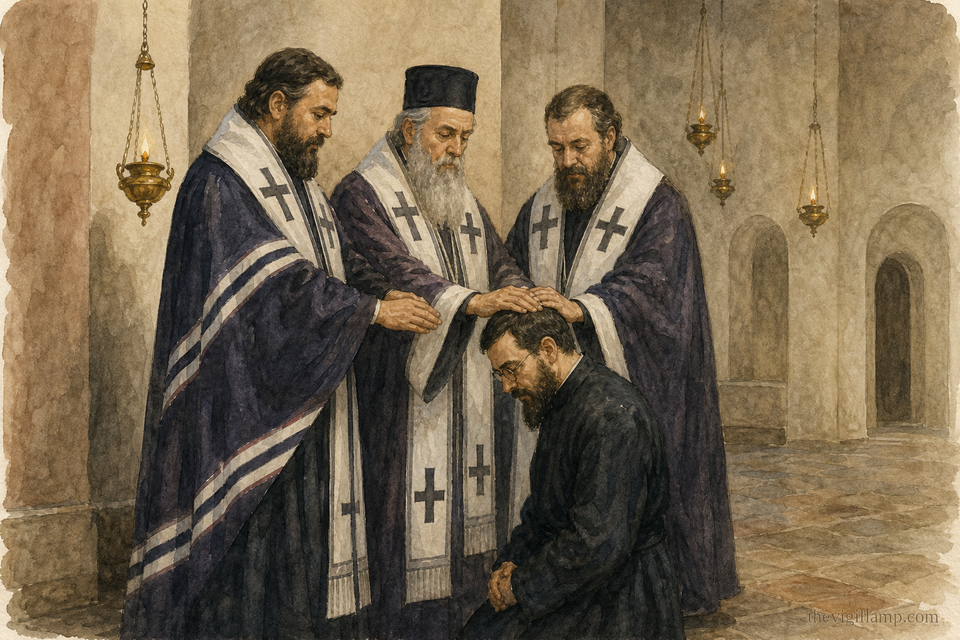
The consecration in Belgrade: Patriarch Dimitri and the bishops praying the Church's prayer over Gorazd; no extra speech in the scene

Hieromartyr Gorazd of Prague

Bishop of Bohemia and Moravia-Silesia
✦ ✦ ✦
Before you begin
Today's Vigil is for your family, not the other way around. If anything feels like too much, that's okay. Do the parts your family loves, and work your way up to the whole Vigil in one sitting.
Movement One
Light the Lamp
Do together: Light your lamp or a candle. Then say: "Today the Church remembers the Hieromartyr Gorazd of Prague, Bishop of Bohemia and Moravia-Silesia."
We begin the way the Church begins any new work
“O Lord Jesus Christ, the only-begotten Son of the eternal Father, Thou hast said, 'Without me you can do nothing.' In faith I embrace Thy words, O Lord, and bow before Thy goodness. Help me to complete the work I am about to begin for Thine own glory: in the Name of the Father, and of the Son, and of the Holy Spirit. Amen.”
Then all together:
“Through the prayers of our holy fathers,
O Lord Jesus Christ our God, have mercy on us.”
The Orthodox prayer before beginning any work, offered for our family and for yours, each time we begin again.
Movement Two
Read the Icon
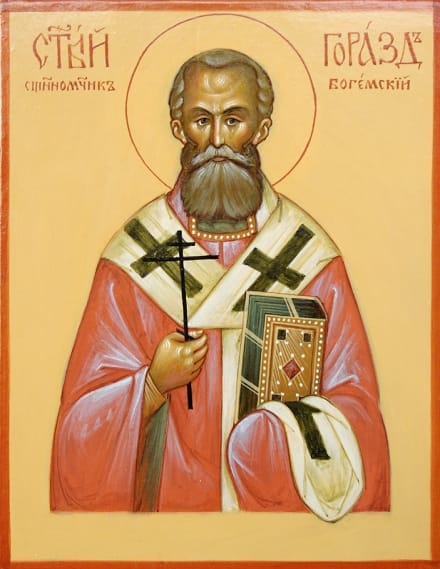
Before we hear his story, let's look at how the Church shows him, and learn to read what this icon is telling us.
Hieromartyr Gorazd of Prague, Bishop of Bohemia · Eleon Icon Painting Workshop, Mukachevo, 2012
What are we looking at?
An icon isn't a photograph, and it isn't a painting to admire. It's a window. Everything in it is there to teach us something true about the saint.
The gold behind him. Not a room in Prague. Not a street in the war. Heaven's own light. The saint stands where God's light fills everything.
The white stole with the dark crosses. Look for the wide white band over his shoulders. This is the omophorion, the shepherd's stole. It tells us this man was a bishop. He carried a whole people the way a shepherd carries a sheep.
The red outer robe. Over his other vestments he wears a warm red phelonion. The Church clothes a bishop in feast-color, even when the story we are about to hear is hard.
The small dark cross. In his right hand he holds a little cross against his chest. This is how the Church marks a martyr — not with a wound, and not with a weapon. With the Cross he would not put down.
The Gospel book. In his left hand he holds a thick book, bound and set with a red jewel. This is the Gospel. He spent his years putting those words into the Czech tongue, so his own people could hear them.
The name. In red Church Slavonic letters: Holy Hieromartyr Gorazd of Bohemia. Every icon names its saint, so you always know whose face you're looking at.
This panel is new. The Church did not have a hundred years of old gold to give him. She painted him the way she paints a bishop who laid down his life.
Eleon Icon Painting Workshop (Иконописная мастерская «Елеон»), Mukachevo, Transcarpathia, 2012; uploaded by Vspreobrazhenskiy as the workshop's own work. Licensed under Creative Commons Attribution-Share Alike 3.0. Image via Wikimedia Commons. Gorazd died in living memory; the Church has no old public-domain panel of him. This modern workshop icon is used because the painter's house released it with an explicit reuse license. Parish photographs of other modern icons, and rights-unclear OCA files, were not used.
The Readings   Movement Three
The Scripture the Church appoints for this day. Open your Bible at home and read the passages aloud together, then listen for these words echoing through the saint's story and the rest of your day.
A Psalm to begin · Psalm 22 (23) : 1
“The Lord tends me as a shepherd, and I shall want nothing.”
The Septuagint (Brenton, 1851), the Old Testament of the Orthodox Church. In ordinary English Bibles this is Psalm 23:1. This verse is chosen for prayer today; it is not a separate lectionary appointment.
The Epistle · Galatians 2 : 6–10
“And when James, Cephas, and John, who seemed to be pillars, perceived the grace that was given unto me, they gave to me and Barnabas the right hands of fellowship.”
Open your Bible and read the full passage together. Text: King James Version (public domain).
The Gospel · Mark 5 : 22–24, 35–6 : 1
“Be not afraid, only believe.”
Open your Bible and read the full passage together. Text: King James Version (public domain).
These are the weekday readings appointed by the Orthodox Church in America for Friday, September 4, 2026. The OCA daily page and the September monthly lectionary list no separate (Saint) pair for Gorazd; this edition therefore uses the appointed weekday pair.
audio-thumbnail
Gorazd of Prague · Read aloud
0:00
/556.747755
Movement Four
The Story

The Church remembers more than one name on the fourth of September.

She remembers the Prophet Moses, who saw God in the bush that burned and was not consumed. She remembers the old bishop Babylas of Antioch, and the children who stood with him. Those are true days. We will not tell those whole lives this morning.

Today she asks us to hear a newer name.

His name was Gorazd. Before that, his name was Matthias Pavlik. He was born in the year 1879, in a Moravian town called Hrubá Vrbka — a little place that would later lie in the Czech lands. He was born into a Roman Catholic family. He went to the seminary in Olomouc. He was ordained a priest.

Then the great war ended, and a new country was made: Czechoslovakia. The old laws that had required the Catholic religion were loosened. Father Matthias, and thousands with him, left that Church. Many of them were looking for a home in the Orthodox Church — the Church of Saints Cyril and Methodius, who had first brought the Faith to those lands. In those years that Church in that region stood under the protection of the Orthodox Church of Serbia.

He took monastic vows. He was given a new name: Gorazd.

The first Gorazd had been a disciple of Saints Cyril and Methodius, and he had succeeded Saint Methodius as bishop of Moravia. The Church gave this man that name so the old mission would not be forgotten.

When he was forty-two years old, they made him a bishop.

It was the twenty-fifth of September, in the year 1921, in Belgrade. The Serbian Patriarch Dimitri consecrated him, together with Metropolitan Anthony Khrapovitsky of Kiev, and other bishops, including Bishop Dositheus of Zagreb. He was made Bishop of Moravia and Silesia.

The Church still keeps the words that were prayed over him that day. They are the words the Church prays when she makes a bishop.

"O Lord, make this man also, who has been proclaimed a steward of the episcopal grace, to be an imitator of You, the true Shepherd, Who laid down Your life for Your sheep."

Those are the Church's words. We will not invent others.

And the Gospel she set beside that prayer is the Lord's own:

"I am the good shepherd. The good shepherd gives His life for the sheep."
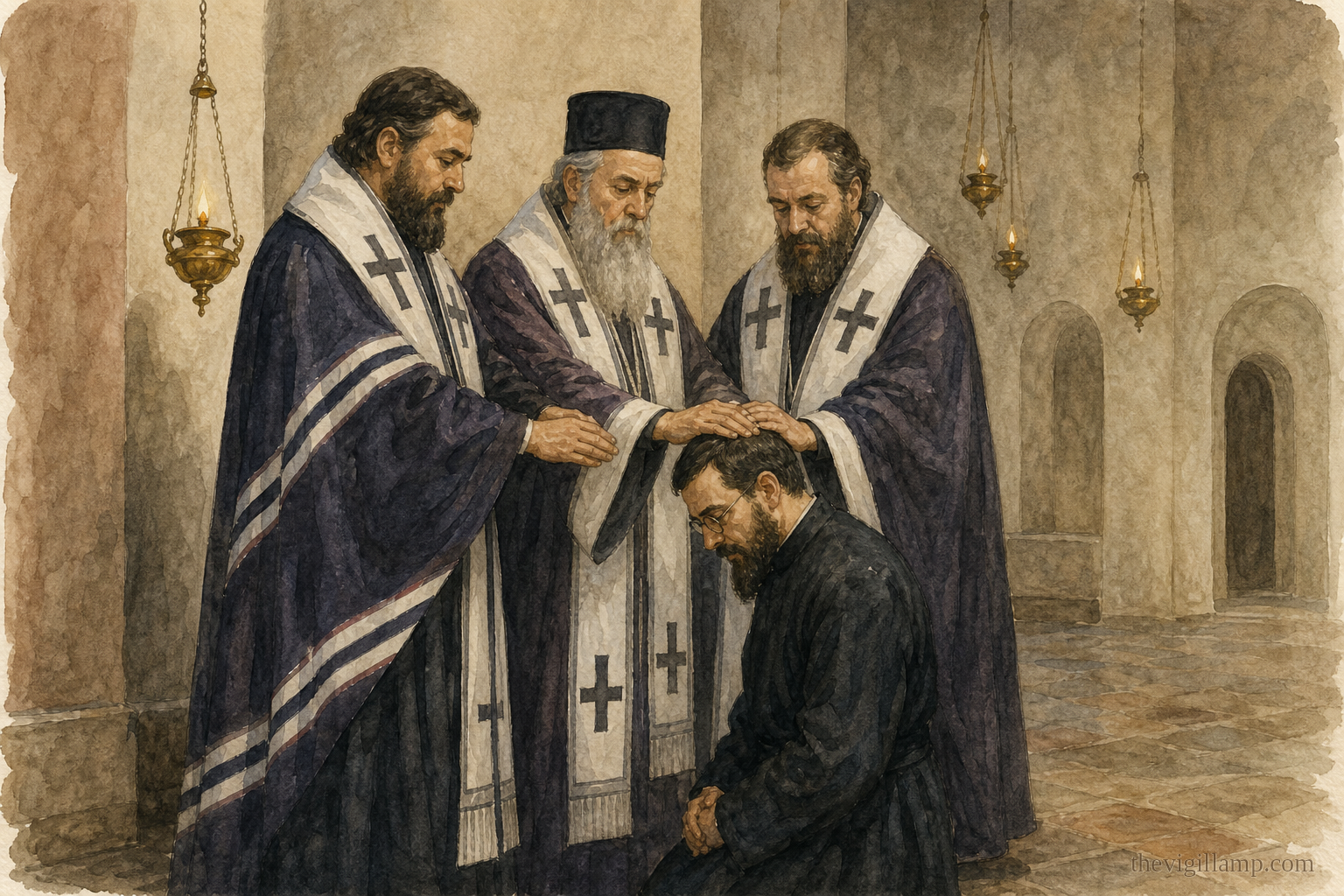
The consecration in Belgrade: Patriarch Dimitri and the bishops praying the Church's prayer over Gorazd; no extra speech in the scene

He went to work at once.

He built eleven churches and two chapels. He translated the service books into the Czech language, so that his people could pray in the words of their own mouth. He paid particular attention to the Carpatho-Rusyns in the east of that land, who were returning to the Orthodox Faith of their ancestors.

He remained a bishop for twenty years. He remained Orthodox when people tried to pull him back. When some Catholic priests rose up against him, a Catholic bishop named Stoian said a true thing, and the Church still keeps the words:

"Leave Pavlik alone, you are not worthy to tie his laces, it would be good if everyone were like Pavlik."

Those are the Church's words. We will not invent others.
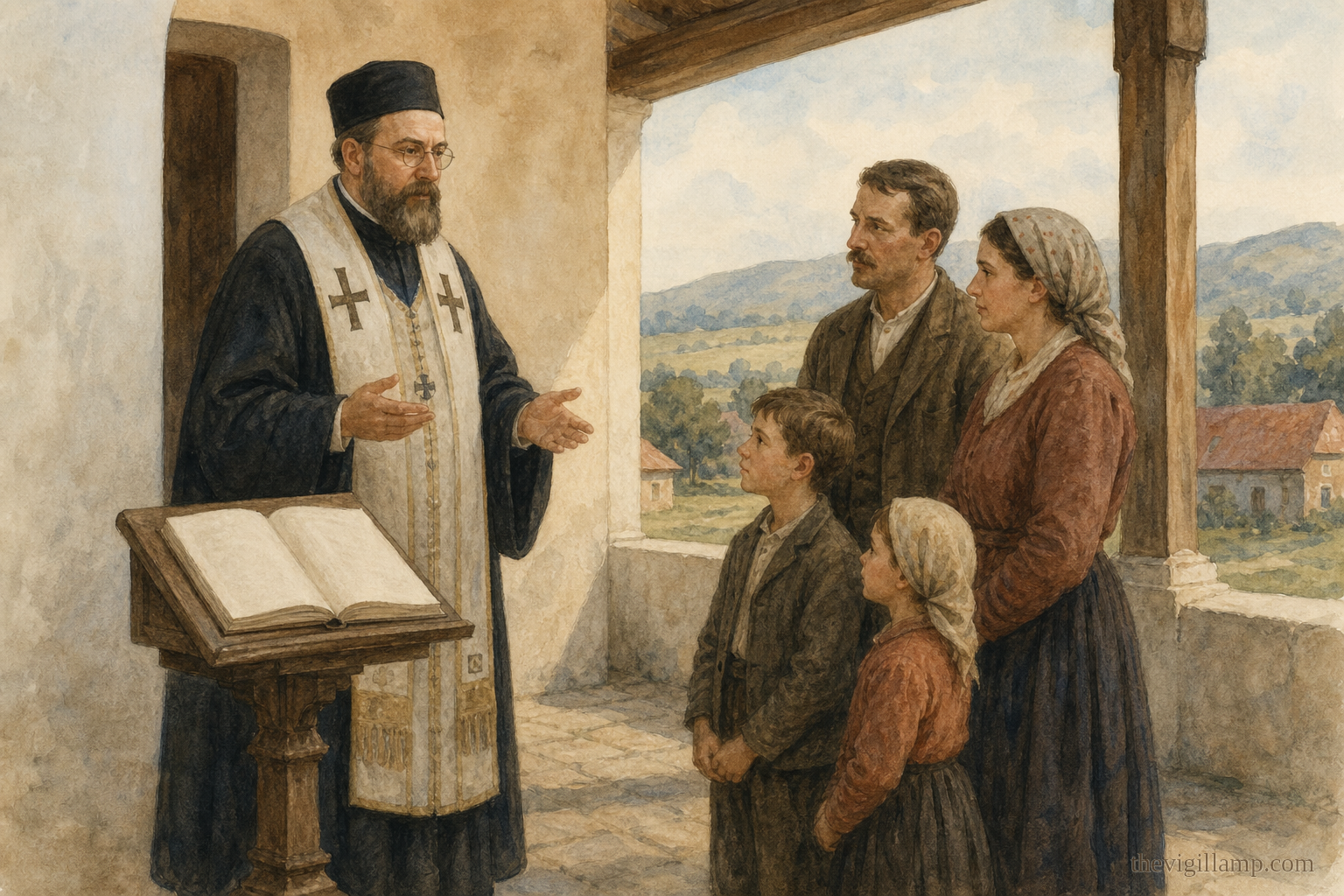
Gorazd among the new churches, with Czech service books open; a people learning to pray in their own language. No extra action invented

Then the country was taken.

The German army came in 1938. The Orthodox Church in those lands was placed under the Orthodox metropolitan in Berlin, Metropolitan Seraphim. A high official of the occupiers was later killed. Some of the men who had done it were hidden in the crypt of the Cathedral of Saints Cyril and Methodius — the Church's own house in Prague.

When Bishop Gorazd learned of this, he understood the danger. Not only for himself. For his priests. For the people who came to that cathedral to pray. For the little Church he had spent twenty years building.

He was about to leave for Berlin, to take part in the consecration of a priest as a bishop. Before he went, he insisted that the men leave the cathedral and find another place.

They were still there on the eighteenth of June. The hiding place was found. The men were killed.

We will not stay in that crypt. We will not tell the manner of it. The Church names the cathedral so we know whose house it was. Then she turns to the bishop.
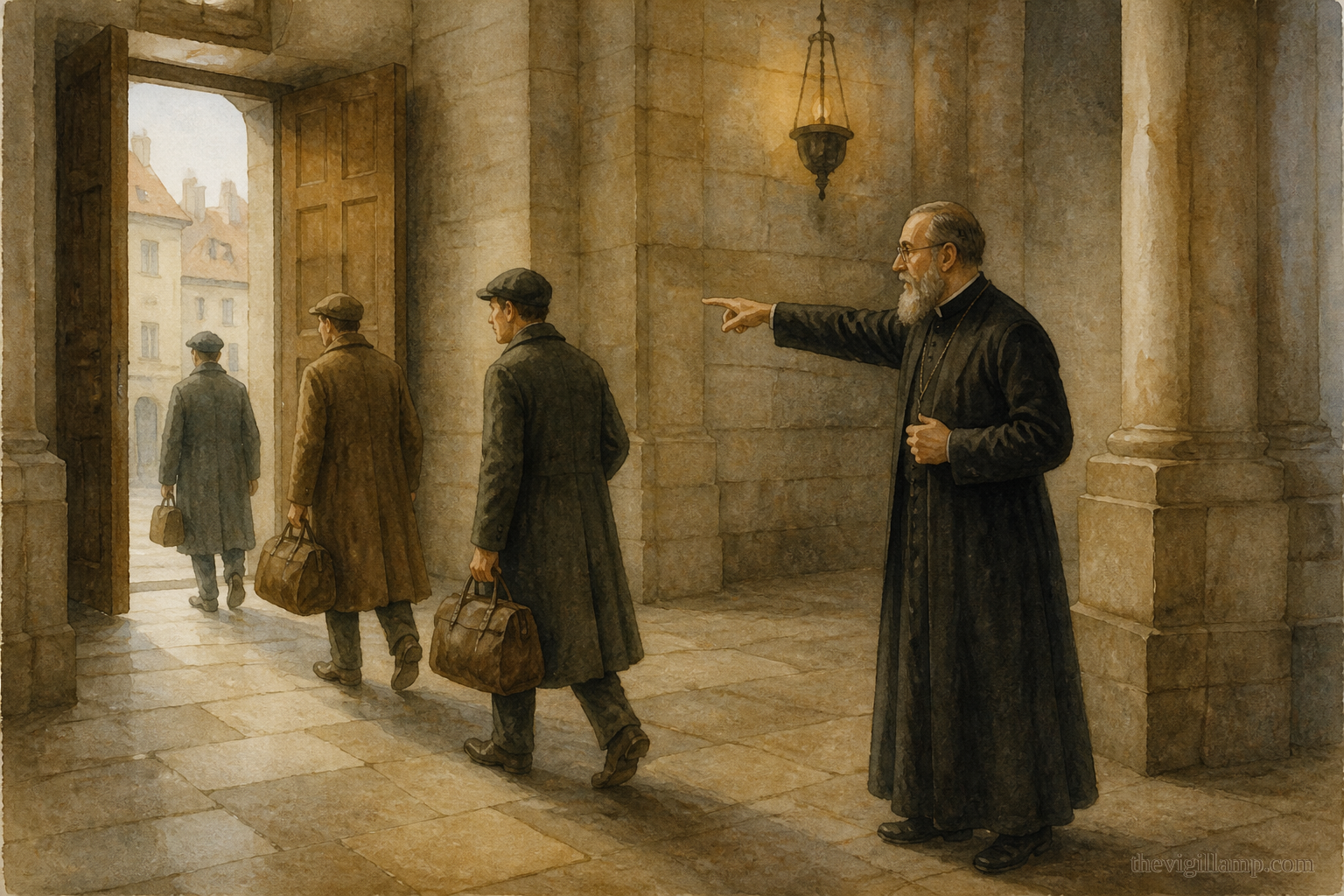
Gorazd at the Cathedral of Saints Cyril and Methodius, insisting that the hidden men leave and find another refuge before he goes to Berlin; no extra speech invented

The occupiers began to punish the whole Church.

The two priests of that cathedral were arrested, and the senior lay people with them. Bishop Gorazd tried to save his people and his church. He did not hide the truth, and he did not hand the blame to anyone else. He wrote letters to the authorities. He took the blame himself.

The Church still keeps the words he wrote:

"I am giving myself up to the authorities and am prepared to face any punishment, including death."

Those are the Church's words. We will not invent others.
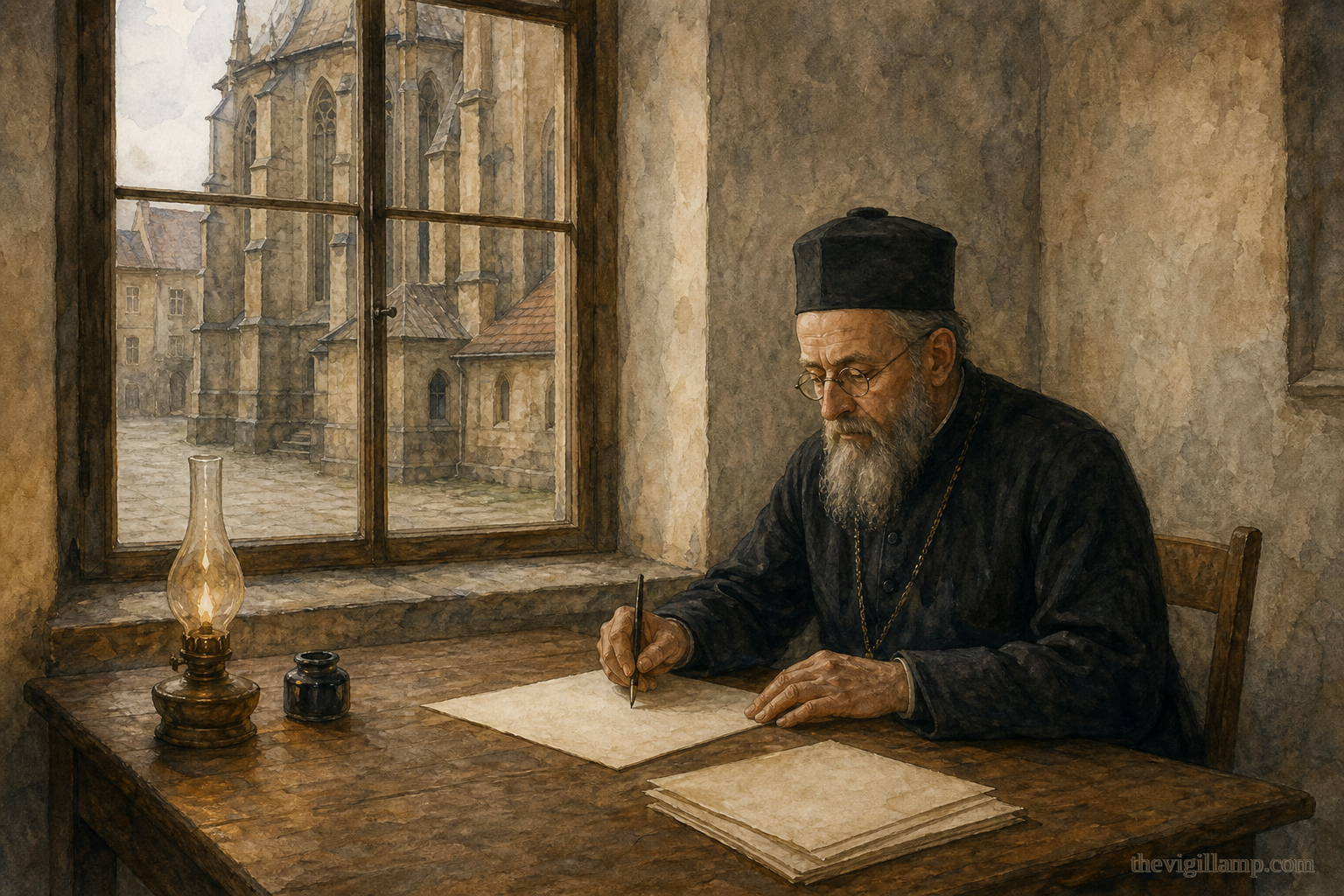
Gorazd writing the letter that takes the blame, the cathedral behind him; no occupiers in the scene, and no extra speech beyond the Church's own words

Think about that for a moment.

A bishop's work is not to keep himself safe. His work is to keep his people. He had built the churches. He had put the prayers into Czech. He had told the hidden men to go. And when the danger did not pass, he put his own name on the letter.

He was arrested on the twenty-seventh of June, in the year 1942. On the fourth of September he was put to death, at the place the Church names: the shooting range at Kobylisy. He was sixty-three years old.

The two cathedral priests were also put to death. The Church says that hundreds of people died in the punishment that followed. She also names a village, Lidice, that was destroyed. We will not stay with that. We say the name so we know how wide the harm was. Then we return to the bishop who tried to stand in the way of it.

After he died, the Orthodox Church in Bohemia and Moravia was closed. The churches were shut. The priests were sent away.

He had given himself up so that his flock might be spared. The occupiers did not spare them. The Church still calls him a shepherd, because he did the shepherd's work anyway.

Years later the Orthodox Church of Serbia recognized him as a new martyr, on the fourth of May, 1961. On the twenty-fourth of August, 1987, he was glorified in the Cathedral of Saint Gorazd in Olomouc — the same city where he had once gone to seminary. His feast is this day, the day of his martyrdom.

The word we heard this morning is a weekday word, not a saint's own pair. The apostles gave Paul the right hand of fellowship, and asked only that he remember the poor. Gorazd received that kind of fellowship from the Church of Serbia, and from Metropolitan Anthony, and he remembered his own poor Church: he built her houses, and he put the Gospel into her language. And the Lord says, in the house of Jairus, "Be not afraid, only believe." That is not a story about Gorazd raising a child. It is the word the Church reads on the morning she says his name. He wrote that he was prepared to die. He did not ask the people at home to be brave in his place.

And today, on the day the Church still keeps as his own, we say his name once more, out loud, together — Hieromartyr Gorazd of Prague — and he is praying for us still.

Movement Five
The Prayer
Troparion of Saint Gorazd · Tone 4
Orthodox leader and restorer of the Moravian Church,
Godly chief shepherd, Father Gorazd!
With joy, you suffered for the Truth.
Pray to our gracious God to save our souls!
Kontakion of Saint Gorazd · Tone 2
Amid currents of uncertainty, you remained in truth like the hardest diamond,
and you preached to your native land Orthodoxy -- the way of salvation.
After a God-favored life as a teacher of the Gospel, O high priest and shepherd,
you patiently and bravely received the martyrs' crown from Christ the Savior.
O Martyr, Enlightener, Father Gorazd, pray for us in the Kingdom of God.
The troparion and kontakion appointed by the Orthodox Church in America on the September 4 page of Martyr Gorazd of Prague. Wording is exact; slash marks were converted to line breaks only. These are the saint's own hymns, not a fabricated common.
Movement Six
Let's Talk About It Together
Talk about it:
Gorazd put his own name on the letter so the blame would not fall on his people. When is taking responsibility the hard, good thing in our house?
He built churches and put the services into Czech, so his people could pray in words they already knew. What would it mean, this week, to help someone pray in words they can understand?
The Church reads today, "Be not afraid, only believe." What is one thing we are afraid of — and what would it look like to ask the Good Shepherd to hold us there?
Movement Seven
Do This Together
Do this together   Any time of day
The Shepherd's Letter
  1. Sit at a little table with the lamp, and a scrap of paper.
  2. One child writes — or says, slowly, for someone else to write — one true sentence that takes a small real care: "I will look after ___." No pretending. A person, or a chore, or a kindness already owed.
  3. While everyone is quiet, that child says the psalm we heard: "The Lord tends me as a shepherd, and I shall want nothing."
  4. Then that child does one small, real good work right away: clear a plate, help a little brother, say something kind. Gorazd wrote the letter. He did not only mean it.
  5. Take turns. When everyone has had a turn, sit together and each name one person you want to look after this week the way a shepherd looks after a sheep — not by doing their whole life for them, but by not leaving them to carry a hard thing alone. Write the names on a scrap of paper and keep the papers under the lamp until next Sunday.
Little ones (2–4): help them sit still and say "I will take care" while you count to five. · Make it stick: say the psalm together each night this week — "The Lord tends me as a shepherd, and I shall want nothing."
Movement Eight
Go in Peace
Go in Peace
Say the saint's name together:
“Holy Hieromartyr Gorazd of Prague,
Bishop of Bohemia and Moravia-Silesia,
pray to God for us.”
And close, as the Church always closes, with the Lord's Prayer:
Our Father, Who art in heaven, hallowed be Thy Name. Thy Kingdom come, Thy will be done,
on earth as it is in heaven. Give us this day our daily bread,
and forgive us our trespasses, as we forgive those who trespass against us; and lead us not into temptation,
but deliver us from the evil one. Amen.
Do together: Put out the lamp, or leave it burning a while. The lamp keeps watch until tomorrow. "Glory to God for all things. Amen."
A note on our storytellingEvery edition of The Vigil Lamp is an original retelling. The saint is real, and the names, places, events, and directly quoted words in this edition are drawn from the Orthodox Church in America's traditional account of Hieromartyr Gorazd of Prague and from the Church's own appointed hymns and weekday readings. The older commemorations of the day are named and not given lives. No invented historical dialogue is presented as fact. Occupation and martyrdom are told as the Church records them, without reconstructed conversations or last words. The words of narration are our own, written to make a true story vivid and a joy for families to read aloud together.