Today's Vigil is for your family, not the other way around. If anything feels like too much, that's okay. Do the parts your family loves, and work your way up to the whole Vigil in one sitting.
Movement One
Light the Lamp
Do together: Light your lamp or a candle. Then say: "Today the Church remembers the Hieromartyr Anthimus, Bishop of Nicomedia, and those who suffered with him."
We begin the way the Church begins any new work
“O Lord Jesus Christ, the only-begotten Son of the eternal Father, Thou hast said, 'Without me you can do nothing.' In faith I embrace Thy words, O Lord, and bow before Thy goodness. Help me to complete the work I am about to begin for Thine own glory: in the Name of the Father, and of the Son, and of the Holy Spirit. Amen.”
Then all together:
“Through the prayers of our holy fathers, O Lord Jesus Christ our God, have mercy on us.”
The Orthodox prayer before beginning any work, offered for our family and for yours, each time we begin again.
Movement Two
Read the Icon
Before we hear his story, let's look at how the Church shows him, and learn to read what this icon is telling us.
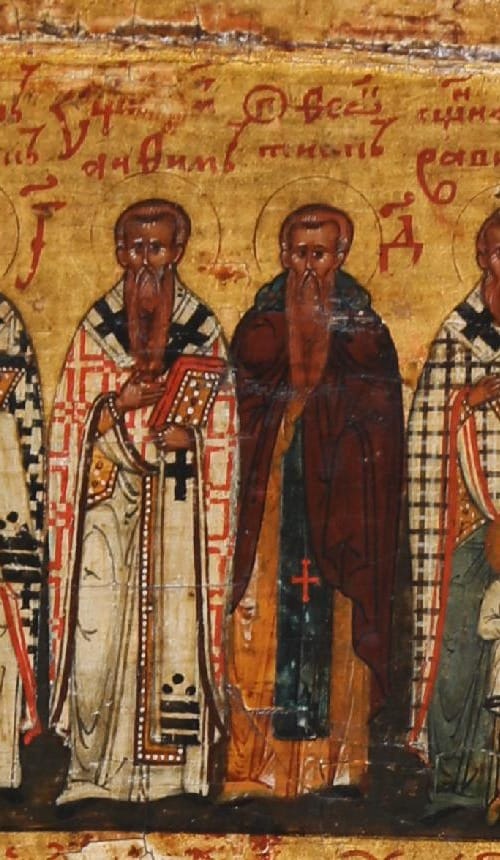
Hieromartyr Anthimus, Bishop of Nicomedia · detail within a September Menaion icon · Central Russia, first quarter of the seventeenth century · Museum of Christian Art “Church-Archaeological Cabinet”
What are we looking at?
An icon isn't a photograph, and it isn't a painting to admire. It's a window. Everything in it is there to teach us something true about the saint.
The whole month. This is a calendar icon, called a Menaion. Across four long rows, many saints and feasts of September stand together on a gold ground. Their days form one shared procession.
Anthimus, in the first row. After the pillar of Symeon, and after the pair for September 2, the museum's catalog names the next bishop as the Hieromartyr Anthimus of Nicomedia. He stands full length, with a thin gold halo, on the worn gold field.
The white stole with black crosses. Look for the wide white band over his shoulders. This is the omophorion, the shepherd's stole. It tells us this man was a bishop. He carried a whole city the way a shepherd carries a sheep.
The robe with the red grid. Over his other vestments he wears a pale phelonion marked with a red cross-hatch. The pattern is the Church's way of clothing a bishop in many crosses.
The red book. In one hand he holds a thick book bound in red, with small pale ornaments on the cover. This is the Gospel. Even on a crowded calendar, the icon will not let us forget what he was sent to keep.
His other hand. It is held at his chest. He is not shown with a sword, and he is not shown in a crowd. On this panel he stands as the bishop he was.
The name. Fine red Church Slavonic writing runs above him. The painted words keep the calendar's people and days joined to their names. The letters of Anthimus can still be read.
Theoctistus beside him. The next figure wears dark monastic clothes, not a bishop's stole. The Church remembers Venerable Theoctistus on this same day. We rest our eyes on Anthimus, and we do not pretend the neighbor on the panel is not there.
Anonymous Russian icon painter, Menaion: September, first quarter of the seventeenth century, tempera, gesso, and gilding on wood; Museum of Christian Art “Church-Archaeological Cabinet,” inventory MMDA “TsAK” KP-205. Public domain. The day’s own miniature in the Menologion of Basil II was inspected: it is an execution scene and is not shown to the family. Modern OCA files were not used.
The ReadingsMovement Three
The Scripture the Church appoints for this day. Open your Bible at home and read the passages aloud together, then listen for these words echoing through the saint's story and the rest of your day.
A Psalm to begin · Psalm 26 (27) : 1
“The Lord is my light and my Saviour; whom shall I fear? the Lord is the defender of my life; of whom shall I be afraid?”
The Septuagint (Brenton, 1851), the Old Testament of the Orthodox Church. In ordinary English Bibles this is Psalm 27:1. This verse is chosen for prayer today; it is not a separate lectionary appointment.
The Epistle · Galatians 1 : 1–10, 20–2 : 5
“For do I now persuade men, or God? or do I seek to please men? for if I yet pleased men, I should not be the servant of Christ.”
Open your Bible and read the full passage together. Text: King James Version (public domain).
The Gospel · Mark 5 : 1–20
“Go home to thy friends, and tell them how great things the Lord hath done for thee, and hath had compassion on thee.”
Open your Bible and read the full passage together. Text: King James Version (public domain).
These are the weekday readings appointed by the Orthodox Church in America for Thursday, September 3, 2026. The OCA daily page and the September monthly lectionary list no separate (Saint) pair for Anthimus or those with him; this edition therefore uses the appointed weekday pair.
Anthimus of Nicomedia · Read aloud
0:00
/496.718367
Movement Four
The Story
The Church remembers a bishop, and she remembers the people who stood with him.
His name was Anthimus. He was Bishop of Nicomedia — a great city in the East, a city where an emperor liked to live, and a city where many people had already learned the Name of Christ.
A bishop is a shepherd. That is what the white stole on the icon is for. Anthimus's work was not to keep himself safe. His work was to keep his people close to Christ.
In those days the emperors were Diocletian and Maximian, and they turned against the Church. After a fire at the palace in Nicomedia, the pagans said the Christians had set it. We will not pretend to know who lit that fire. We only say what the Church says: the accusation was false, and the city became a hard place for anyone who belonged to Christ.
The Church names the ones who suffered with their bishop.
There were Dorotheus, Mardonius, Migdonius, Peter, Indes, and Gorgonius. There was Zeno, a soldier, who would not be quiet when the emperor did wrong. There was the virgin Domna, who had once served the old gods as a priestess and had turned to Christ. There was Euthymius. And there was Theophilus the deacon, who carried the bishop's letters.
They would not deny the Lord. They gave their lives for Him. We will not linger on the manner of their deaths. The Church knows their names, and that is enough for us this morning.
On the day the Church was keeping the Nativity of Christ, a great company of Christians were gathered in a church in Nicomedia, and they too gave their lives. The Church remembers that company on another day — the twenty-eighth of December. We will not stay with the fire.
Domna and Euthymius had one care left: that the bodies of the holy martyrs should be buried. They were not willing to let the Church's dead be thrown away as if they had no name.
The flock asked their bishop to hide.
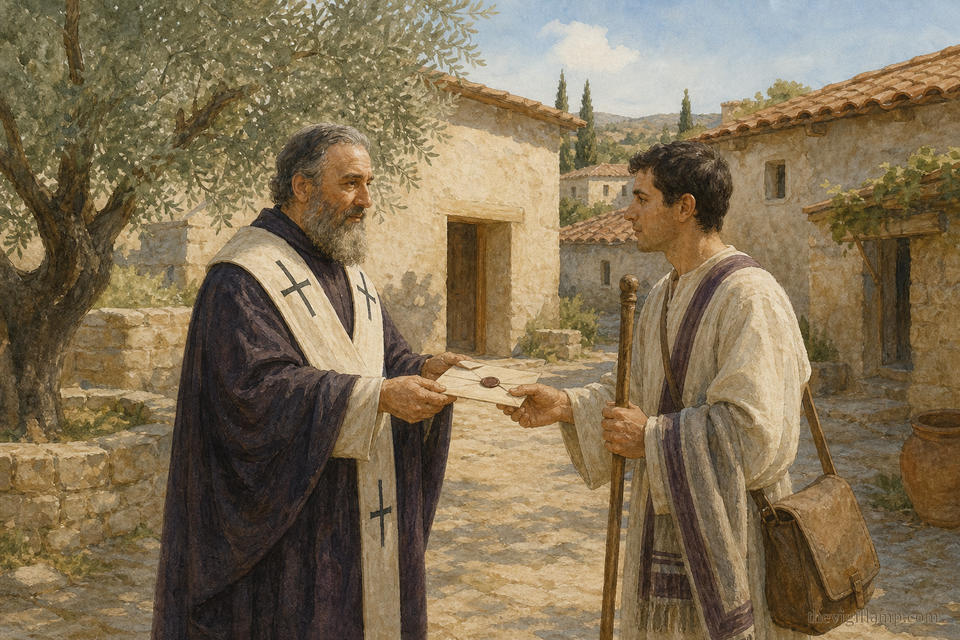
They were not asking him to stop being a bishop. They were asking him to stay alive long enough to keep feeding them. So Anthimus went to a village not far from the city. From there he sent letters. The letters said the thing a good shepherd says when the wolves have come: hold fast to the holy Faith. Do not be afraid.
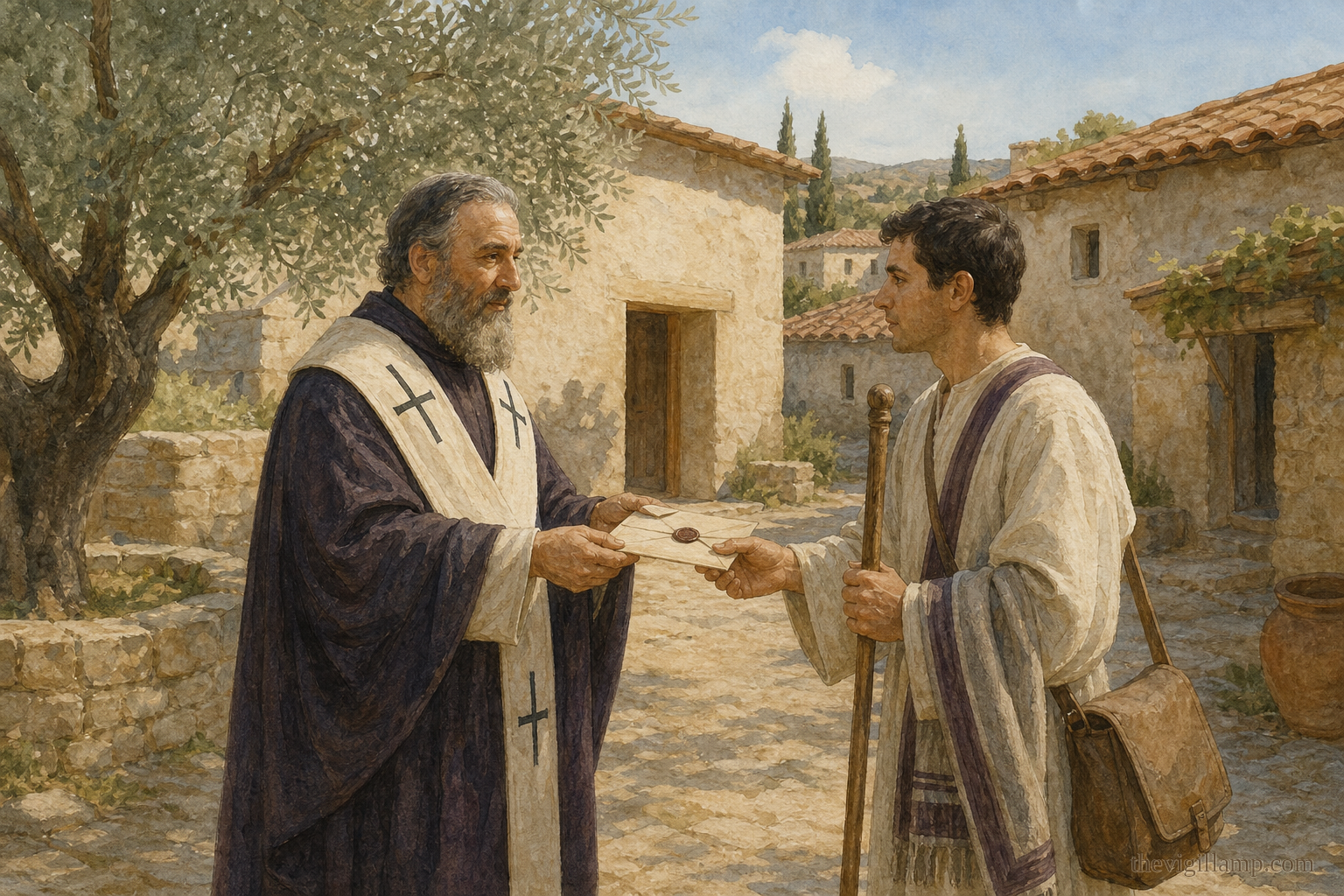
Anthimus in a village near Nicomedia, sending letters to his flock; Deacon Theophilus setting out with one of them. No extra speech in the scene
One of those letters went with Deacon Theophilus.
The letter was taken, and it was given to the emperor Maximian. They questioned Theophilus. They wanted the village. They wanted the bishop.
Theophilus would not tell them.
He kept the secret, and he gave his life for Christ. The Church remembers a deacon who would rather die than hand over his bishop.
After a while Maximian learned where Saint Anthimus was. He sent a detachment of soldiers to bring him in.
The bishop met them on the way.
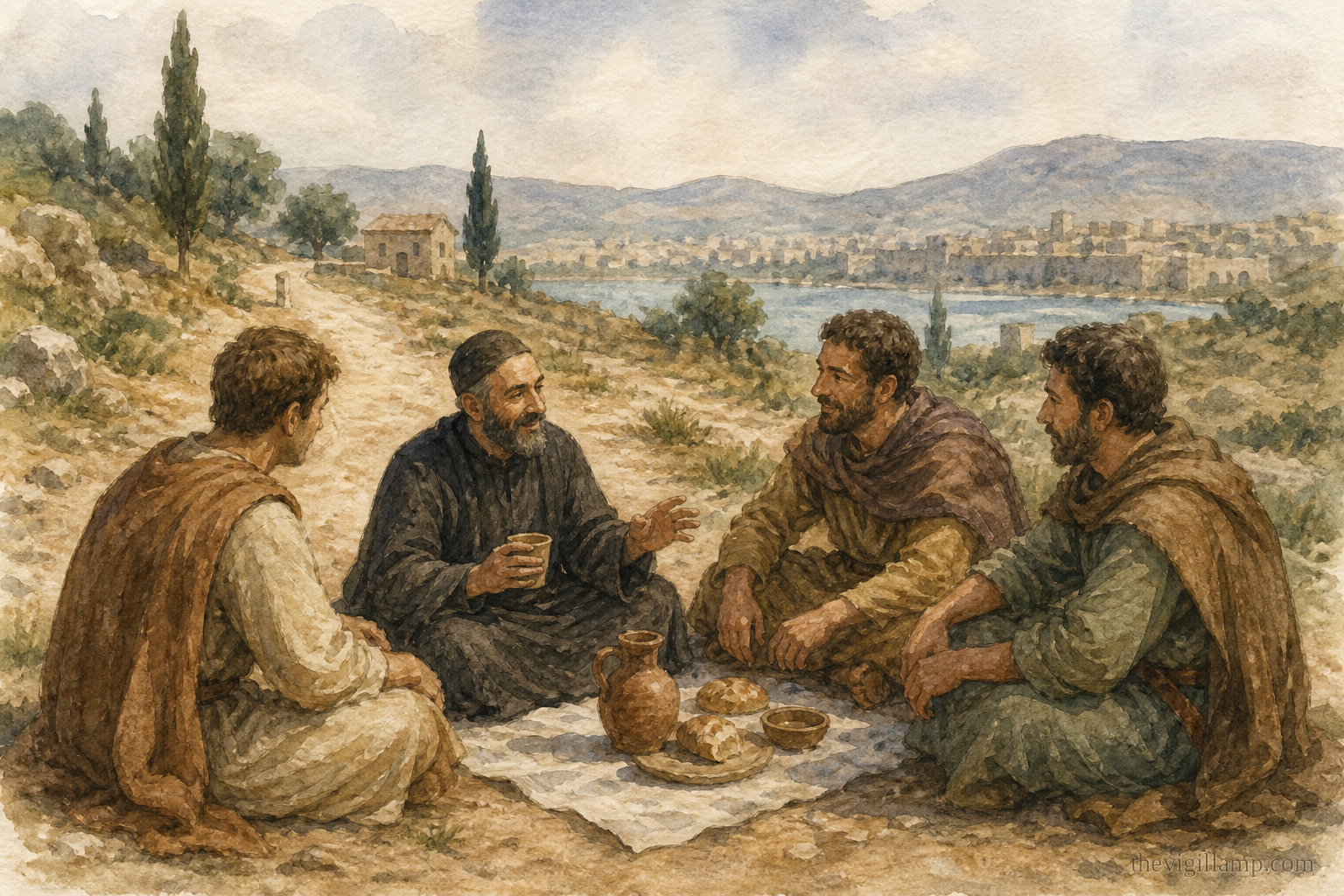
They did not know him. He did not run. He invited them to come with him, and he gave them a meal. Then — after they had eaten at his table — he told them the truth. He was the one they were looking for.
Anthimus meeting the soldiers on the road and sharing a meal with them; they do not yet know who he is. No extra action invented
The soldiers did not know what to do.
They wanted to leave him there. They wanted to go back and tell the emperor they had not found him.
Bishop Anthimus was not one to tolerate a lie. He would not consent to this.
Think about that for a moment. A lie would have been easy. A lie would have looked like kindness. The soldiers were offering him a door. He would not walk through a door made of untruth.
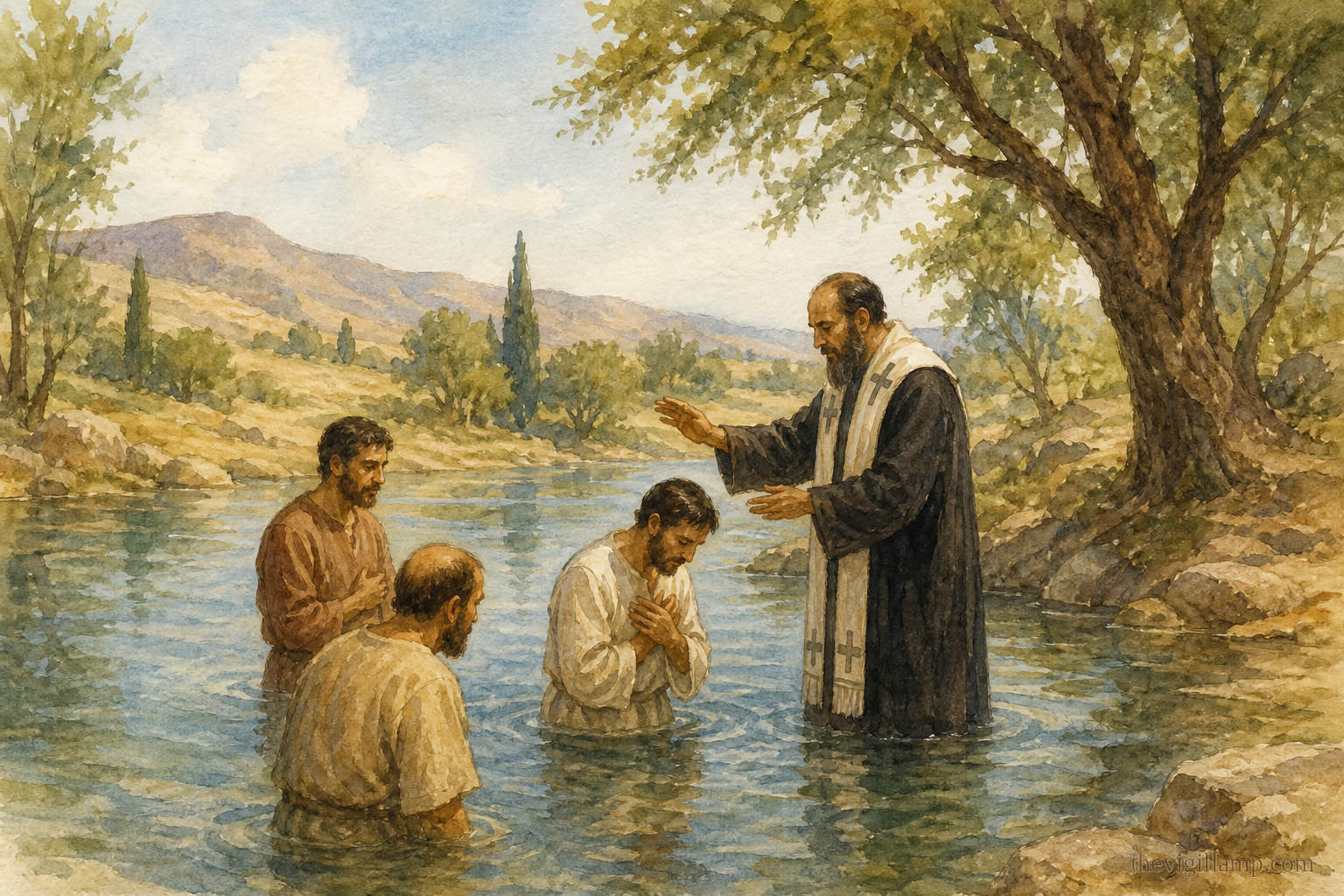
The soldiers came to believe in Christ. They received holy Baptism. And then the saint ordered them to carry out the emperor's instructions. He would not buy his life with a false word, and he would not ask newly baptized men to begin their life in Christ by lying.
The soldiers receiving holy Baptism after Anthimus has told them the truth; no extra speech invented
So they brought him in.
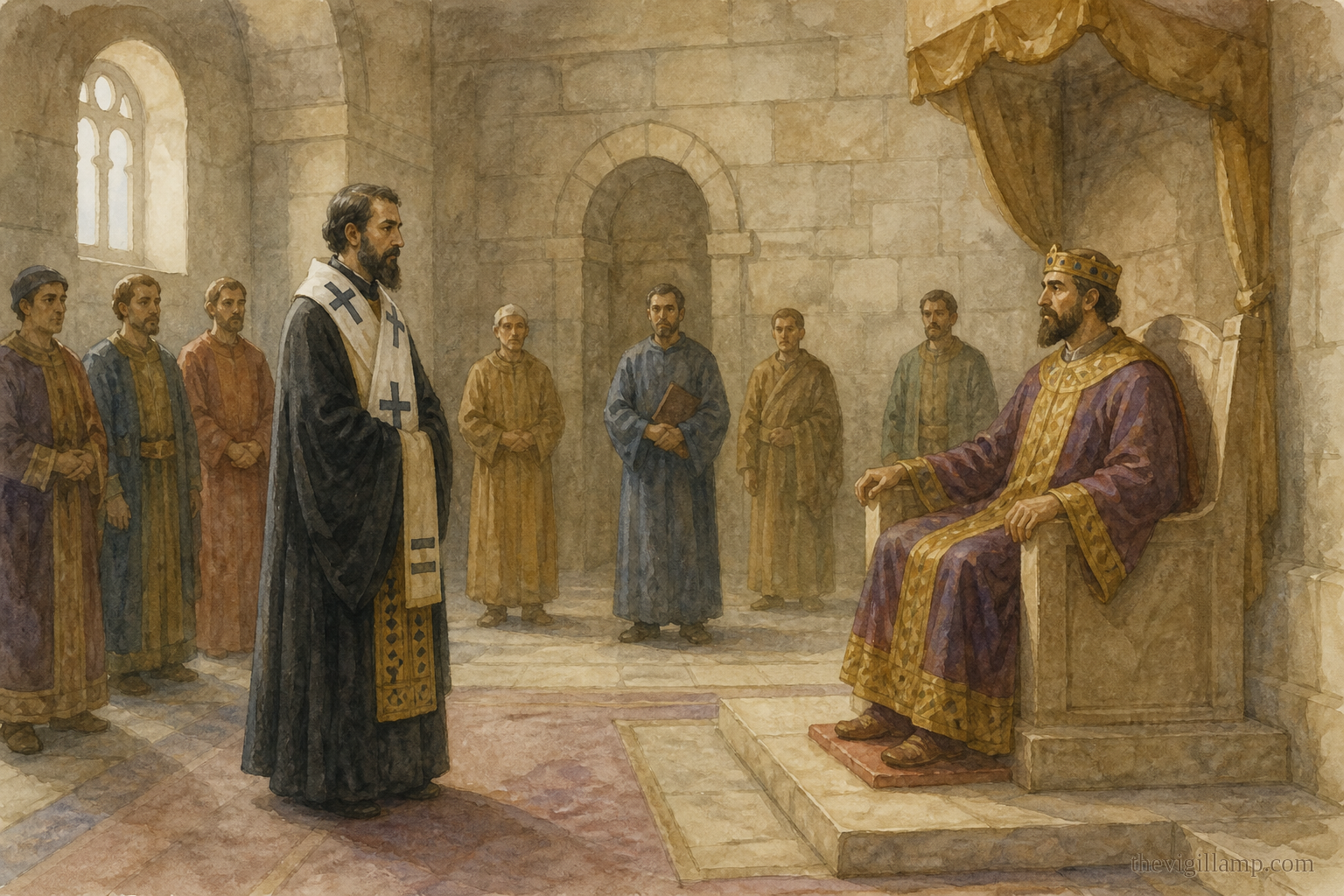
When Bishop Anthimus was set before the emperor, the emperor ordered that the instruments of execution be brought out and placed in front of him. The Church still keeps the words the bishop said then.
"Do you think, emperor, to frighten me with these tools of execution?" asked the saint. "No indeed, you cannot frighten one who wishes to die for Christ! Execution is frightening only for the cowardly, for whom the present life is most precious."
Those are the Church's words. We will not invent others.
Anthimus before the emperor, the tools of execution set out before him; no wounds shown, and no extra speech beyond the Church's own words
The emperor then directed that the saint be put to death by the sword.
Bishop Anthimus joyfully glorified God with his last breath, and received the crown of martyrdom.
He had protected his flock with his blood. He had written to them when he could not stand in their church. He had fed the men sent to take him. He had told the truth when a lie would have been easier. And he had gone to the emperor without hating him.
The word we heard this morning is a weekday word, not a saint's own pair: "if I yet pleased men, I should not be the servant of Christ." Anthimus would not please the emperor with a lie. And the Gospel sends a man home to tell how great things the Lord has done. The bishop's letters were that kind of telling. The soldiers who were baptized became that kind of telling. The Church still says his name, and the names of those with him, so the telling does not stop.
And today, so many hundreds of years later, we say his name once more, out loud, together — Hieromartyr Anthimus, Bishop of Nicomedia — and he is praying for us still.
Movement Five
The Prayer
Troparion of Saint Anthimus · Tone 1
You protected your flock with your blood, not fearing your adversaries. Now you rejoice in heaven standing before the throne. Glory to Christ who has strengthened you; glory to your courage; glory to your endurance, O holy Hieromartyr Anthimus!
Troparion of the Holy Martyrs · Tone 4
Your holy martyrs O Lord, through their sufferings have received incorruptible crowns from You, our God. For having Your strength, they laid low their adversaries, and shattered the powerless boldness of demons. Through their intercessions, save our souls!
Kontakion of Saint Anthimus · Tone 4
Illustrious priest and steadfast martyr, Anthimus, worthy of praise: You assailed the worship of idols, and championed your flock which fervently cries to you: By your prayers deliver us from dangers!
Kontakion of Saint Anthimus · Tone 4
Living honorably as a priest, you completed the course of martyrdom; you extinguished the worship of idols and became a champion of your flock, divinely-wise one. Therefore, we honor you, mystically crying out: “Through your prayers deliver us from calamity, ever-memorable Anthimus.”
The troparia and kontakia appointed by the Orthodox Church in America on the September 3 page of Hieromartyr Anthimus. Wording is exact; slash marks were converted to line breaks only.
Movement Six
Let's Talk About It Together
Talk about it:
Anthimus would not let the soldiers tell a lie to save him. When is telling the truth the hard, good thing in our house?
He hid so he could keep writing to his people, not so he could keep himself safe. What does it mean to take care of someone and still tell them the truth?
The Church reads today, "if I yet pleased men, I should not be the servant of Christ." Who are we trying to please this week — and what would it look like to please Christ first?
Movement Seven
Do This Together
Do this togetherAny time of day
The Honest Table
Set a little table in the middle of the room — bread, or a cup of water, or only the lamp if that is what you have.
One child sits and welcomes the others, the way Anthimus welcomed the men he met on the road. Share the bread, or sit still together. No rushing.
While everyone is quiet, that child says, slowly, the psalm we heard: "The Lord is my light and my Saviour; whom shall I fear?"
Then that child does one small, true thing: tells a hard truth kindly, or writes a short note of courage for someone in the house — "Hold fast. Do not be afraid." Anthimus fed the men first. Then he told them the truth.
Take turns. When everyone has had a turn, sit together and each name one person you want to tell the truth to this week — not a sharp truth meant to win, but a good truth meant to keep them close to Christ. Write the names on a scrap of paper and keep the papers under the lamp until next Sunday.
Little ones (2–4): help them sit at the table and say "do not be afraid" while you count to five. · Make it stick: say the psalm together each night this week — "The Lord is my light and my Saviour; whom shall I fear?"
“Holy Hieromartyr Anthimus, Bishop of Nicomedia, and all who suffered with you, pray to God for us.”
And close, as the Church always closes, with the Lord's Prayer:
Our Father, Who art in heaven, hallowed be Thy Name. Thy Kingdom come, Thy will be done, on earth as it is in heaven. Give us this day our daily bread, and forgive us our trespasses, as we forgive those who trespass against us; and lead us not into temptation, but deliver us from the evil one. Amen.
Do together: Put out the lamp, or leave it burning a while. The lamp keeps watch until tomorrow. "Glory to God for all things. Amen."
A note on our storytellingEvery edition of The Vigil Lamp is an original retelling. The saint is real, and the names, places, events, and directly quoted words in this edition are drawn from the Orthodox Church in America's traditional account of Hieromartyr Anthimus, Bishop of Nicomedia, and those with him, and from the Church's own appointed hymns and weekday readings. The companions are named as the Church names them. No invented historical dialogue is presented as fact. The words of narration are our own, written to make a true story vivid and a joy for families to read aloud together.