remembered together with Venerable Theodosius of the Kiev Far Caves
✦ ✦ ✦
Before you begin
Today's Vigil is for your family, not the other way around. If anything feels like too much, that's okay. Do the parts your family loves, and work your way up to the whole Vigil in one sitting.
Movement One
Light the Lamp
Do together: Light your lamp or a candle. Then say: "Today the Church remembers our Venerable Father Anthony of the Kiev Far Caves, and with him Venerable Theodosius."
We begin the way the Church begins any new work
“O Lord Jesus Christ, the only-begotten Son of the eternal Father, Thou hast said, 'Without me you can do nothing.' In faith I embrace Thy words, O Lord, and bow before Thy goodness. Help me to complete the work I am about to begin for Thine own glory: in the Name of the Father, and of the Son, and of the Holy Spirit. Amen.”
Then all together:
“Through the prayers of our holy fathers, O Lord Jesus Christ our God, have mercy on us.”
The Orthodox prayer before beginning any work, offered for our family and for yours, each time we begin again.
Movement Two
Read the Icon
Before we hear his story, let's look at how the Church shows him, and learn to read what this icon is telling us.
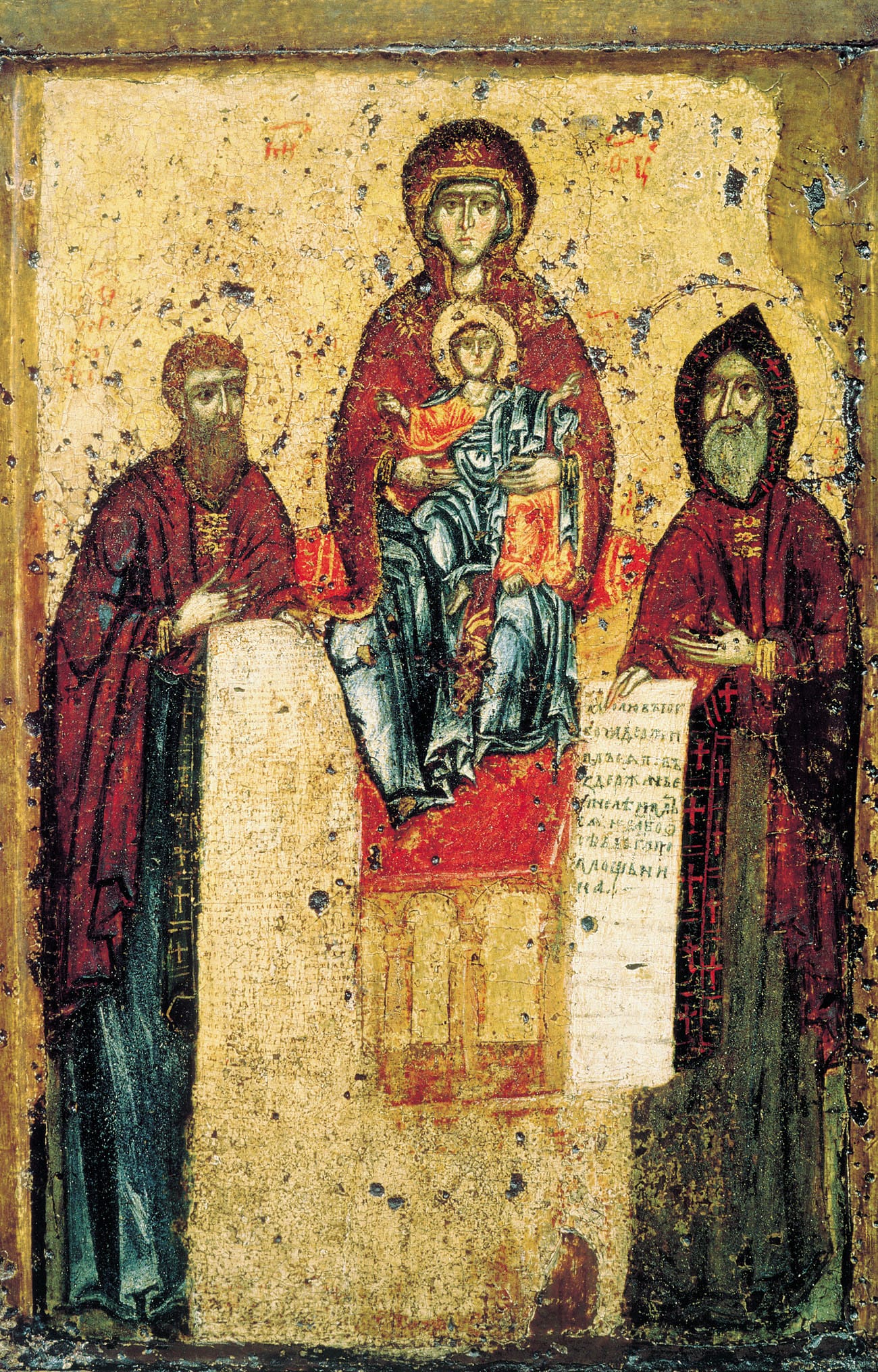
The Mother of God of the Caves (Svenskaya / Pecherskaya), with Venerable Anthony and Venerable Theodosius · last quarter of the thirteenth century · State Tretyakov Gallery
What are we looking at?
An icon isn't a photograph, and it isn't a painting to admire. It's a window. Everything in it is there to teach us something true about the saint.
The gold behind them. It is worn and cracked with age. Not a sky, not a hillside. Heaven's own light. The saints stand where God's light fills everything.
The throne in the middle. The Mother of God is seated, in a dark red-brown veil with a gold edge. A small gold star marks her shoulder. On her lap sits the Child, dressed in pale gold and cool blue-gray. His right hand is raised in blessing. A cross is marked in His halo. The Church does not put Anthony alone at the center of this old panel. She puts him beside the Mother of God, because the house he founded was hers.
Anthony, on our right. Look for the pointed dark hood drawn close around his face. Small red crosses mark the edge of that hood. This is the great monastic covering, the kukol. His beard is long and gray-white. Over a dark robe he wears a reddish-brown mantle, fastened at the chest. A band with crosses lies down the front. In one hand he holds an unrolled white scroll; the other rests near his heart. The letters on the scroll are old and hard to read. We will not invent them.
Theodosius, on our left. His head is bare. His hair and beard are dark. He wears a green inner robe and a deep red mantle, and he too holds a long white scroll. The Church remembers him with Anthony today. We rest our eyes on Anthony, and we do not pretend the other founder is not there.
The worn names. Time has taken most of the painted words. The Tretyakov catalog still reads fragments of Theodosius's name at the left. Anthony is known by the hood and by the Church's memory of this panel. Every icon means to name its saint. Even when the paint is thin, the face and the name belong together.
Anonymous icon painter, The Mother of God of the Caves (Svenskaya / Pecherskaya) with Saints Anthony and Theodosius, last quarter of the thirteenth century (about 1288), egg tempera on limewood, 67 × 42 cm; State Tretyakov Gallery, Moscow, inv. 12723; from the Dormition Svensky Monastery near Bryansk. Public domain. Image via Wikimedia Commons. The seventeenth-century TsAK September Menaion was inspected: for September 2 it shows Martyr Mamas and Saint John the Faster, not Anthony, and is not used. Modern OCA files were not used.
The ReadingsMovement Three
The Scripture the Church appoints for this day. Open your Bible at home and read the passages aloud together, then listen for these words echoing through the saint's story and the rest of your day.
A Psalm to begin · Psalm 26 (27) : 5
“For in the day of mine afflictions he hid me in his tabernacle: he sheltered me in the secret of his tabernacle; he set me up on a rock.”
The Septuagint (Brenton, 1851), the Old Testament of the Orthodox Church. In ordinary English Bibles this is Psalm 27:5. This verse is chosen for prayer today; it is not a separate lectionary appointment.
The Epistle · 2 Corinthians 13 : 3–14
“Finally, brethren, farewell. Be perfect, be of good comfort, be of one mind, live in peace; and the God of love and peace shall be with you.”
Open your Bible and read the full passage together. Text: King James Version (public domain).
The Gospel · Mark 4 : 35–41
“And he arose, and rebuked the wind, and said unto the sea, Peace, be still. And the wind ceased, and there was a great calm.”
Open your Bible and read the full passage together. Text: King James Version (public domain).
These are the weekday readings appointed by the Orthodox Church in America for Wednesday, September 2, 2026. The OCA daily page and the September monthly lectionary list no separate (Saint) pair for Anthony or Theodosius; this edition therefore uses the appointed weekday pair.
Anthony of the Caves · Read aloud
0:00
/518.556735
Movement Four
The Story
The Church remembers more than one Anthony.
There is Anthony the Great of Egypt, the old father of the desert. Today is not his day.
Today she remembers Venerable Anthony of the Kiev Far Caves — a man from the land of Rus who went looking for a quiet life, and then, by obedience, brought that quiet home.
He was born in the year 983, in a place called Liubech, not far from Chernigov. In Baptism they named him Antipas. From the time he was young he had the fear of God. He wanted the monastic clothes — the schema that says, I belong to God now.
When he was grown he wandered until he came to the Holy Mountain, Athos, burning to live as its holy inhabitants lived. There he received the monastic tonsure, and the new name Anthony. The Church says he pleased God in every part of the struggle. He was especially given to humility and obedience, so that all the monks rejoiced to see his life.
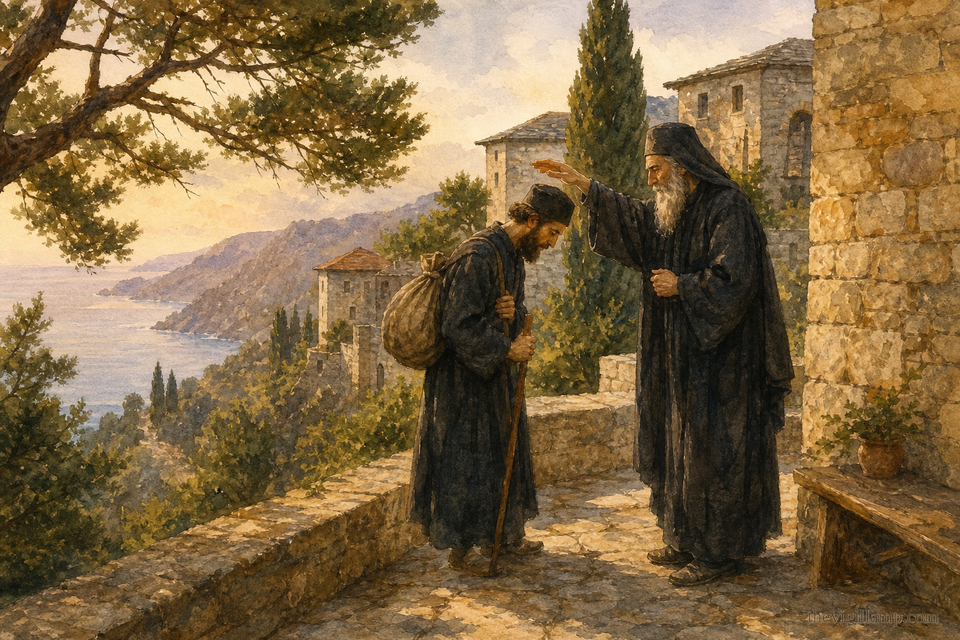
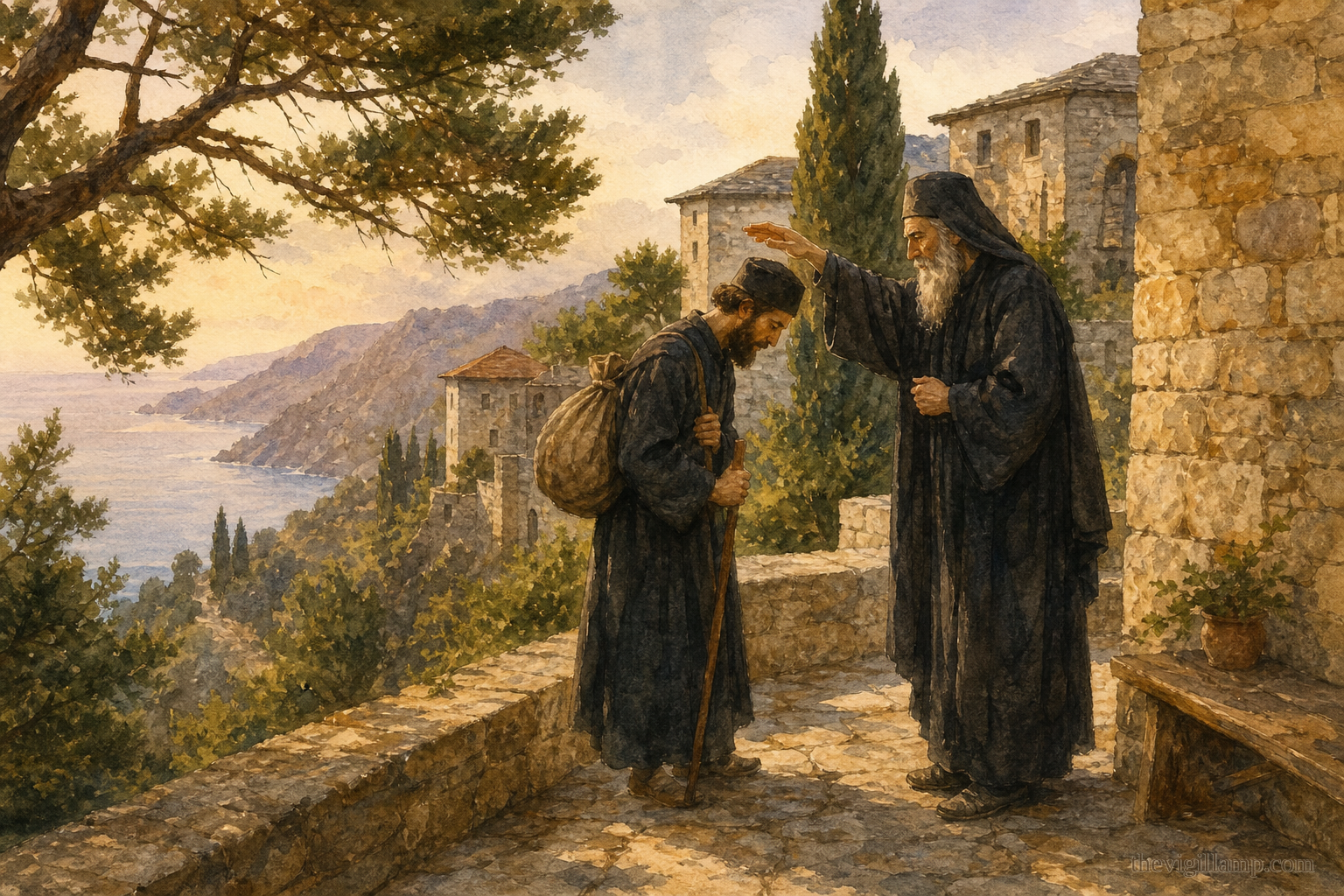
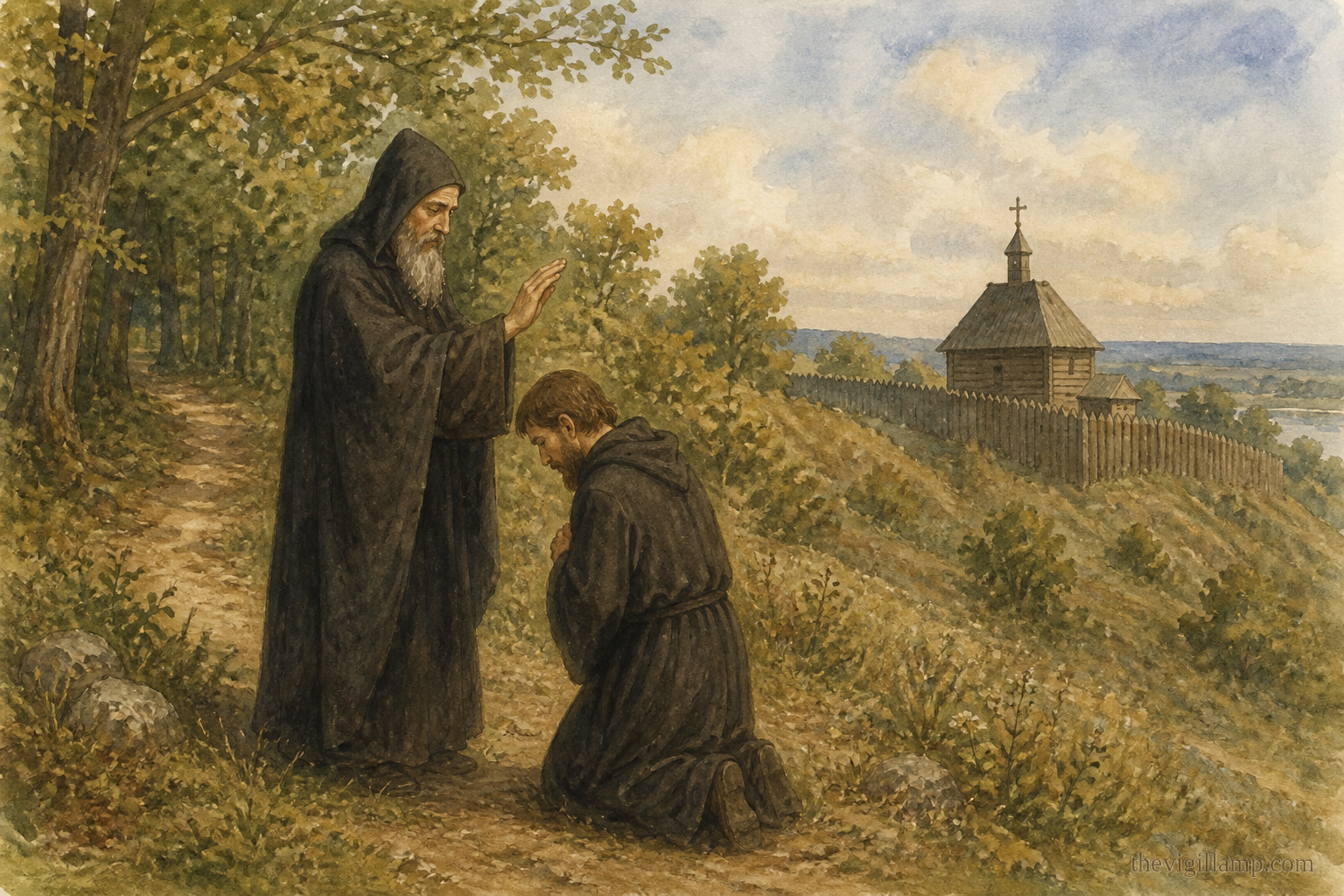
The igumen of that house — the father of the monastery — saw what God meant to do with him. Inspired by God, he sent him back to his own land.
"Anthony," he said, "it is time for you to guide others in holiness. Return to your own Russian land, and be an example for others. May the blessing of the Holy Mountain be with you."
Those are the Church's words. We will not invent others.
The igumen of the Holy Mountain sending Anthony home with Athos's blessing; no extra speech in the scene
So Anthony went home.
He began to make the rounds of the monasteries about Kiev. He was looking for the same strict life that had drawn him to Athos. He did not find it.
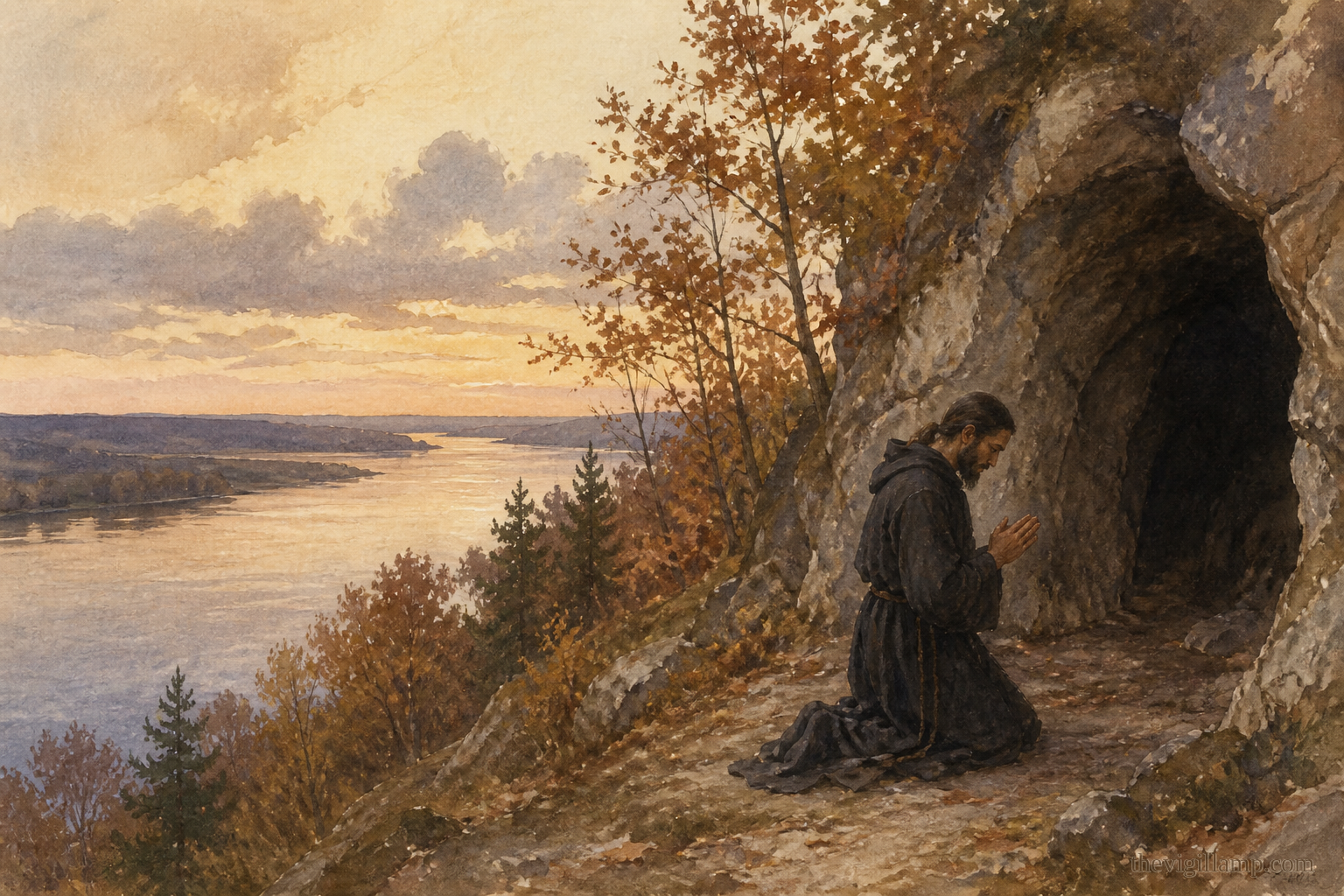
Then, by the Providence of God, he came to the hills of Kiev, by the banks of the River Dnieper. The woods near the village of Berestovo reminded him of the Holy Mountain. There he found a cave that had already been dug by a priest named Hilarion, who later became Metropolitan of Kiev.
Anthony liked the place. He prayed with tears.
"Lord, let the blessing of Mt. Athos be upon this spot, and strengthen me to remain here."
He remained.
Anthony at Hilarion's cave by the Dnieper, praying that the blessing of Athos rest there; no extra action invented
He gave himself to prayer, to keeping watch, and to work with his hands. He ate very little — dry bread and a little water, and not every day. We are not asked to copy the measure of his meals. We are asked to hear what the quiet was for.
People began to come for his blessing and his counsel. Some decided to stay.
Among his first disciples was Saint Nikon. In the year 1032, Nikon tonsured a young man named Theodosius — the same Theodosius the Church remembers with Anthony today. We will not tell Theodosius's whole life this morning. We only say that he came, and that Anthony received him.
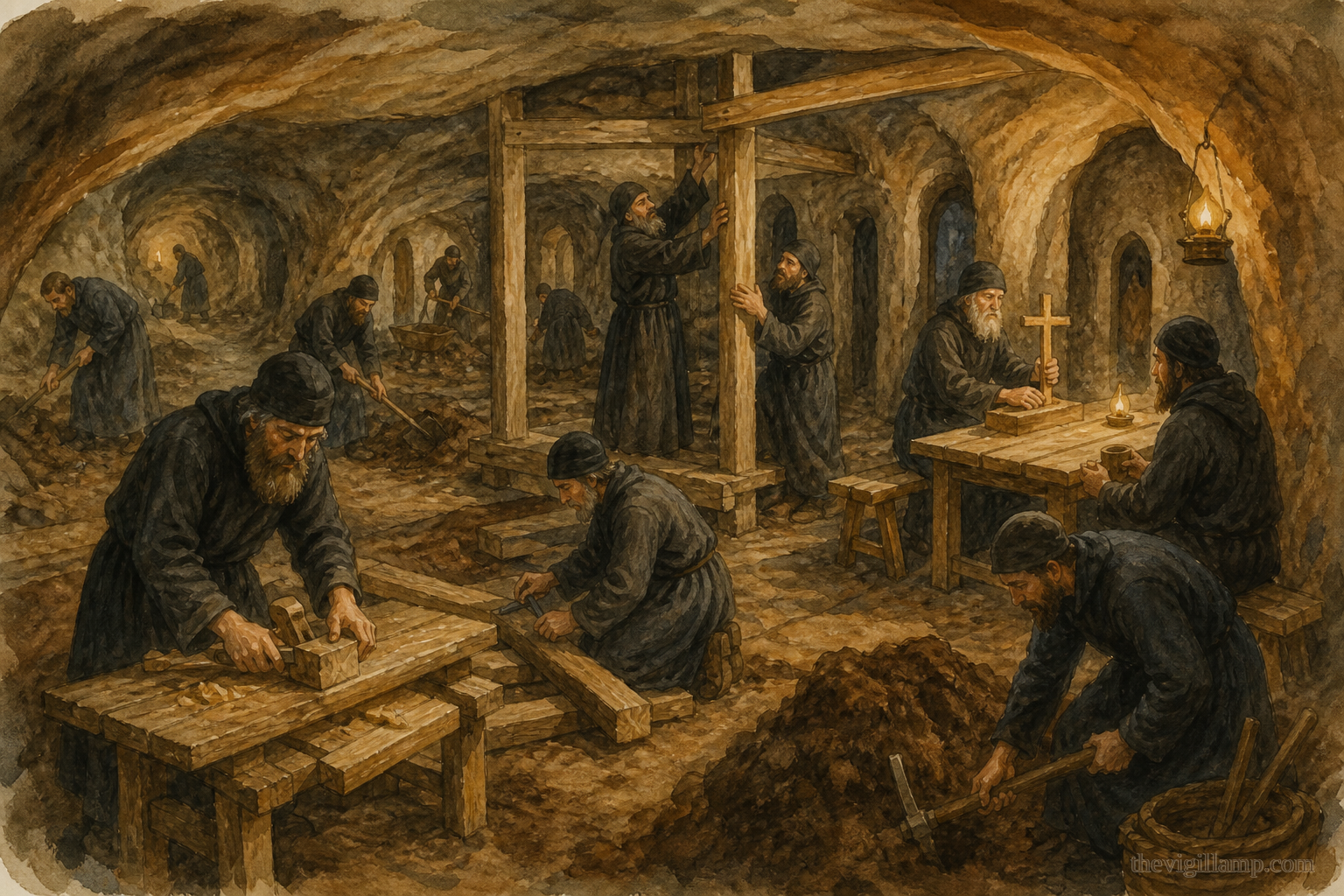
Anthony loved the ones who yearned for the monastic life. He taught them how to follow Christ, and then he asked Nikon to tonsure them. When twelve disciples had gathered, the brethren dug a larger cave, and they built a church and cells inside it.
Twelve brothers making a church and cells in the larger cave; no invented speech
Anthony appointed an abbot named Barlaam to guide them. Then he did what he had come to do in the first place. He withdrew. He dug a new cave for himself, farther on, and hid himself in it. Monks began to settle around him there too. Over those Far Caves he built a small wooden church in honor of the Dormition of the Mother of God.
Prince Izyaslav later sent Barlaam to another monastery. With Anthony's blessing, and with the agreement of the brethren, they chose the meek and humble Theodosius as igumen. By then a hundred men had gathered. The prince gave them the hill. They built a large church and cells, and a palisade all around.
Anthony blessing Theodosius as igumen, then withdrawing toward the Far Caves; no invented speech
That is how the renowned monastery over the caves was established — the Caves Lavra.
The old chronicler said a true thing: many monasteries are built by emperors and nobles, and still they cannot compare with those built by holy prayers and tears, and by keeping watch. Anthony had no gold. He built a house that became the first spiritual center of Rus.
God glorified him with insight, and with wonders. The Church's tradition says that when the Great Church of the Caves was to be built, the Most Holy Theotokos herself provided for it. She stood before Anthony and Theodosius. The OCA life says they were shown in the Blachernae church in Constantinople, though they had not left their own monastery — two angels appeared there in their forms. Master builders came from that city at her command. At that appearing she also told them that Anthony's earthly end was near.
He departed to the Lord on the tenth of July, in the year 1073. Through Divine Providence his relics remain hidden. The Church keeps that July day. She also keeps this day, the second of September, and she says his name together with Theodosius — the one he blessed to guide the brethren.
The word we heard this morning is a weekday word, not a saint's own pair: "Peace, be still." And to the brothers, "be of one mind, live in peace." Anthony left the world's weather. He made a cave in the earth. Then he would not keep the quiet only for himself. He blessed another man to lead, and a whole house of prayer grew on the hill.
And today, so many hundreds of years later, we say his name once more, out loud, together — Venerable Anthony of the Kiev Far Caves — and he is praying for us still.
Movement Five
The Prayer
Troparion of Saint Anthony · Tone 8
By a flood of tears you made the desert fertile, and your longing for God brought forth fruits in abundance. By the radiance of miracles you illumined the whole universe! O our holy father Anthony, pray to Christ our God to save our souls!
Troparion of Saint Anthony · Tone 4
Having departed from worldly tumults, in leaving the world you followed Christ according to the Gospel. You reached the quiet refuge of the Holy Mount Athos, living there a life equal to the angels. Therefore, with the blessing of the Fathers, you came to the Kievan hills. There having fulfilled a life loving of labors, you illumined your homeland. And having shown a multitude of monastics the pathway leading to the heavenly kingdom, you led them to Christ. Beseech him, O Venerable Anthony, that he may save our souls!
Kontakion of Saint Anthony · Tone 8
From your youth you gave yourself to God whom you loved above all, O Venerable One; and in love you followed after him with your whole soul. Scorning the passing corruption of the world, you made a cave in the earth; and in it you struggled nobly facing the snares of the invisible enemy, while illumining the ends of the earth like a bright, shining sun. Therefore, with rejoicing you entered into the heavenly chambers. Standing now before the throne of the Master together with the angels, remember us who honor your holy memory, that we may cry out to you: Rejoice, Anthony our Holy Father!
The first troparion is the hymn printed by the Orthodox Church in America on Anthony's September 2 page. The Tone 4 troparion and the kontakion are the proper texts printed on his July 10 page, the day the OCA life gives as his repose. Wording is exact; slash marks were converted to line breaks only.
Movement Six
Let's Talk About It Together
Talk about it:
Anthony found a cave and asked God to let the blessing of the Holy Mountain rest there. Where is the quiet place in our house — and what would it mean to ask God to bless it?
He could have stayed hidden. Instead he received the men who came, taught them, and blessed Theodosius to lead them. When someone in our family needs a quiet start, how do we help them without taking the work away from them?
The Church reads today, "Peace, be still," and "be of one mind, live in peace." What is one noisy thing we can set down this week, so we can be of one mind at home?
Movement Seven
Do This Together
Do this togetherAny time of day
The Quiet Cave
Make a little cave: a blanket over a table or two chairs. (No blanket? Sit close together and cup your hands around the lamp.)
One child goes into the quiet and says, slowly, Anthony's own prayer: "Lord, let the blessing of the Holy Mountain be upon this spot, and strengthen me to remain here."
While that child stays still, everyone else is quiet. Count slowly to ten. The hard part is not the words. The hard part is remaining.
Then come out, and do one small, real good work right away: clear a plate, help a little brother, say something kind. Anthony went into the cave to pray. He came out far enough to bless the people God sent him.
Take turns. When everyone has had a turn, sit together and each name one person you want to bless this week the way Anthony blessed Theodosius — not by doing their work for them, but by asking God to make them strong. Write the names on a scrap of paper and keep the papers under the lamp until next Sunday.
Little ones (2–4): help them sit still in the "cave" and say "bless this place, Lord" while you count to five. · Make it stick: say the psalm together each night this week — "he sheltered me in the secret of his tabernacle."
“Holy Venerable Father Anthony of the Kiev Far Caves, and Venerable Theodosius, pray to God for us.”
And close, as the Church always closes, with the Lord's Prayer:
Our Father, Who art in heaven, hallowed be Thy Name. Thy Kingdom come, Thy will be done, on earth as it is in heaven. Give us this day our daily bread, and forgive us our trespasses, as we forgive those who trespass against us; and lead us not into temptation, but deliver us from the evil one. Amen.
Do together: Put out the lamp, or leave it burning a while. The lamp keeps watch until tomorrow. "Glory to God for all things. Amen."
A note on our storytellingEvery edition of The Vigil Lamp is an original retelling. The saint is real, and the names, places, events, and directly quoted words in this edition are drawn from the Orthodox Church in America's traditional account of Saint Anthony of the Kiev Caves and from the Church's own appointed hymns and weekday readings. The Blachernae appearing is told as the Church's tradition, without invented detail. No invented historical dialogue is presented as fact. The words of narration are our own, written to make a true story vivid and a joy for families to read aloud together.