August 31 · Placing of the Cincture

Share
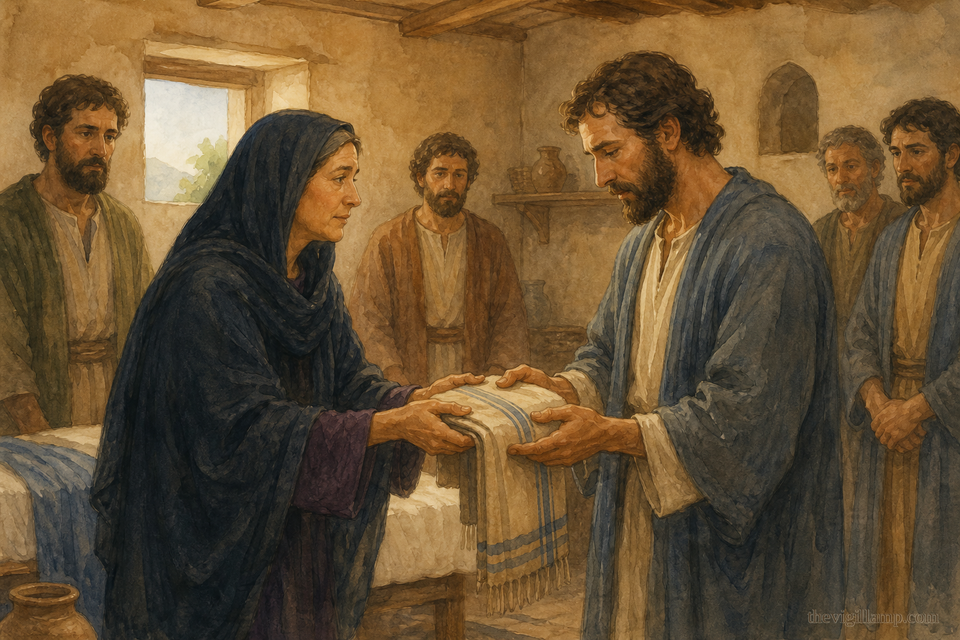
After the Dormition: the Most Holy Theotokos entrusts her sash to the Apostle Thomas; no invented speech in the scene

The Placing of the Cincture (Sash / Belt) of the Most Holy Theotokos

✦ ✦ ✦
Before you begin
Today's Vigil is for your family, not the other way around. If anything feels like too much, that's okay. Do the parts your family loves, and work your way up to the whole Vigil in one sitting.
Movement One
Light the Lamp
Do together: Light your lamp or a candle. Then say: "Today the Church remembers the Placing of the Cincture — the sash, the belt — of the Most Holy Theotokos."
We begin the way the Church begins any new work
“O Lord Jesus Christ, the only-begotten Son of the eternal Father, Thou hast said, 'Without me you can do nothing.' In faith I embrace Thy words, O Lord, and bow before Thy goodness. Help me to complete the work I am about to begin for Thine own glory: in the Name of the Father, and of the Son, and of the Holy Spirit. Amen.”
Then all together:
“Through the prayers of our holy fathers,
O Lord Jesus Christ our God, have mercy on us.”
The Orthodox prayer before beginning any work, offered for our family and for yours, each time we begin again.
Movement Two
Read the Icon
Before we hear today's story, let's look at how the Church shows this feast, and learn to read what the icon is telling us.
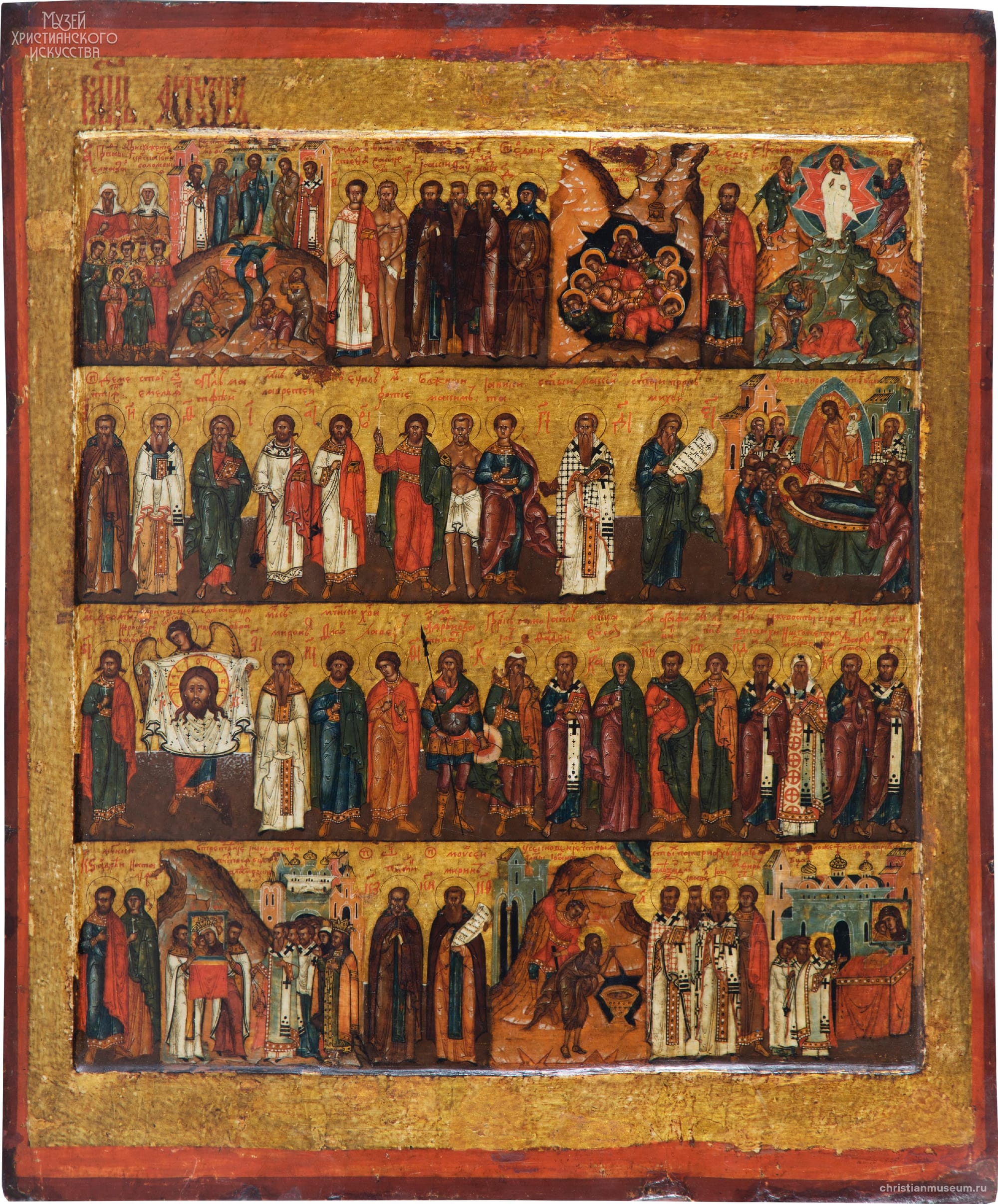
The Placing of the Cincture of the Most Holy Theotokos · detail within an August Menaion icon · Central Russia, first quarter of the seventeenth century · Museum of Christian Art “Church-Archaeological Cabinet”
What are we looking at?
An icon isn't a photograph, and it isn't a painting to admire. It's a window. Everything in it is there to teach us something true about the feast.
The whole month. This is a calendar icon, called a Menaion. Across four long rows, many saints and feasts of August stand together on a gold ground. Their days form one shared procession.
The last scene of August. At the far right of the lowest row, after the Beheading of the Forerunner and the patriarchs of Constantinople, the Church paints today's placing.
The writing. Fine red Church Slavonic letters run above the scene. They name the feast: the Placing of the Precious Belt of the Most Holy Theotokos. Every icon keeps a name joined to a face — or, here, to an hour — so we know which holy thing we are standing before.
The church. Pale walls rise behind the people, with golden onion domes and little crosses. The placing is shown where the Church gathers, not in a storeroom.
The altar. A rectangular holy table is covered with a deep red cloth. This is not a hidden chest. The Church has set the relic where prayer is offered.
The golden coffer. On the altar sits an ornate gold box. The panel does not unwind a long sash for us to admire. It shows the coffer — the Church's way of keeping, and then opening, the holy belt.
The small icon. At the back of the altar stands a smaller icon of the Mother of God holding the Christ Child. The belt is not shown as a souvenir. It is shown under her own face.
The hierarchs. Haloed clergy stand at the left, in white vestments marked with black crosses. The leading bishop has a long white beard and a white omophorion, the shepherd's stole. His hands are raised toward the altar. Other clerics stand with him. The Church is not alone at this hour.
The inscription has already told us which feast this is. We will not guess the bishop's name from the paint, and we will not give the painted church a street name it does not write.
Anonymous Russian icon painter, Menaion: August, first quarter of the seventeenth century, tempera, gesso, and gilding on wood; Museum of Christian Art “Church-Archaeological Cabinet,” inventory MMDA “TsAK” KP-216. Public domain. Image via Wikimedia Commons. A standalone seventeenth-century placing panel already on file was inspected and is not approved: identity and museum provenance could not be independently verified.
The Readings   Movement Three
The Scripture the Church appoints for this day. Open your Bible at home and read the passages aloud together, then listen for these words echoing through the feast's story and the rest of your day.
A Psalm to begin · Psalm 44 (45) : 10
“The queen stood by on thy right hand, clothed in vesture wrought with gold, and arrayed in divers colours.”
The Septuagint (Brenton, 1851), the Old Testament of the Orthodox Church. In ordinary English Bible numbering this is Psalm 45:9. This verse is chosen for prayer today; it is not a separate lectionary appointment.
The Epistle · 2 Corinthians 12 : 10–19
“Therefore I take pleasure in infirmities, in reproaches, in necessities, in persecutions, in distresses for Christ's sake: for when I am weak, then am I strong.”
Open your Bible and read the full passage together. Text: King James Version (public domain).
The Gospel · Mark 4 : 10–23
“And he said unto them, Is a candle brought to be put under a bushel, or under a bed? and not to be set on a candlestick?”
Open your Bible and read the full passage together. Text: King James Version (public domain).
These are the weekday readings appointed by the Orthodox Church in America for Monday, August 31, 2026. The OCA daily page and the August monthly lectionary list this pair only. They do not print a separate Theotokos feast pair for this date. Some other calendars appoint Hebrews 9:1–7 and Luke 10:38–42; 11:27–28 for the sash. This edition carries the OCA pair appointed for the day.
audio-thumbnail
Placing of the Cincture · Read aloud
0:00
/504.868571
Movement Four
The Story

Today is the last day of the Church year.

Tomorrow the Church will begin again. Tonight she does not hurry past the Mother of God in order to start the new work. She stops. She remembers a sash.

Not a crown. Not a throne. A sash — a belt, a cincture — the kind of thing a woman ties about herself when she is at work. The Most Holy Theotokos wore it. The Church has kept it. And on this day she remembers how that holy sash was placed, and placed again, in the house of God.

This is not the feast of her Robe.

In July the Church keeps another placing: the honorable Robe of the Mother of God, laid up at Blachernae by the sea. That is a different holy garment, and a different church. In October she keeps still another day: the Protection, when the Mother of God spread her veil over the people at prayer. That is not this day either. Today the Church is looking at the sash — the belt — and at the hour it was set in its place.

What is a cincture? It is a sash. It is a belt. The Church uses all three names because she is talking about one thing: the girdle of the Mother of God, the band that belonged to her own body.

The Church's tradition is simple, and we will not make it larger than it is.

After her Dormition — after she had fallen asleep in the Lord — the Most Holy Theotokos entrusted her sash to the Apostle Thomas. The OCA life says that plainly: entrusted to Thomas by the Mother of God herself. We will not invent the words she spoke. We will not invent the hour, or the road, or a speech for Thomas. We only say what the Church has said: the sash was given, and it was kept.

Pious Christians kept it at Jerusalem.
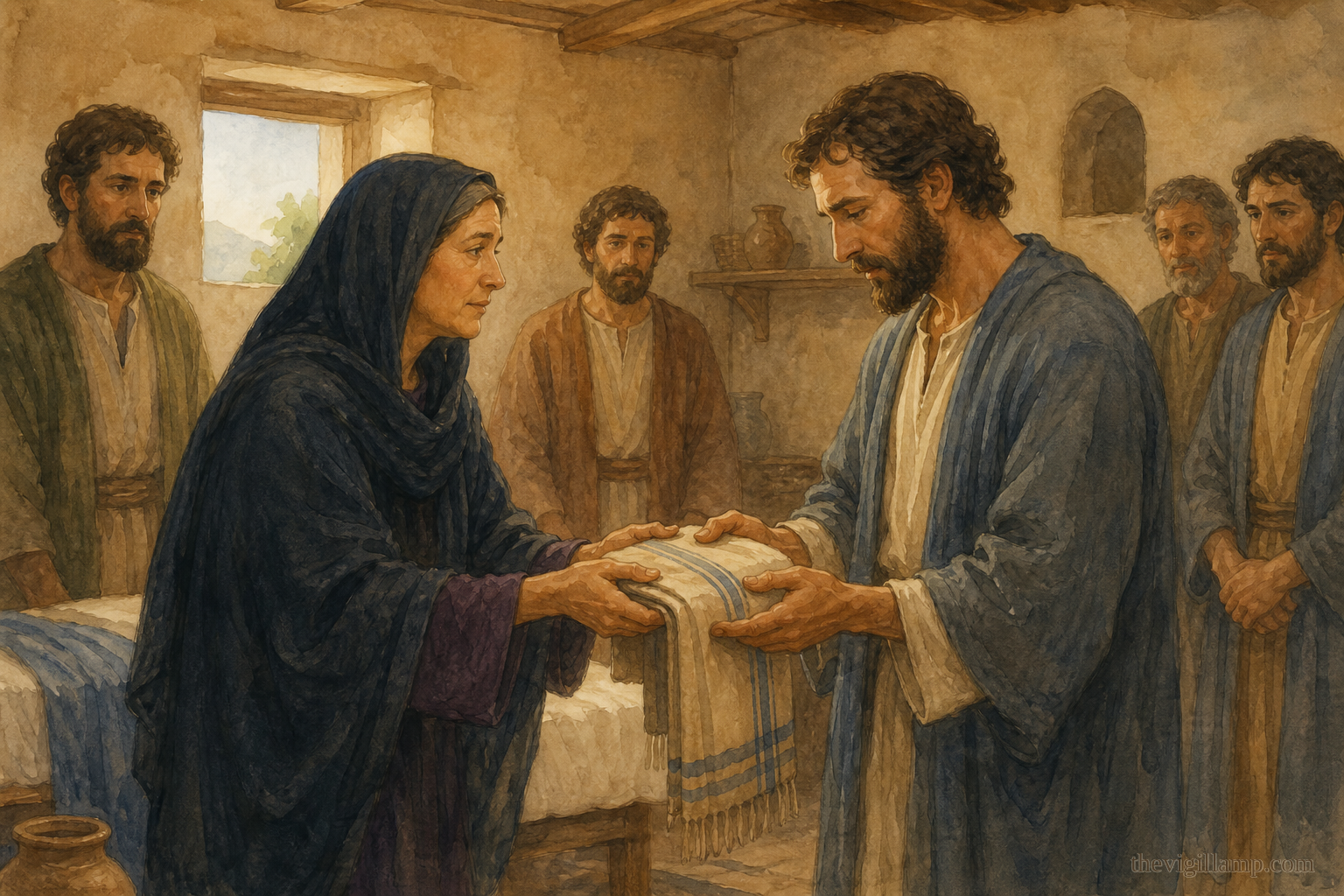
After the Dormition: the Most Holy Theotokos entrusts her sash to the Apostle Thomas; no invented speech in the scene

Years later the holy relic was brought to Constantinople, the city of the emperors, and placed in a church in the Chalcoprateia — the district of the copper-workers, west of the Great Church. The OCA life sets that first placing in the reign of the emperor Theodosius the Younger.

Some of the Church's old books also remember Zela — a diocese in Pontus, near Amasia — as a place where the sash was kept, or found, before it was laid up in the capital. The old books do not all tell that part the same way. We will not invent a journey from town to town. We will only say that the Church has more than one memory of where the sash was guarded, and that the memory she sings today is the placing in Constantinople.

They laid it in a coffer. They sealed it.

Think of that for a moment. A holy thing can be kept so carefully that a whole city almost forgets it is there. The Gospel appointed for this very day asks, "Is a candle brought to be put under a bushel, or under a bed? and not to be set on a candlestick?" The sash was not trash. It was treasure. But treasure that is never opened can become a secret. The Church would not leave it a secret forever.
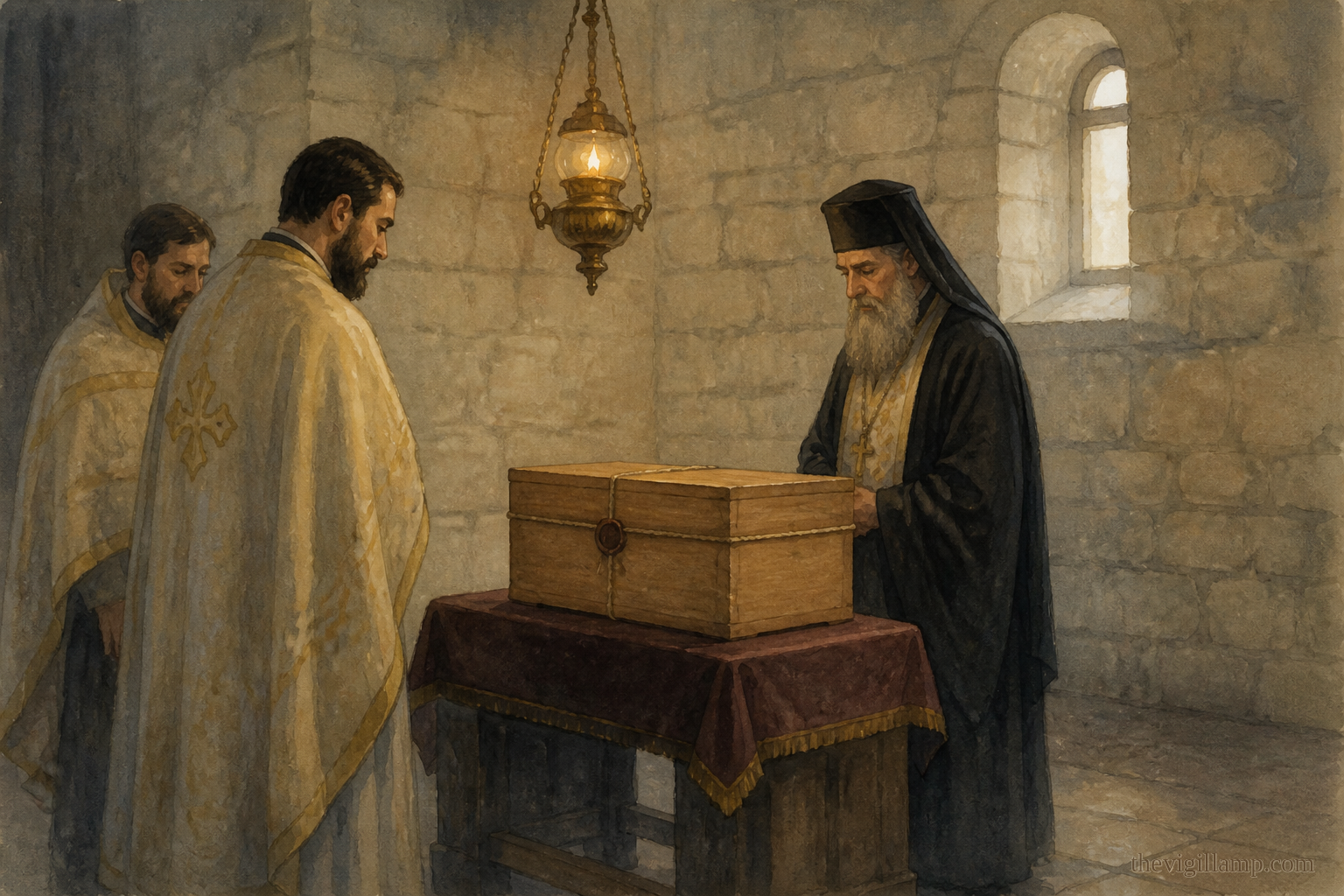
The first placing: the sealed coffer received in the church of the Chalcoprateia; clergy standing by, no invented speech

Then came the second placing.

In the reign of the emperor Leo the Wise — the OCA life gives the years 886 to 911 — his wife Zoe was afflicted with an unclean spirit. The emperor prayed that God would heal her.

The empress had a vision: she would be healed of her infirmity if the Belt of the Mother of God were placed upon her.

We will not invent her words. We will not invent a dream-speech, or a palace conversation. The Church says she was shown what to ask for. The emperor asked the Patriarch to open the coffer.

The Patriarch removed the seal.

He opened the coffer in which the relic was kept.

And the Belt of the Mother of God appeared completely whole, undamaged by time.

That is the sentence the Church wants us to hear. Years had gone over it. Seals had held it. The sash had not fallen to dust. The Mother of God's own girdle was still itself.

The Patriarch placed the Belt on the sick empress.

Immediately she was freed from her infirmity.
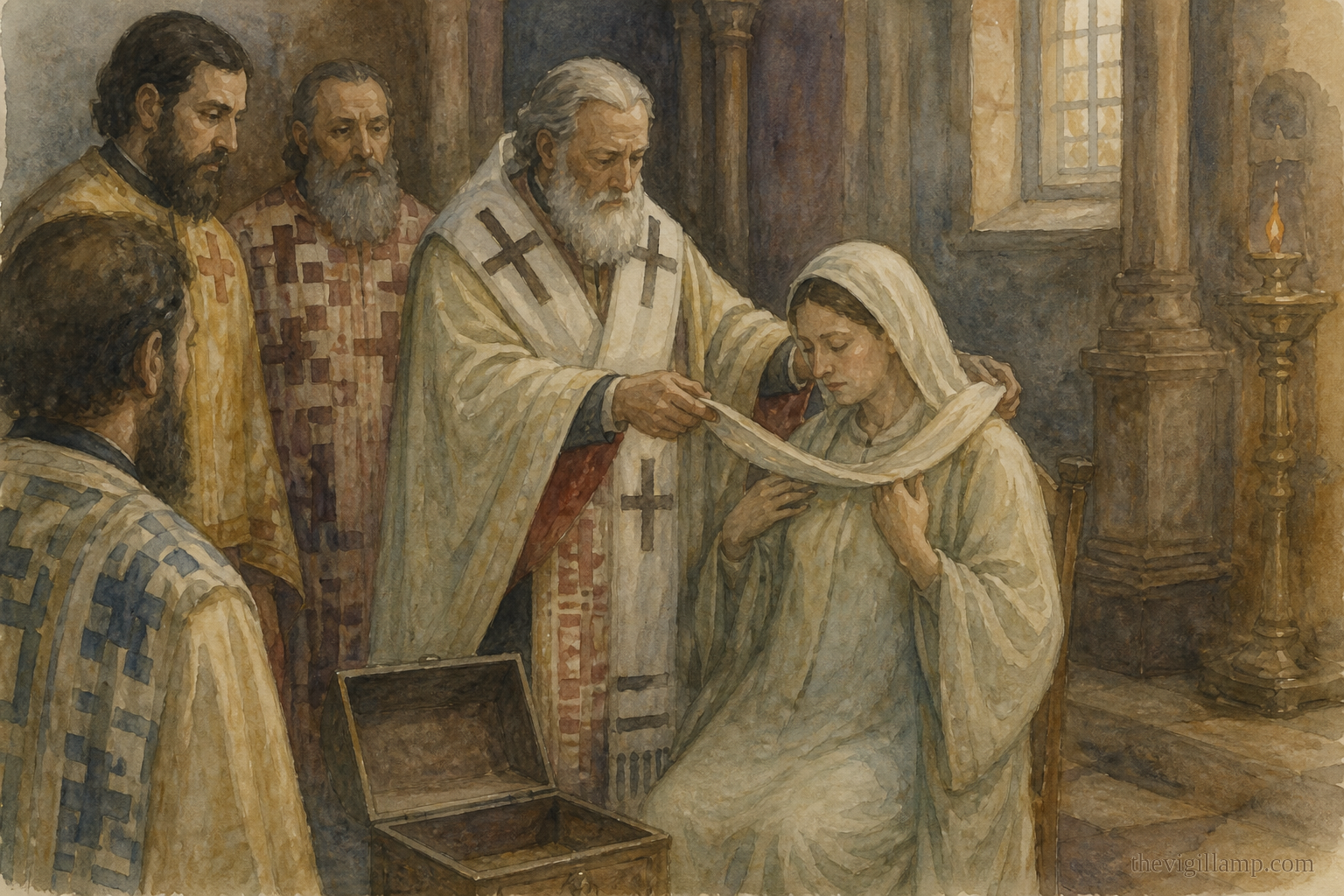
The coffer opened: the belt whole and undamaged; the Patriarch placing it upon Empress Zoe; no invented speech

They sang hymns of thanksgiving to the Most Holy Theotokos.

Then they placed the venerable Belt back into the coffer and resealed it.

The Church did not keep the sash out as a show. She opened it for mercy. She gave thanks. She laid it up again. That is how a holy thing is treated: not as a prize to display, and not as a secret to hide, but as a mercy to be asked for and then kept with honor.

In commemoration of that healing, and of the twofold placing of the venerable Belt, the Feast of the Placing of the Venerable Belt of the Most Holy Theotokos was established. That is why we are here tonight. Not because we have a new story. Because the Church would not let the second opening be forgotten, and she would not let the first placing be lost.

The appointed Epistle sounds like the hour in the coffer. Paul says, "for when I am weak, then am I strong." Zoe was not strong. The emperor's prayer was not a speech that could heal her. The strength was the Mother of God's, and the Lord's. Weakness was the door.

The psalm we read is the Church's old song for the Mother of God: "The queen stood by on thy right hand, clothed in vesture wrought with gold, and arrayed in divers colours." The sash is not the queen. The sash is a sign that the queen was real — that the Mother of God had a body, and clothes, and a life among us, and that God did not let even this small thing of hers be thrown away.

The hymns appointed for this very day tell us what the Church is doing when she keeps a sash.

The troparion calls her Ever-Virgin, protectress of mankind. It says she has given her people a powerful legacy: the robe and sash of her most honored body, which remained incorrupt throughout her seedless childbearing. Through her, time and nature are renewed. Then the hymn asks what we are still asking: "Grant peace to your people and to our souls great mercy."

The kontakion is shorter, and it is enough. "Today your flock celebrates the enshrinement of your precious sash, and it earnestly cries out to you: 'Rejoice, O Virgin, boast of all Christians!'"

That is the cry of the day. Not a history lesson. A greeting.

Hymns of thanksgiving after the healing: the belt returned to the coffer and resealed; the church quiet around it; no invented speech

The OCA life adds one more sentence, and we will add only that. Parts of the holy Belt are in the Vatopedi monastery on Mount Athos, in Trier monastery, and in Georgia. We will not make a travelogue of how each part went. The old accounts of those later translations do not all agree, and this feast is not a map. It is a placing. The Church still knows where the sash is honored. That is enough.

On this same date the Church also remembers other holy people — Cyprian of Carthage, Gennadius of Constantinople, Aidan of Lindisfarne, Eanswythe of Folkestone, and the restoration of a church of the Theotokos at Neorion. We will not tell their lives tonight. We only say that the last day of the year is not empty. The lamp is wide enough for them.

And today, so many hundreds of years later, on the last evening of the Church's year, we say the Mother of God's name once more, out loud, together — Most Holy Theotokos — and we remember the sash she left, and she is praying for us still.

The coffer was opened. The sash was whole. The weak were made strong. The year is ending, and the Church's last word is not worry. It is the word the kontakion still teaches a family to say:

Rejoice, O Virgin, boast of all Christians.

Movement Five
The Prayer
Troparion of the Placing of the Cincture · Tone 8
Ever-Virgin Theotokos, protectress of mankind,
you have given your people a powerful legacy:
the robe and sash of your most honored body which remained
incorrupt throughout your seedless childbearing;
for through you time and nature are renewed!
Therefore we implore you: “Grant peace to your people and to our souls great mercy!”
Kontakion of the Placing of the Cincture · Tone 4
Today your flock celebrates the enshrinement of your precious sash,
and it earnestly cries out to you:
“Rejoice, O Virgin, boast of all Christians!”
The troparion and kontakion appointed by the Orthodox Church in America for the Placing of the Cincture on August 31. Text reproduced exactly from the OCA feast hymn page, with line breaks replacing OCA slash marks. The troparion is the shared relic-hymn that also names the robe; the kontakion is the proper text of this day's enshrinement of the sash.
Movement Six
Let's Talk About It Together
Talk about it:
The Church kept the sash in a sealed coffer for a long time, then opened it when someone was in need. What holy things do we keep close in our house — an icon, a cross, a prayer book — and when do we bring them out instead of leaving them unused?
Empress Zoe was not strong, and the healing did not come from a clever speech. When we are weak or frightened, whom do we ask to stand with us, and what do we actually do first?
Today is the last day of the Church year. The kontakion teaches us to say, "Rejoice, O Virgin, boast of all Christians." What do we want to thank the Mother of God for, before the new year begins tomorrow?
Movement Seven
Do This Together
Do this together   Any time of day
The Sealed Coffer
  1. Sit by the lamp. Take a simple ribbon, a cloth strip, or a sash from a robe — nothing fancy.
  2. Fold it and place it in a small box, or cover it with a cloth. Say together, slowly, "Is a candle brought to be put under a bushel?"
  3. Keep a short silence — long enough to count to twenty. Remember the years the coffer was sealed, and the people who did not forget what was inside it.
  4. Open the box together. Look at the ribbon. Then say the kontakion line: "Rejoice, O Virgin, boast of all Christians."
  5. Give each person a scrap of paper. Write one person who needs the Mother of God's help, or one weakness you will not hide from her. Fold the papers and set them under the lamp with the ribbon. Leave them there until next Sunday.
Little ones (2–4): let them fold the ribbon into the box and say, "Rejoice, O Virgin," while you count to five. · Make it stick: say the psalm together each night this week — "the queen stood by on thy right hand."
Movement Eight
Go in Peace
Go in Peace
Say the feast together:
“Most Holy Theotokos,
save us.”
And close, as the Church always closes, with the Lord's Prayer:
Our Father, Who art in heaven, hallowed be Thy Name. Thy Kingdom come, Thy will be done,
on earth as it is in heaven. Give us this day our daily bread,
and forgive us our trespasses, as we forgive those who trespass against us; and lead us not into temptation,
but deliver us from the evil one. Amen.
Do together: Put out the lamp, or leave it burning a while. The lamp keeps watch until tomorrow. "Glory to God for all things. Amen."
A note on our storytellingEvery edition of The Vigil Lamp is an original retelling. The feast is real, and the names, places, events, and directly quoted words in this edition are drawn from the Orthodox Church in America's traditional account of the Placing of the Cincture, from the Church's own appointed hymns and weekday readings, and from the older public synaxaria used only as controls. No invented miracle, speech, biography, or historical dialogue is presented as fact. The words of narration are our own, written to make a true story vivid and a joy for families to read aloud together.