remembered together with Saints John and Paul the New, Patriarchs of Constantinople
✦ ✦ ✦
Before you begin
Today's Vigil is for your family, not the other way around. If anything feels like too much, that's okay. Do the parts your family loves, and work your way up to the whole Vigil in one sitting.
Movement One
Light the Lamp
Do together: Light your lamp or a candle. Then say: "Today the Church remembers Saint Alexander, Patriarch of Constantinople, and with him Saints John and Paul the New."
We begin the way the Church begins any new work
“O Lord Jesus Christ, the only-begotten Son of the eternal Father, Thou hast said, 'Without me you can do nothing.' In faith I embrace Thy words, O Lord, and bow before Thy goodness. Help me to complete the work I am about to begin for Thine own glory: in the Name of the Father, and of the Son, and of the Holy Spirit. Amen.”
Then all together:
“Through the prayers of our holy fathers, O Lord Jesus Christ our God, have mercy on us.”
The Orthodox prayer before beginning any work, offered for our family and for yours, each time we begin again.
Movement Two
Read the Icon
Before we hear his story, let's look at how the Church shows him, and learn to read what this icon is telling us.
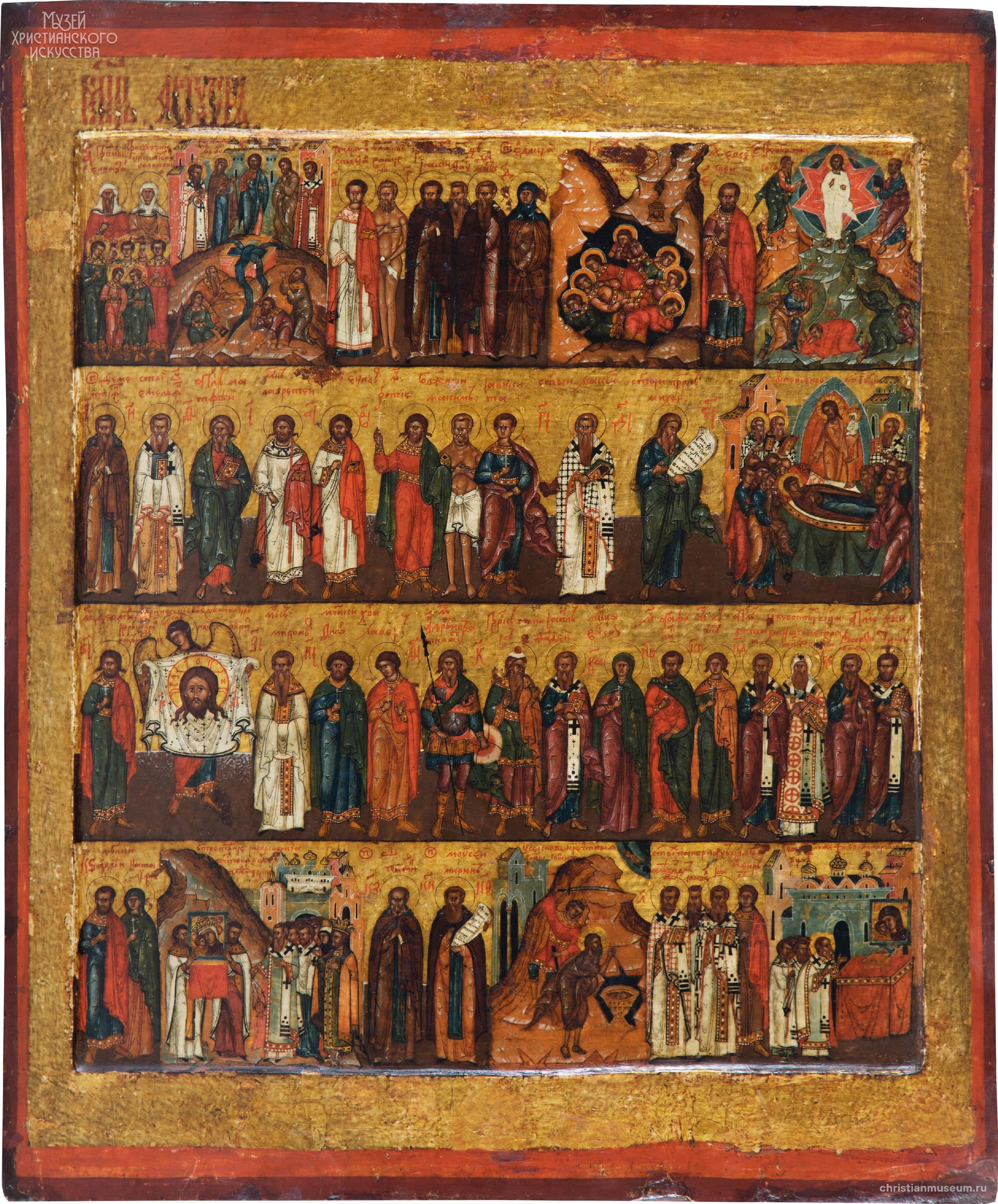
Saints Alexander, John, and Paul the New, Patriarchs of Constantinople · detail within an August Menaion icon · Central Russia, first quarter of the seventeenth century · Museum of Christian Art “Church-Archaeological Cabinet”
What are we looking at?
An icon isn't a photograph, and it isn't a painting to admire. It's a window. Everything in it is there to teach us something true about the saints.
The whole month. This is a calendar icon, called a Menaion. Across four long rows, many saints and feasts of August stand together on a gold ground. Their days form one shared procession.
The late-August group. Near the end of the lowest row, immediately after the scene of the Forerunner's Beheading, a tight group of haloed hierarchs stands frontally on the worn gold.
Alexander. He stands in the left foreground. He has short dark hair and a short dark beard. A white phelonion — the bishop's outer vestment — is marked with a grid of small red-brown crosses. Over his shoulders lies a white omophorion with large black crosses, the shepherd's stole. His right hand is raised in blessing. His left holds a closed, gold-bound Gospel book against his chest. Red letters above him include his name.
The companion at his right. An older bishop stands in the right foreground, with a longer pointed grey-white beard. His white vestment is marked with black crosses, and he too wears a white omophorion with black crosses and holds a gold Gospel book.
The other halo. Between and behind them at least one further haloed head is visible, with a dark beard. The Church remembers Alexander on this day together with Saints John and Paul the New, patriarchs of the same city. The calendar keeps them as one group.
The inscriptions. Fine red liturgical lettering runs above the group. The painted words keep the calendar's people and days joined to their names.
Anonymous Russian icon painter, Menaion: August, first quarter of the seventeenth century, tempera, gesso, and gilding on wood; Museum of Christian Art “Church-Archaeological Cabinet,” inventory MMDA “TsAK” KP-216. Public domain. Image via Wikimedia Commons. The OCA image labeled for this date was inspected: it shows Saint Alexander Nevsky, not this patriarch, and rights are unclear. The 2002 Commons scan of an old OCA lives page is also not approved for reuse.
The ReadingsMovement Three
The Scripture the Church appoints for this day. Open your Bible at home and read the passages aloud together, then listen for these words echoing through the saint's story and the rest of your day.
A Psalm to begin · Psalm 131 (132) : 9
“Thy priests shall clothe themselves with righteousness; and thy saints shall exult.”
The Septuagint (Brenton, 1851), the Old Testament of the Orthodox Church. In ordinary English Bibles this is Psalm 132:9. This verse is chosen for prayer today; it is not a separate lectionary appointment.
The Epistle · 1 Corinthians 16 : 13–24
“Watch ye, stand fast in the faith, quit you like men, be strong.”
Open your Bible and read the full passage together. Text: King James Version (public domain).
The Gospel · Matthew 21 : 33–42
“The stone which the builders rejected, the same is become the head of the corner: this is the Lord's doing, and it is marvellous in our eyes.”
Open your Bible and read the full passage together. Text: King James Version (public domain).
These are the Sunday readings appointed by the Orthodox Church in America for the Thirteenth Sunday after Pentecost, August 30, 2026. The OCA daily and August monthly lectionaries list no separate (Saint) pair for the patriarchs; this edition therefore uses the appointed Sunday pair. The 2nd Matins Gospel (Mark 16:1–8) belongs to the Sunday cycle and is not printed as the family pair.
Alexander of Constantinople · Read aloud
0:00
/526.315102
Movement Four
The Story
The Church has a memory for shepherds who would not let a true word slip.
We have just heard the Sunday word: “Watch ye, stand fast in the faith.” That is not a decoration hung on this life. It is the shape of it.
Today she remembers Saint Alexander, Patriarch of Constantinople. He lived in the years when the city by the water was still learning its new name — Byzantium become Constantinople, the emperor Constantine's city — and when the Church had to say, out loud, who the Son of God is.
The first patriarch there was an old man named Metrophanes. Alexander was his vicar: a bishop at the old man's side, doing the work the aged patriarch could no longer travel to do.
In the year 325 the First Ecumenical Synod gathered at Nicaea. Metrophanes was too old to go. He sent Alexander in his place.
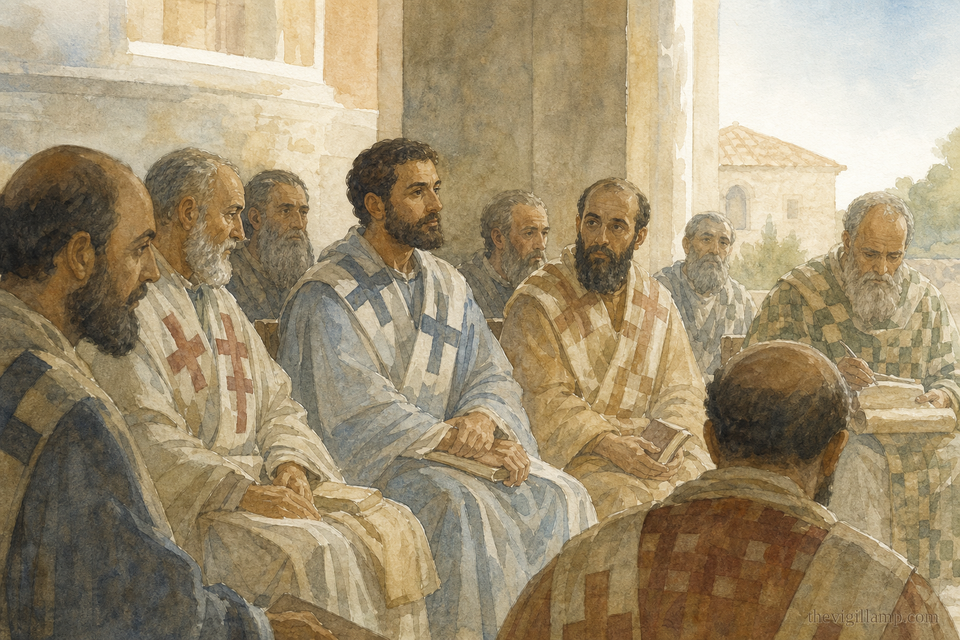
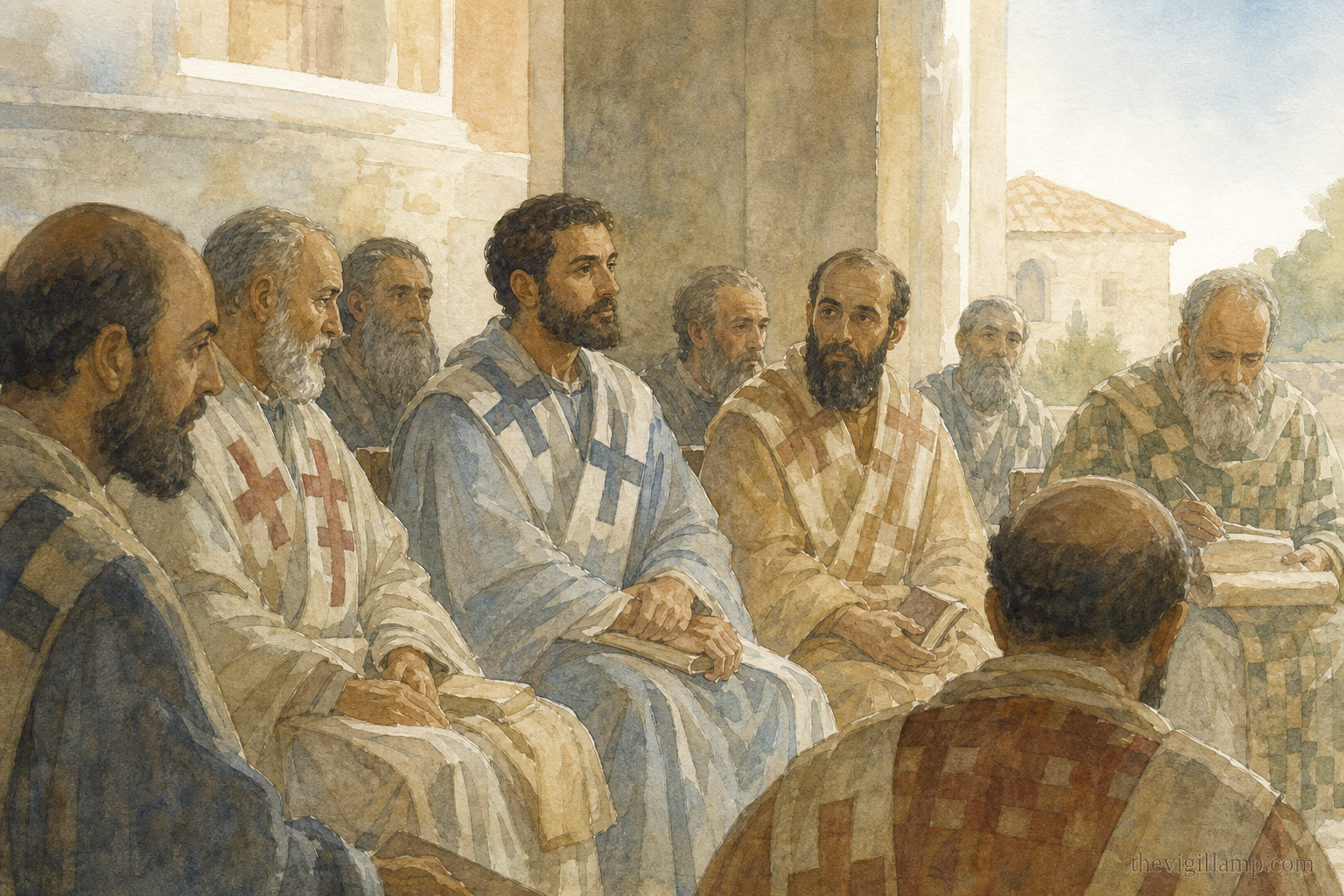
Alexander among the Fathers at Nicaea, sent in the aged Metrophanes's place; no invented speech in the scene
A priest named Arius had been teaching that the Son of God was a creature — great, but made. The Fathers would not let that word stand. They confessed that the Son is true God, of one essence with the Father. The OCA life does not give us Alexander's speeches at that council, and we will not invent them. We only say what the Church says: he was there, standing in Metrophanes's place, and he stood with the faith of Nicaea.
When the council was ending, the emperor and the holy Fathers went to see the ailing patriarch. Constantine asked Metrophanes to name a successor. He named Alexander. He left it in his will: elect my vicar. Then Metrophanes departed to the Lord.
So the throne of Constantinople was set in Alexander's hands.
The work waiting for him was not quiet. He had to contend with the Arians, who still wanted their teaching received, and with pagans, who still wanted the old gods.
Once, in a dispute with a pagan philosopher, the saint said to him, "In the Name of our Lord Jesus Christ I command you to be quiet!"
And the man suddenly could not speak.
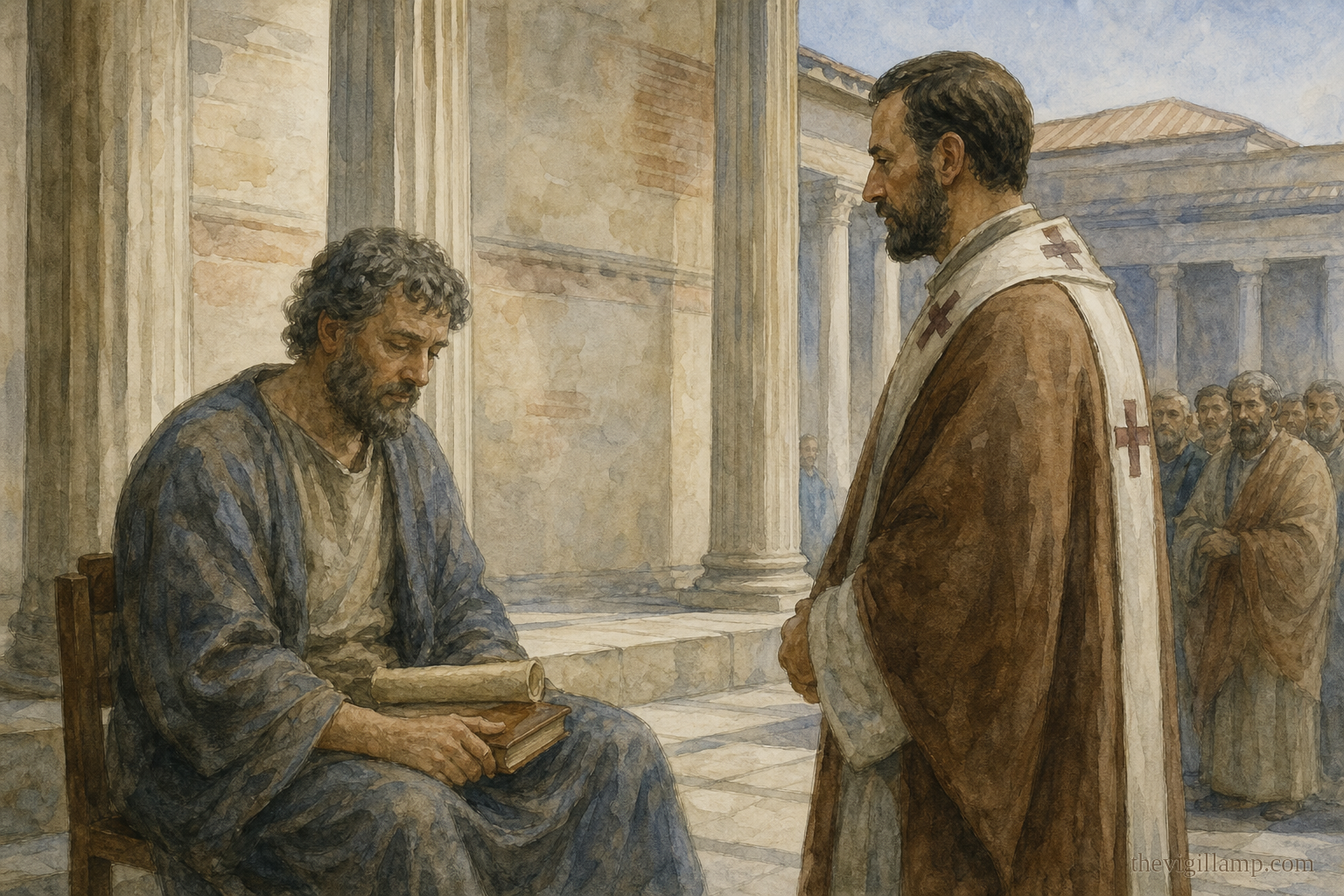
The pagan philosopher falling silent at the Name of Christ; Alexander standing still before him; no extra action invented
When the philosopher gestured that he knew he had been wrong, and that the Christian teaching was true, his speech returned. He believed in Christ — and many other pagan philosophers with him. The faithful rejoiced, glorifying God who had given such power to His saint.
The harder fight was still Arius.
Years after Nicaea, Arius appeared to agree to enter into communion with the Orthodox. The emperor asked him if he believed as the Fathers of Nicaea taught. Arius laid his hand upon his breast — and beneath his clothes, the Church's tradition says, he had hidden a paper with his own false creed written on it — and he said, "This is what I believe!"
Saint Constantine, who did not see the deceit, set a day for receiving him into the Church.
Alexander would not do it.
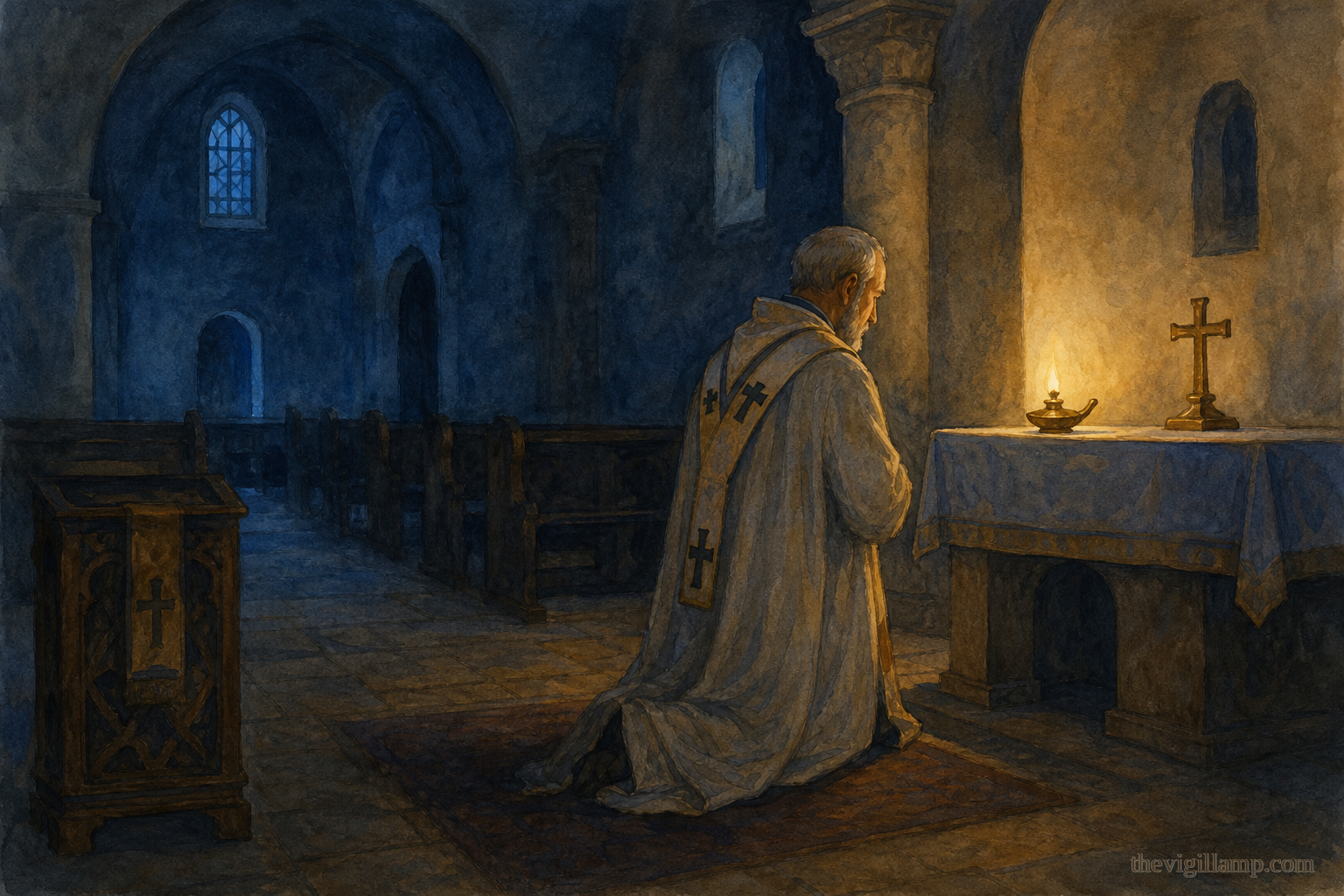
The Church's old historians remember that powerful men pressed him, even with threats. He was less afraid of losing his throne than of watching the faith of Nicaea be undone. So he made God his refuge. All night long he prayed, asking the Lord not to permit this heretic to be received into communion with the Church. They remember that he shut himself up in the church called Irene — the church of Peace — and poured out his prayer there.
Alexander keeping watch in prayer through the night, the church quiet around him; no invented speech
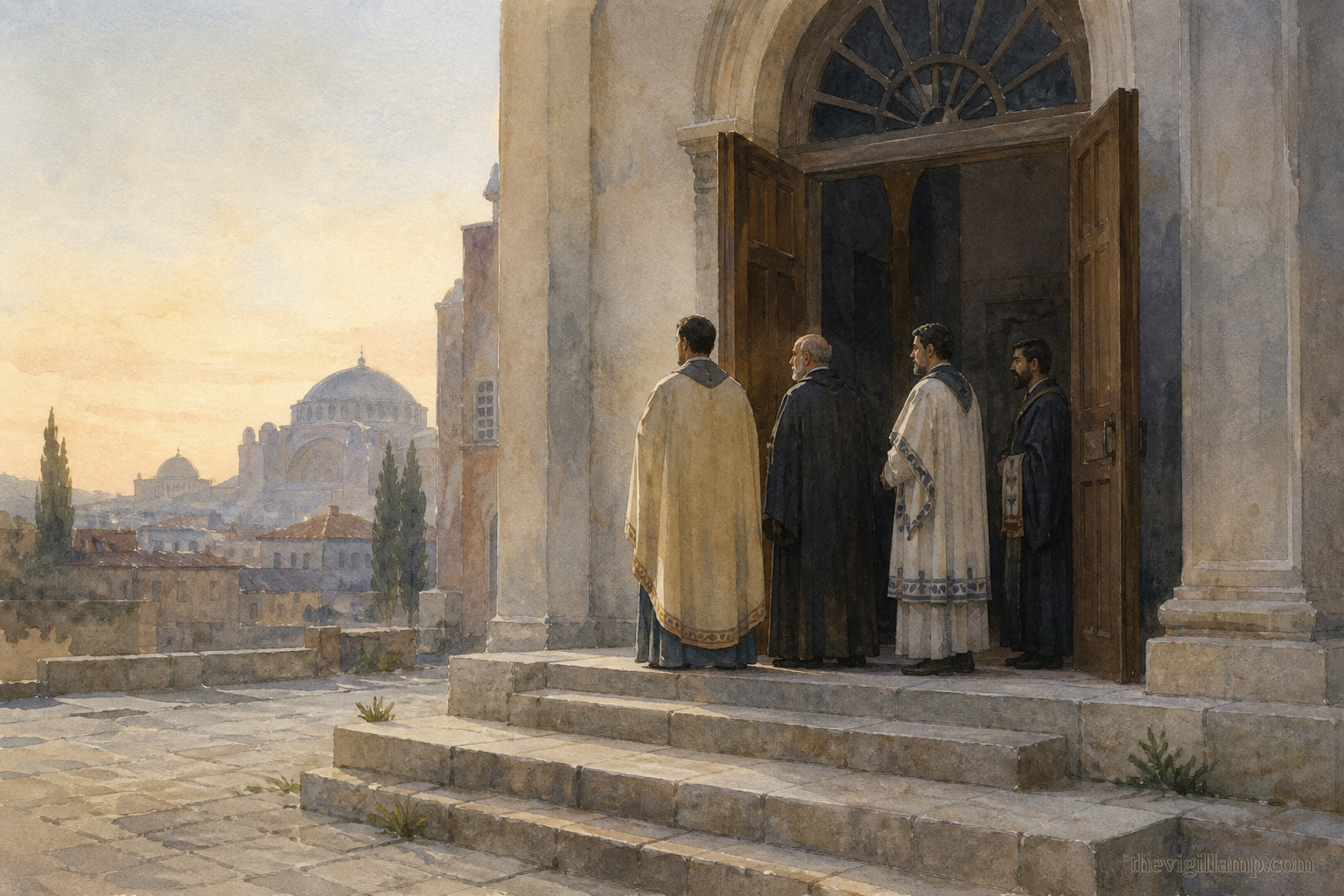
In the morning Arius set out for the church, surrounded by imperial counselors and soldiers.
He did not arrive.
The Church's tradition is plain and grave: divine judgment overtook him on the way. He perished before he could be received. We will not make a spectacle of that hour. We will only say what the Church has always said — that God heard the patriarch's prayer, and the false communion did not take place.
Morning at the church door: the day set for communion, and Arius does not come; no violence shown
Alexander had toiled much. He died in the year 340, at the age of ninety-eight. Saint Gregory the Theologian later mentioned him in an encomium to the people of Constantinople — a word of praise that still joined the city's memory to its old shepherd.
The word the Church reads on this Sunday sounds like his whole life: "Watch ye, stand fast in the faith, quit you like men, be strong."
His own hymn calls him a light upon the lampstand, a faithful steward, a pillar of Orthodoxy. He did not keep that light by winning an argument in a palace. He kept it by staying awake and asking God to guard what is true.
Today the Church remembers him together with two other patriarchs of that same city, who also had to stand when the teaching was under pressure. Saint John the Faster taught the Church how to receive a secret confession with mercy. Saint Paul the New, after a timid silence in the years of the broken icons, left the throne rather than go on failing the flock, and asked for a council to set the Church right. We will not tell their full lives this morning. We only say their names beside Alexander's, because the Church says them together.
And today, so many hundreds of years later, we say his name once more, out loud, together — Holy Father Alexander, Patriarch of Constantinople — and he is praying for us still.
Movement Five
The Prayer
Troparion of Saints Alexander, John, and Paul · Tone 4
O God of our Fathers, always act with kindness towards us; take not Your mercy from us, but guide our lives in peace through the prayers of the Patriarchs Alexander, John, and Paul.
Troparion of Saint Alexander · Tone 4
Christ, the God over all, has appointed you as a venerable shepherd of His Church, O Godly-wise Alexander, a light upon the lampstand, a faithful steward, and the most holy example of a pillar of Orthodoxy. Therefore, we keep festival in your memory.
Kontakion of Saints Alexander, John, and Paul · Tone 8
Set aflame by the love of Christ, O glorious ones, you took up the yoke of His precious Cross revealing yourselves as followers in His footsteps by your way of life, and you became partakers of His divine glory, divinely-wise Alexander, with wonderful John and glorious Paul. As you stand before His throne, earnestly pray for our souls.
Kontakion of Saint Alexander · Tone 8
With your flock, as one who was delivered from the ungodly, I bring tokens of victory and thanksgiving to you, O invincible valiant hierarch, for you overcame the foolish Arius, and silenced the arrogant philosopher. Therefore, I say to you: Rejoice, thrice-happy Father.
The troparia and kontakia appointed by the Orthodox Church in America for August 30. The first pair is the hymn of the three patriarchs together. The second pair is the proper text given on Saint Alexander's own page. Wording is exact; slash marks were converted to line breaks only.
Movement Six
Let's Talk About It Together
Talk about it:
Alexander could not argue the emperor into keeping the faith, so he spent the night asking God to guard the Church. When a true word is under pressure in our house, what is our first work — more talking, or asking God to keep what is true?
The philosopher fell silent at the Name of Christ, not at a clever speech. When we want to be right at home, what would it look like to trust Christ's Name more than our own argument?
The Church reads today, “Watch ye, stand fast in the faith.” What is one true word about Christ our family will not let slip this week — and how will we keep watch for it?
Movement Seven
Do This Together
Do this togetherAny time of day
The Night Watch
Light the lamp. Sit close enough that everyone can see its small flame.
Say together, slowly, "Watch ye, stand fast in the faith."
Keep a short silence — long enough to count to twenty. Remember the old patriarch awake in the church of Peace, asking God to keep what is true.
Give each person a scrap of paper. Write one true word about Christ your family will not let go: that He is God, that He is with us, that He is good. Fold the papers and set them under the lamp.
End by saying, "Holy Father Alexander, pray to God for us." Leave the papers there until next Sunday.
Little ones (2–4): let them hold a small unlit candle (or a stone) and say, "Jesus is true God," while you count to five. · Make it stick: say the watch-word together each night this week — "Watch ye, stand fast in the faith."
“Holy Father Alexander, Patriarch of Constantinople, and Holy Fathers John and Paul the New, pray to God for us.”
And close, as the Church always closes, with the Lord's Prayer:
Our Father, Who art in heaven, hallowed be Thy Name. Thy Kingdom come, Thy will be done, on earth as it is in heaven. Give us this day our daily bread, and forgive us our trespasses, as we forgive those who trespass against us; and lead us not into temptation, but deliver us from the evil one. Amen.
Do together: Put out the lamp, or leave it burning a while. The lamp keeps watch until tomorrow. "Glory to God for all things. Amen."
A note on our storytellingEvery edition of The Vigil Lamp is an original retelling. The saint is real, and the names, places, events, and directly quoted words in this edition are drawn from the Orthodox Church in America's traditional account of Saint Alexander and from the Church's own appointed hymns and Sunday readings. The prayer and death of Arius are told as the Church's tradition, without invented detail. No invented historical dialogue is presented as fact. The words of narration are our own, written to make a true story vivid and a joy for families to read aloud together.