August 29 · Beheading of the Forerunner

Share
John the Forerunner standing in the wilderness by the Jordan, camel-hair garment and rough mantle, the river and bare hills behind him; no invented speech in the scene

The Beheading of the Holy Glorious Prophet, Forerunner, and Baptist John

✦ ✦ ✦
This is a major commemoration of the Forerunner. The Church also keeps it as a day of strict fasting. Your family should follow the rule of your parish and household, or the blessing of your priest.
Before you begin
Today's Vigil is for your family, not the other way around. If anything feels like too much, that's okay. Do the parts your family loves, and work your way up to the whole Vigil in one sitting.
Movement One
Light the Lamp
Do together: Light your lamp or a candle. Then say: "Today the Church remembers the Beheading of the Holy Glorious Prophet, Forerunner, and Baptist John."
We begin the way the Church begins any new work
“O Lord Jesus Christ, the only-begotten Son of the eternal Father, Thou hast said, 'Without me you can do nothing.' In faith I embrace Thy words, O Lord, and bow before Thy goodness. Help me to complete the work I am about to begin for Thine own glory: in the Name of the Father, and of the Son, and of the Holy Spirit. Amen.”
Then all together:
“Through the prayers of our holy fathers,
O Lord Jesus Christ our God, have mercy on us.”
The Orthodox prayer before beginning any work, offered for our family and for yours, each time we begin again.
Movement Two
Read the Icon
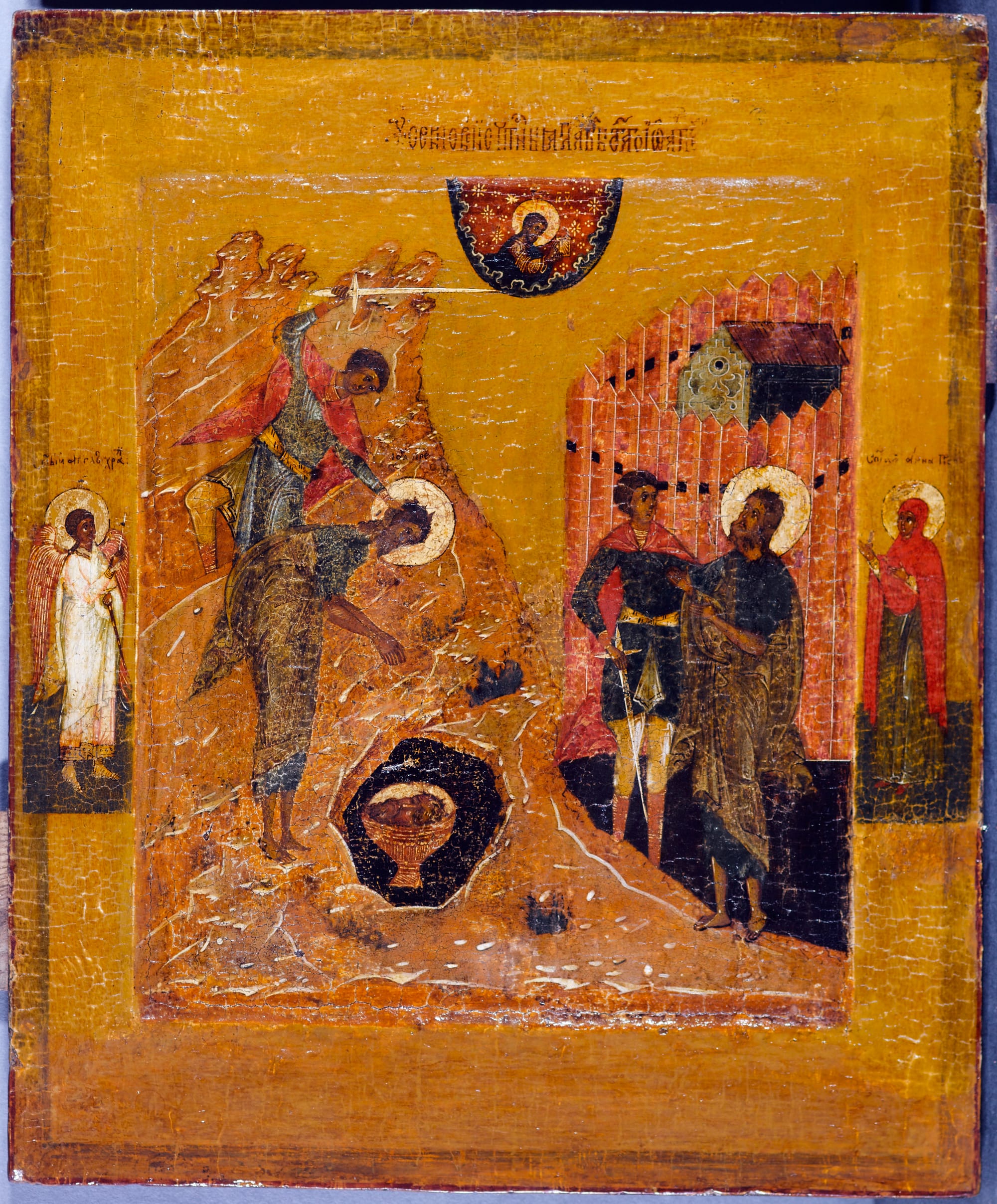
Before we hear his story, let's look at how the Church shows him, and learn to read what this icon is telling us.
The Beheading of Saint John the Forerunner · traditional Moscow-school icon · seventeenth century · Musée des Beaux-Arts de la Ville de Paris (Petit Palais)
What are we looking at?
An icon isn't a photograph, and it isn't a painting to admire. It's a window. Everything in it is there to teach us something true about the saint.
The gold field. Aged and cracked with time, it is still gold. This is not the color of a palace hall. It is the unsetting light of God. The hardest hour of John's life is shown inside that light.
John, twice. The Church does not give us only one moment. On the right he stands near a palisade and a small arched building — the prison. He is still speaking. On the left he bows, haloed, his long hair and beard the wilderness still on him, a dark mantle over his rough garment. He is not struggling away. He is giving himself.
The raised sword. A soldier in a red cloak stands over him. One hand steadies John's head. The other lifts a long straight sword. The icon does not hide the cost of the truth John told. It also does not make a show of wound or blood. The hour is grave. The saint is at prayer.
The dark opening and the vessel. Beneath him a cave-like hollow opens in the earth. Inside it rests a golden vessel, and in the vessel the Church shows the holy head of the Forerunner. The Gospel itself names that vessel. The icon treats it the way the Church treats holy things — quietly, as a witness, not as a spectacle.
The half-circle of heaven. At the top, a dark blue segment is set with small stars. A small blessing figure looks down from that opening. The palace did not have the last word. Heaven saw.
The writing. Fine Church Slavonic letters name the feast and the saint. Every icon keeps a face joined to a name, so we know whose hour we are standing in.
Unknown Moscow-school painter, The Beheading of Saint John the Baptist, seventeenth century, tempera on wood, 31 × 26 cm; Musée des Beaux-Arts de la Ville de Paris (Petit Palais), inventory PPP4917. Public domain (CC0 Paris Musées). Image via Paris Musées / Wikimedia Commons.
The Readings   Movement Three
The Scripture the Church appoints for this day. Open your Bible at home and read the passages aloud together, then listen for these words echoing through the saint's story and the rest of your day.
A Psalm to begin · Psalm 118 (119) : 46
“And I spoke of thy testimonies before kings, and was not ashamed.”
The Septuagint (Brenton, 1851), the Old Testament of the Orthodox Church. In ordinary English Bible numbering this is Psalm 119:46. This verse is chosen for prayer today; it is not a separate lectionary appointment.
The Epistle · Acts 13 : 25–33
“And as John fulfilled his course, he said, Whom think ye that I am? I am not he. But, behold, there cometh one after me, whose shoes of his feet I am not worthy to loose.”
Open your Bible and read the full passage together. Text: King James Version (public domain).
The Gospel · Mark 6 : 14–30
“For Herod feared John, knowing that he was a just man and an holy, and observed him; and when he heard him, he did many things, and heard him gladly.”
Open your Bible and read the full passage together. Text: King James Version (public domain).
These are the Forerunner readings appointed by the Orthodox Church in America for Saturday, August 29, 2026. The OCA daily page labels them Epistle, Forerunner and Gospel, Forerunner; the August monthly lectionary marks the same pair (Forerunner). The ordinary weekday pair for this date is 1 Corinthians 2:6–9 and Matthew 22:15–22. This edition carries the feast pair.
audio-thumbnail
Beheading of the Forerunner · Read aloud
0:00
/556.721633
Movement Four
The Story

There are days the Church sings, and days the Church also weeps. Today is both.

The man we remember is John — the Holy Glorious Prophet, Forerunner, and Baptist of the Lord. He is the last of the old prophets and the first to point with his own hand: There. That is the Lamb of God. He is the voice in the wilderness. He is the one who poured Jordan water over the head of Christ.

The appointed Epistle keeps the word he would not let anyone steal. As he finished his course, John said, “Whom think ye that I am? I am not he. But, behold, there cometh one after me, whose shoes of his feet I am not worthy to loose.”

He would not take the honor that belonged to Another. He would not take a king's lie, either.
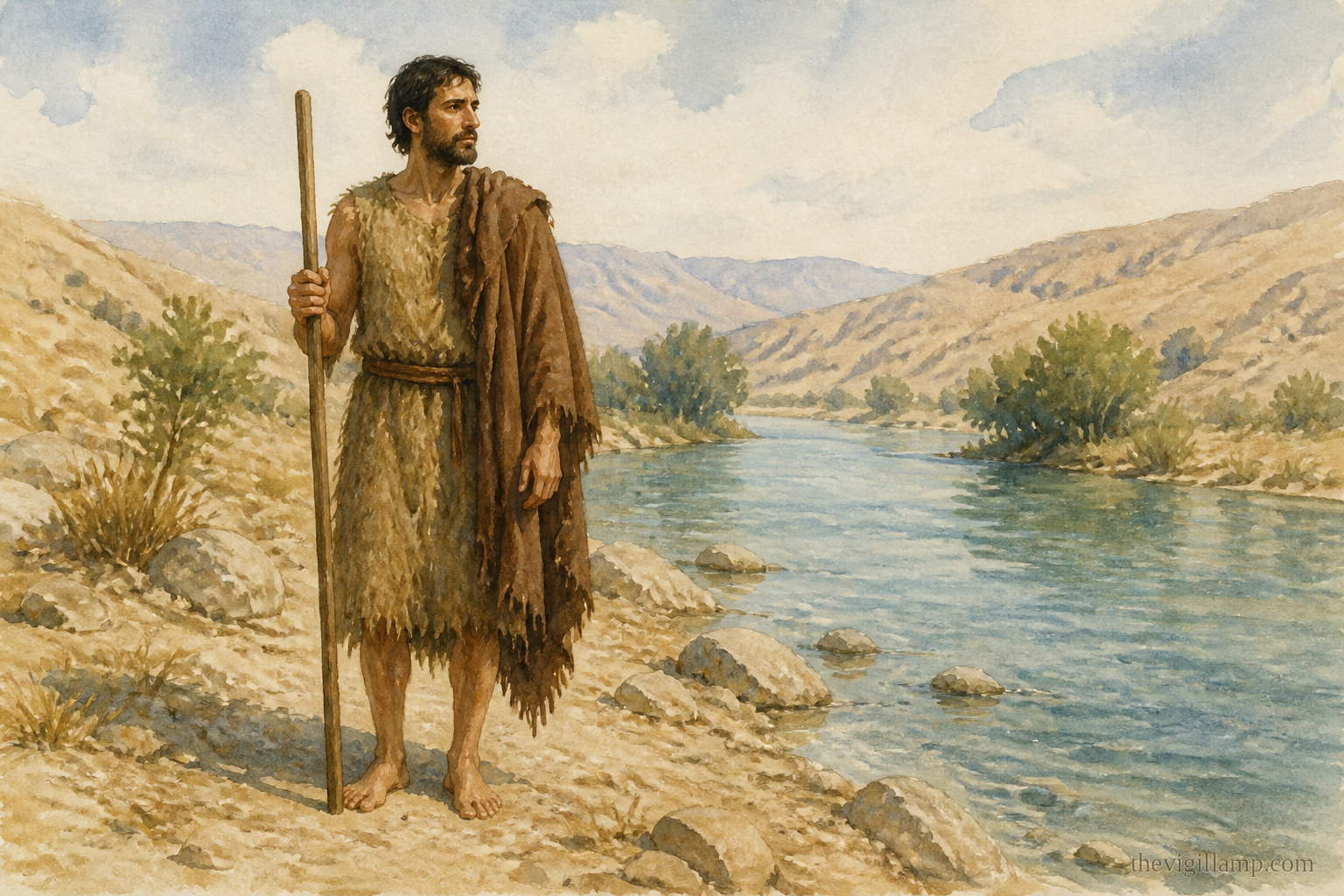
John the Forerunner standing in the wilderness by the Jordan, camel-hair garment and rough mantle, the river and bare hills behind him; no invented speech in the scene

The Church places his martyric end in the year 32 after the Birth of Christ. Matthew and Mark both tell it. After the Baptism of the Lord, Herod Antipas — tetrarch of Galilee, a ruler of one fourth of the Holy Land — locked John in prison.

Why?

Because John told the truth out loud.

Herod had left his lawful wife, the daughter of the Arabian king Aretas, and taken Herodias, the wife of his brother Philip. The Gospel is plain. John said to Herod, “It is not lawful for thee to have thy brother's wife.”

That is not a private whisper. That is a prophet standing in front of a throne.

Herodias held it against him. She wanted him dead. She could not have him killed — not yet. Mark says Herod feared John. He knew John was a just man and a holy man. He observed him; when he heard him, he heard him gladly.

Think of that for a moment. A ruler can enjoy a holy word the way a man enjoys a song, and still refuse to change his life. Herod liked to listen. He did not like to repent.

So John waited in the prison, and the truth waited with him.
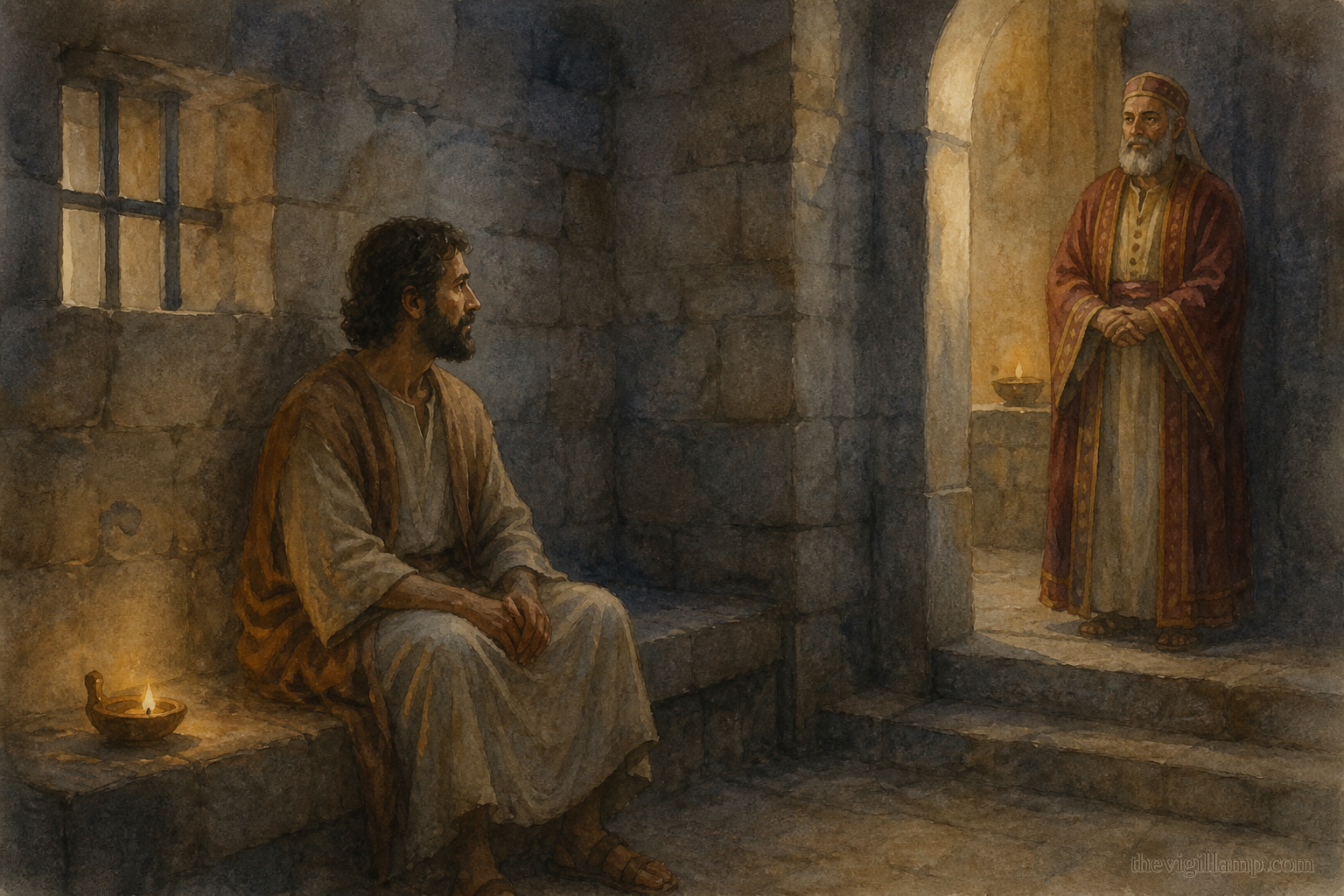
John in the prison speaking quietly while Herod listens at a distance, no chains as spectacle, no invented speech shown

Then came a convenient day.

It was Herod's birthday. He made a feast for his nobles, his captains, and the chief men of Galilee. The OCA life says dignitaries, elders, and a thousand chief citizens were there. Music, honor, wine, the kind of night when a man wants to look large in front of other men.

Herodias's daughter came in and danced, and she pleased Herod and those who sat with him. The Church's tradition names her Salome. The king said to the girl, “Ask of me whatsoever thou wilt, and I will give it thee.” He swore it: whatever she asked, even to the half of his kingdom.

She went out to her mother.

“What shall I ask?”

And Herodias said, “The head of John the Baptist.”

The girl came back in haste. She asked for John's head to be given her at once, on a platter.

The king was exceeding sorry.

Mark wants us to see that. Herod was not glad. He had heard John gladly. He knew what sort of man he was sending for. But he had sworn in front of his guests, and he would not be shamed in his own hall. Because of the oath, and because of those who sat with him, he would not refuse her.

That is how a careless promise and a hard heart can do together what neither might have done alone.

He sent an executioner. John was killed in the prison.

We will say that plainly, and we will not linger over it. The Church does not pretend the death was gentle. She also does not ask a family to stare at cruelty. What she asks us to see is this: a holy man told the truth, and the world that wanted its own way would not bear it.
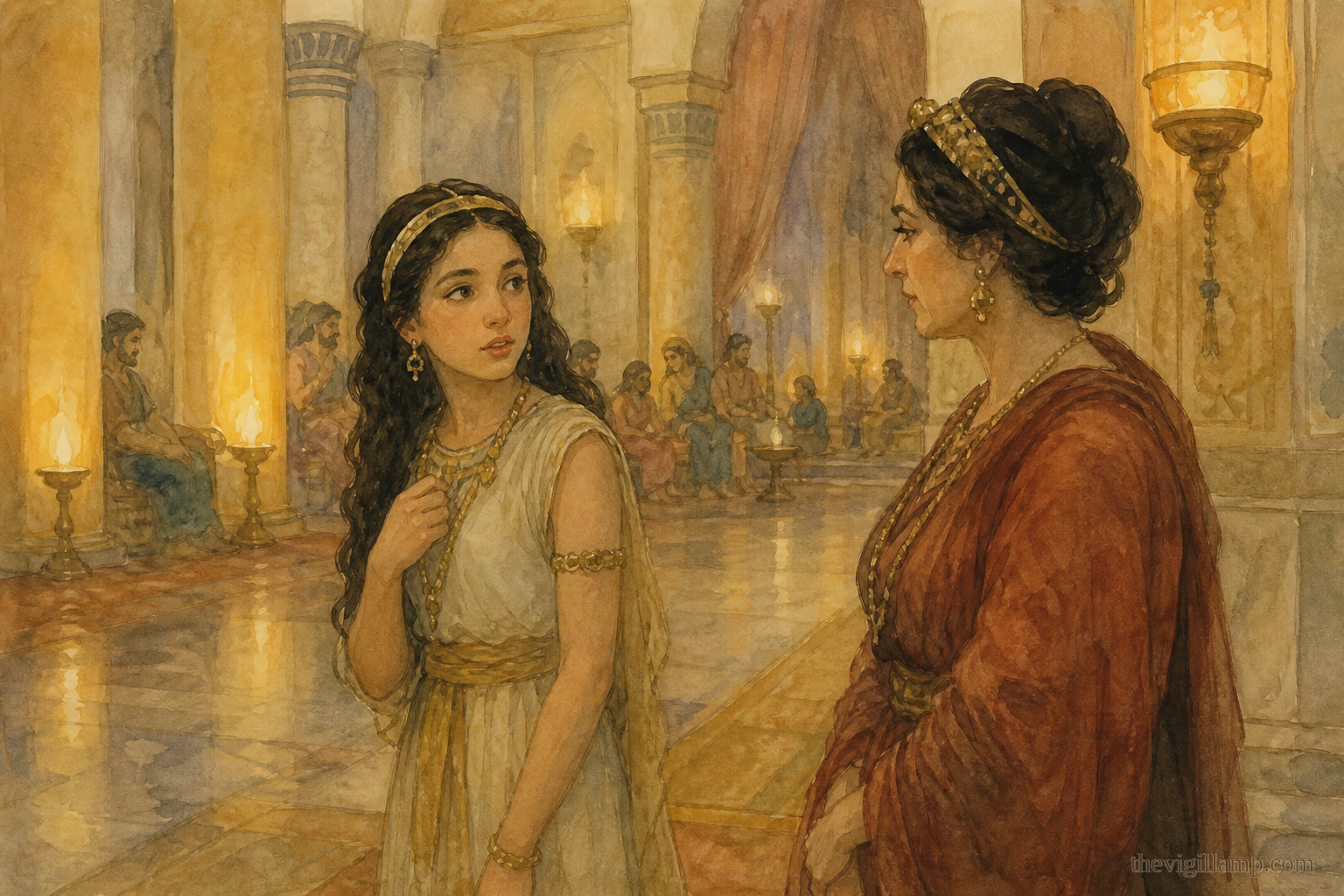
The birthday hall after the dance: Salome turning toward Herodias to ask what she should request, guests and lamps in the distance; no platter, no violence, no invented speech

When his disciples heard, they came. They took his body and laid it in a tomb. The Church's tradition remembers that place as Sebastia, there where the wicked deed had been done.

The Gospel stops at the tomb. The Church keeps a little more, and she keeps it quietly.

The pious Joanna, wife of Herod's steward Chuza, is named in the Gospel among the women who followed the Lord. The traditional account says she took the holy head of the Forerunner, placed it in an earthen vessel, and buried it on the Mount of Olives, on a parcel of land that belonged to Herod. The Church later keeps the uncovering of that honorable head on February 24. We will not make a second story of it tonight. We only say that God did not let the prophet be thrown away as if his witness were trash.
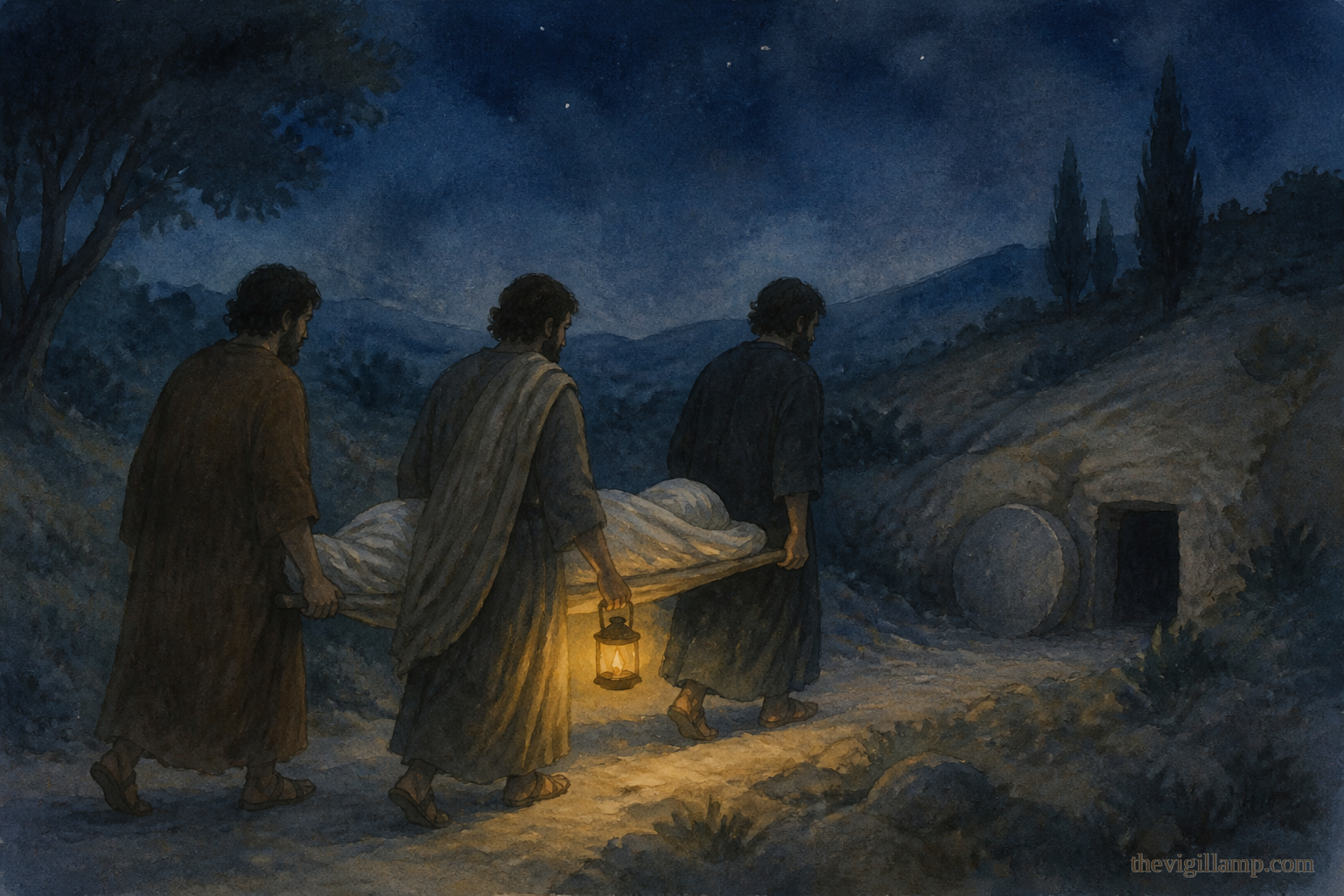
John's disciples carrying his wrapped body by night toward burial at Sebastia, a small lamp among them, the hills quiet; no wounds shown

The hymns appointed for this very day tell us why the Church can sing on a day of grief.

The troparion says the Lord's own testimony is enough for John. Jesus had already said that among those born of women there had not risen a greater than John the Baptist. Kings may swear. Guests may watch. A ruler may be sorry and still give the order. The Lord's word is heavier than all of that.

The kontakion says the glorious beheading of the Forerunner became an act of divine dispensation, for he preached to those in hell — to those who had already died — the coming of the Savior. John had gone ahead of Christ in the wilderness. The Church believes he went ahead once more, into the place of the dead, and told them the same news: the One who takes away the sin of the world is coming.

Herodias is told to lament. She asked for a lawless murder. She loved what is false and temporal, not the law of God, not eternal life.

After John's death, Herod went on ruling for a time. When people began to speak of Jesus, Herod was frightened. He said, “This is John, whom I beheaded; he has been raised from the dead.” Later, Pontius Pilate sent the Lord Jesus to him, and Herod mocked Him. The man who would not keep faith with a prophet did not recognize the King when He stood in the room.

The judgment of God came upon that house even in this life. The OCA life records that king Aretas, in revenge for the disrespect shown his daughter, made war on Herod. The defeated tetrarch suffered the wrath of the Roman emperor and was exiled with Herodias, first to Gaul and then to Spain.

We do not tell that as a grim satisfaction. We tell it because the Church remembers that thrones are not safer than truth. The psalm we read together is John's whole life in one line: “And I spoke of thy testimonies before kings, and was not ashamed.”

The Church established this day as a feast, and she keeps it as a day of strict fasting because of the grief of Christians at the violent death of the saint. Your family should follow the rule of your parish and household, or the blessing of your priest. We will not tell you what you must eat. We will only say that this is not a day for pretending nothing costly happened.

On this same date the Church also makes remembrance of Orthodox soldiers killed on the field of battle, a commemoration established in 1769. Grief has more than one name. The lamp is wide enough for them.

And today, so many hundreds of years later, we say the Forerunner's name once more, out loud, together — Holy Glorious Prophet, Forerunner, and Baptist John — and he is praying for us still.

The voice was not lost in the prison. The voice was not lost in the tomb. The voice still says what it has always said: He is coming. I am not He. Make His paths straight.

Movement Five
The Prayer
Troparion of the Beheading · Tone 2
The memory of the righteous is celebrated with hymns of praise,
but the Lord’s testimony is sufficient for you, O Forerunner.
You were shown in truth to be the most honorable of the prophets,
for you were deemed worthy to baptize in the streams of the Jordan Him whom they foretold.
Therefore, having suffered for the truth with joy,
you proclaimed to those in hell God who appeared in the flesh,
who takes away the sin of the world,
and grants us great mercy.
Kontakion of the Beheading · Tone 5
The glorious beheading of the Forerunner,
became an act of divine dispensation,
for he preached to those in hell the coming of the Savior.
Let Herodias lament, for she entreated lawless murder,
loving not the law of God, nor eternal life,
but that which is false and temporal.
The troparion and kontakion appointed by the Orthodox Church in America for the Beheading of the Forerunner on August 29. Text reproduced exactly from the OCA feast page, with line breaks replacing OCA slash marks.
Movement Six
Let's Talk About It Together
Talk about it:
John told Herod a true word he did not want to hear. When is it hard to tell the truth at home, at school, or among friends — and how can we tell it without becoming cruel?
Herod heard John gladly, and still gave the order because of his oath and his guests. What is the difference between liking a holy word and obeying it?
The Church sings that John's death became a way for him to preach, even to those who had died, that the Savior was coming. How can God use a sorrowful day for something larger than the sorrow?
This is a major feast, and the Church keeps it as a day of fasting. Why might the Church ask us to be quieter with our wants on a day of grief and honor? Ask what your parish and household do, or ask your priest. We will not make a rule of food at this table.
Movement Seven
Do This Together
Do this together   Any time of day
The Word Before Kings
  1. Sit by the lamp. Say together, slowly, “And I spoke of thy testimonies before kings, and was not ashamed.”
  2. Keep a short silence — long enough to count to twenty. Remember the prison, and the man who would not take his word back.
  3. Give each person a scrap of paper. Write one true word that needs courage in your house this week: an apology, a kindness you have been avoiding, a lie you will not tell, a person you will not mock. Fold the papers and set them under the lamp. Do not read them aloud unless someone chooses to.
  4. This is a day the Church keeps with fasting. Ask a parent what your parish and household do today, or ask your priest for a blessing. We will not make a list of foods, and we will not tell you what you must eat.
  5. End by naming one person who needs courage to tell the truth, and one person the Church remembers among the dead. Say together, “Holy Prophet, Forerunner, and Baptist John, pray to God for us.”
Little ones (2–4): let them hold a small unlit candle (or a stone) and say, “John told the truth,” while you count to five. · Make it stick: say the psalm together each night this week — “And I spoke of thy testimonies before kings, and was not ashamed.”
Movement Eight
Go in Peace
Go in Peace
Say the Forerunner's name together:
“Holy Glorious Prophet, Forerunner, and Baptist John,
pray to God for us.”
And close, as the Church always closes, with the Lord's Prayer:
Our Father, Who art in heaven, hallowed be Thy Name. Thy Kingdom come, Thy will be done,
on earth as it is in heaven. Give us this day our daily bread,
and forgive us our trespasses, as we forgive those who trespass against us; and lead us not into temptation,
but deliver us from the evil one. Amen.
Do together: Put out the lamp, or leave it burning a while. The lamp keeps watch until tomorrow. "Glory to God for all things. Amen."
A note on our storytellingEvery edition of The Vigil Lamp is an original retelling. The saint is real, and the names, places, events, and directly quoted words in this edition are drawn from the Holy Gospel, the Acts of the Apostles, and the Orthodox Church in America's traditional account of the Beheading. No invented historical dialogue is presented as fact. The words of narration are our own, written to make a true story vivid and a joy for families to read aloud together.