Forefeast of the Nativity of the Most Holy Theotokos
✦ ✦ ✦
Before you begin
Today's Vigil is for your family, not the other way around. If anything feels like too much, that's okay. Do the parts your family loves, and work your way up to the whole Vigil in one sitting.
Movement One
Light the Lamp
Do together: Light your lamp or a candle. Then say: "Today the Church keeps the Forefeast of the Nativity of the Most Holy Theotokos."
We begin the way the Church begins any new work
“O Lord Jesus Christ, the only-begotten Son of the eternal Father, Thou hast said, 'Without me you can do nothing.' In faith I embrace Thy words, O Lord, and bow before Thy goodness. Help me to complete the work I am about to begin for Thine own glory: in the Name of the Father, and of the Son, and of the Holy Spirit. Amen.”
Then all together:
“Through the prayers of our holy fathers, O Lord Jesus Christ our God, have mercy on us.”
The Orthodox prayer before beginning any work, offered for our family and for yours, each time we begin again.
Movement Two
Read the Icon
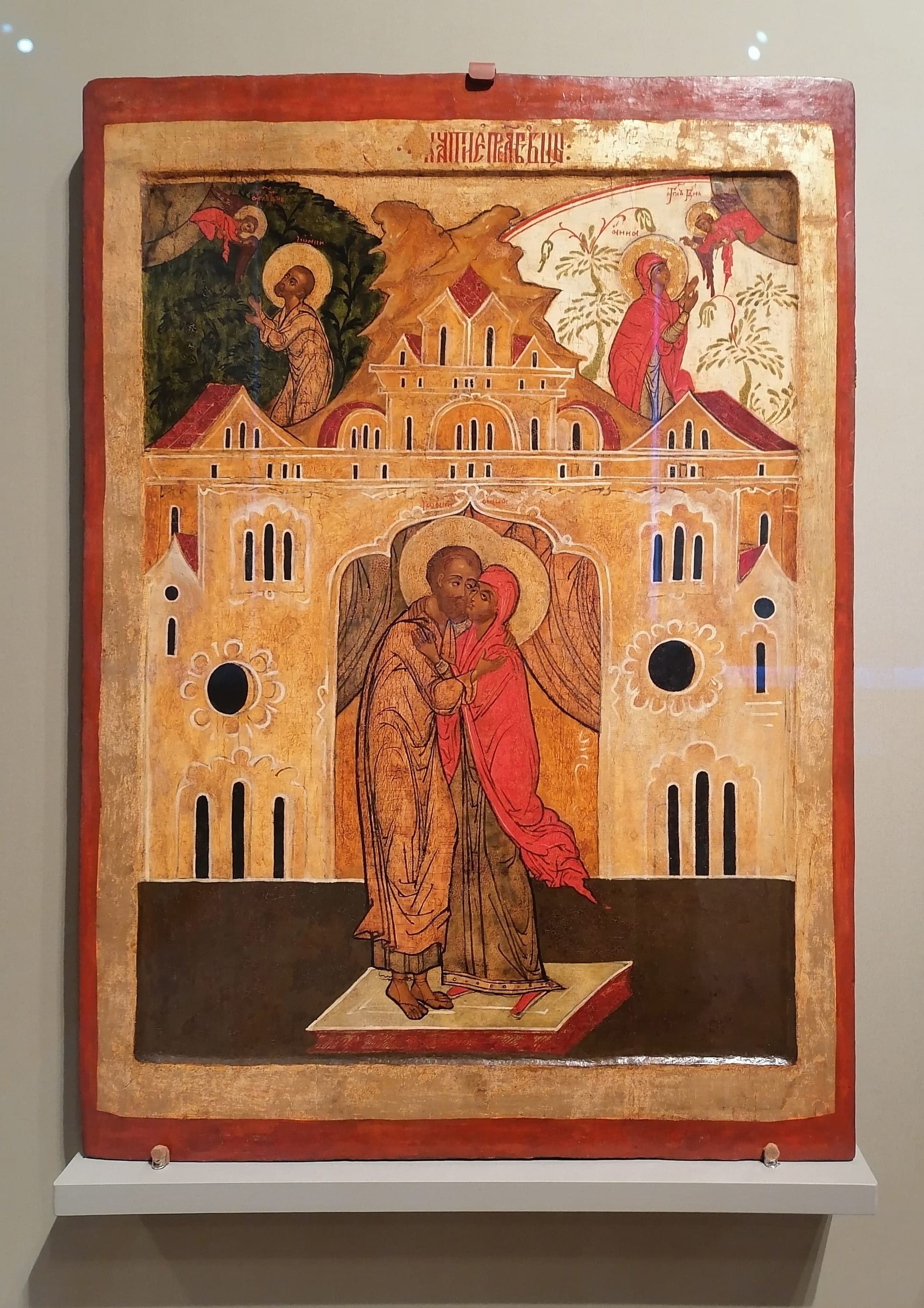
Before we hear today's story, let's look at how the Church shows the holy parents who waited, and learn to read what this icon is telling us.
The Meeting of Joachim and Anna at the Golden Gate · Arkhangelsk lands, first half of the seventeenth century · State Hermitage Museum, Winter Palace, Hall 143
What are we looking at?
An icon isn't a photograph, and it isn't a painting to admire. It's a window. Everything in it is there to teach us something true.
The gold behind them. It is worn, with fine cracks, and in places the gold has thinned. Not a sky over Jerusalem. Heaven's own light. The saints stand where God's light fills everything.
The red border, and the deep board. A wide red band frames the panel. The picture sits down in a shallow recess. This is how old icons were made — a wooden house for a holy scene.
Look first at the top.
Joachim, in the wilderness. In the upper left an older man is among dark green trees and ochre rocks. He wears a pale cloak. His hands are lifted. A small winged figure in red comes toward him from a dark curve of heaven. The Church is showing us the place he went to pray when his gift was not received.
Anna, in the garden. In the upper right a woman in a deep red veil lifts her hands among thin green trees. Another small winged figure in red comes toward her. The Church is showing us that God spoke to both of them, each in the place where they were waiting.
The name. Red Slavonic letters are painted near their heads, and a longer red title sits along the gold at the top. Time has worn some of the letters. We will not invent them. Every icon means to name its saint.
Now look at the middle.
The pale building, and the dark cloth. A tall, many-windowed house rises behind them, with little red roofs. A dark cloth hangs in the great arch. The Church paints that cloth when she wants us to know we are standing at a holy threshold — the Golden Gate of Jerusalem.
Joachim and Anna, meeting. He stands on our left, in a tan cloak, gold halo, dark sandals. She stands on our right, in a red veil over a dark dress, gold halo, small red shoes. They lean in. Cheek to cheek. His arms are around her. Her hands rest on his shoulder. They stand on a little pale platform with a red edge.
This is not yet the birth. This is the promise, and the meeting, and the long wait coming to its door. Tomorrow the Church will keep the Great Feast. This morning she lets us look at the parents God prepared, and at the gate He opened.
Anonymous painter of the Arkhangelsk lands, Meeting of Joachim and Anna at the Golden Gate, first half of the seventeenth century; wood (pine), canvas, gesso, tempera; State Hermitage Museum, Winter Palace, Hall 143. The panel itself is public domain. Photograph by Netelo (2020), Wikimedia Commons, [CC BY-SA 4.0](https://creativecommons.org/licenses/by-sa/4.0/). This is not the birth-scene of tomorrow's Great Feast. The 1497 Kirillo-Belozersky festal-row Nativity was inspected and is not shown. Modern OCA files were not used.
The ReadingsMovement Three
The Scripture the Church appoints for this day. Open your Bible at home and read the passages aloud together, then listen for these words echoing through the story and the rest of your day.
A Psalm to begin · Psalm 90 (91) : 1
“He that dwells in the help of the Highest, shall sojourn under the shelter of the God of heaven.”
The Septuagint (Brenton, 1851), the Old Testament of the Orthodox Church. In ordinary English Bibles this is Psalm 91:1. This verse is chosen for prayer today; it is not a separate lectionary appointment.
The Epistle · Galatians 2 : 11–16
“Knowing that a man is not justified by the works of the law, but by the faith of Jesus Christ… for by the works of the law shall no flesh be justified.”
Open your Bible and read the full passage together. Text: King James Version (public domain).
The Gospel · Mark 5 : 24–34
“Daughter, thy faith hath made thee whole; go in peace, and be whole of thy plague.”
Open your Bible and read the full passage together. Text: King James Version (public domain).
These are the weekday readings appointed by the Orthodox Church in America for Monday, September 7, 2026. The OCA daily page and the September monthly lectionary list no separate Forefeast pair and no saint pair for this date. The three Old Testament lessons named on the OCA Forefeast page — Jacob's ladder, the east gate, and Wisdom's house — belong to Great Vespers of the Nativity of the Theotokos, not to today's Liturgy. Tomorrow the Church appoints the feast pair, Philippians 2:5–11 and Luke 10:38–42; 11:27–28. This edition therefore uses the appointed weekday pair.
Forefeast of the Nativity of the Theotokos · Read aloud
0:00
/555.41551
Movement Four
The Story
The Church remembers more than one name on the seventh of September.
She remembers the Martyr Sozon, and other holy names. Those are true days. We will not tell those whole lives this morning.
Today she asks us to keep a Forefeast.
Tomorrow the Church will keep a Great Feast — the Nativity of the Most Holy Theotokos.
Today is not that day.
Today she lights the lamp before the feast has come. She sings the words that belong to waiting. She looks toward the girl-child God has been preparing, and she has not yet sung the feast in full.
That is how God works with His people. He prepares a place. He shelters the ones who wait. He does not hurry the door open before it is time.
On the Forefeast the Church takes out old words — the ones she will read at Great Vespers when the feast is at the door.
Jacob was in a lonely place, and he dreamed of a ladder set up on the earth, and the top of it reached to heaven, and the angels of God were ascending and descending on it. When he woke he was afraid, and he said, "How dreadful is this place! this is none other but the house of God, and this is the gate of heaven."
The Church hears those words and thinks of Mary. She would be the place where heaven and earth meet. She would be the house God prepared. She would be the gate.
Then the Church reads about a gate in the sanctuary that faces east. God enters by that gate, and it is shut, so that no one else may enter by it. The Church hears those words and thinks of Mary again — the living Temple, the east gate, the place filled with the glory of the Lord.
Then she reads about the house that Wisdom has built.
These are the Church getting the house ready. We will not turn them into tomorrow's feast before tomorrow comes.
The girl the Church is waiting for was not born in a palace, and her name is not first written in the Gospels. The Church has kept her parents' names, and their waiting, as her own tradition.
They lived in Nazareth of Galilee. His name was Joachim, of the tribe of Judah, of the house of David. Her name was Anna, daughter of Matthan the priest, of the tribe of Levi, of the house of Aaron. The couple was without child, because Anna was barren.
Among their people a house without a child felt like a house God had forgotten. They had not forgotten Him.
They reached old age. They did not lose hope in God's mercy. They had strong faith that for God everything is possible, and that He could do for Anna what He had once done for Sarah, the wife of Abraham. They vowed that if the Lord gave them a child, they would dedicate that child to the service of God in the Temple.
They had to endure abuse from their own countrymen. They never grumbled. They prayed. They trusted Him.
Then came a feast day in Jerusalem.
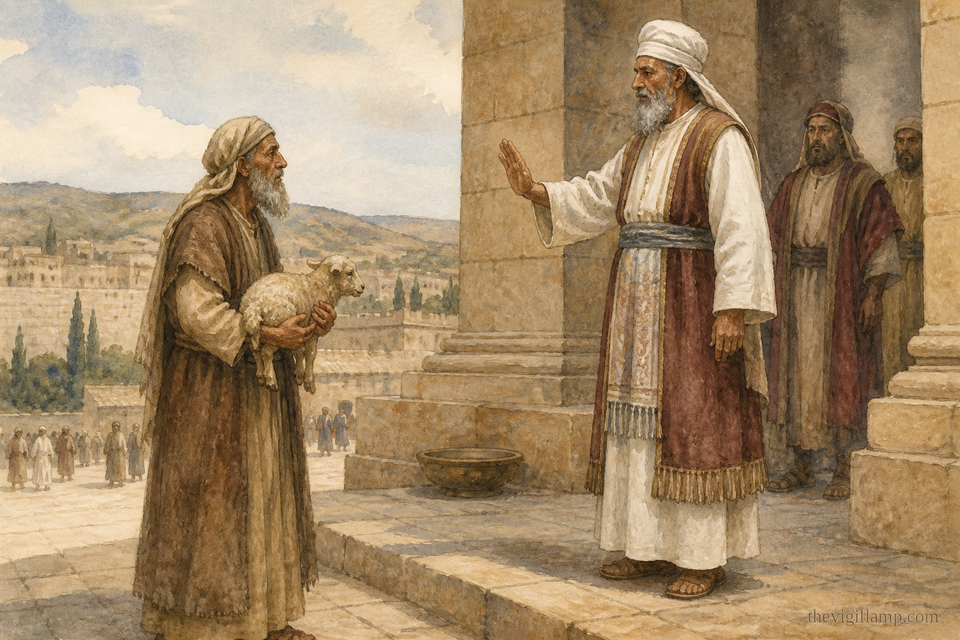
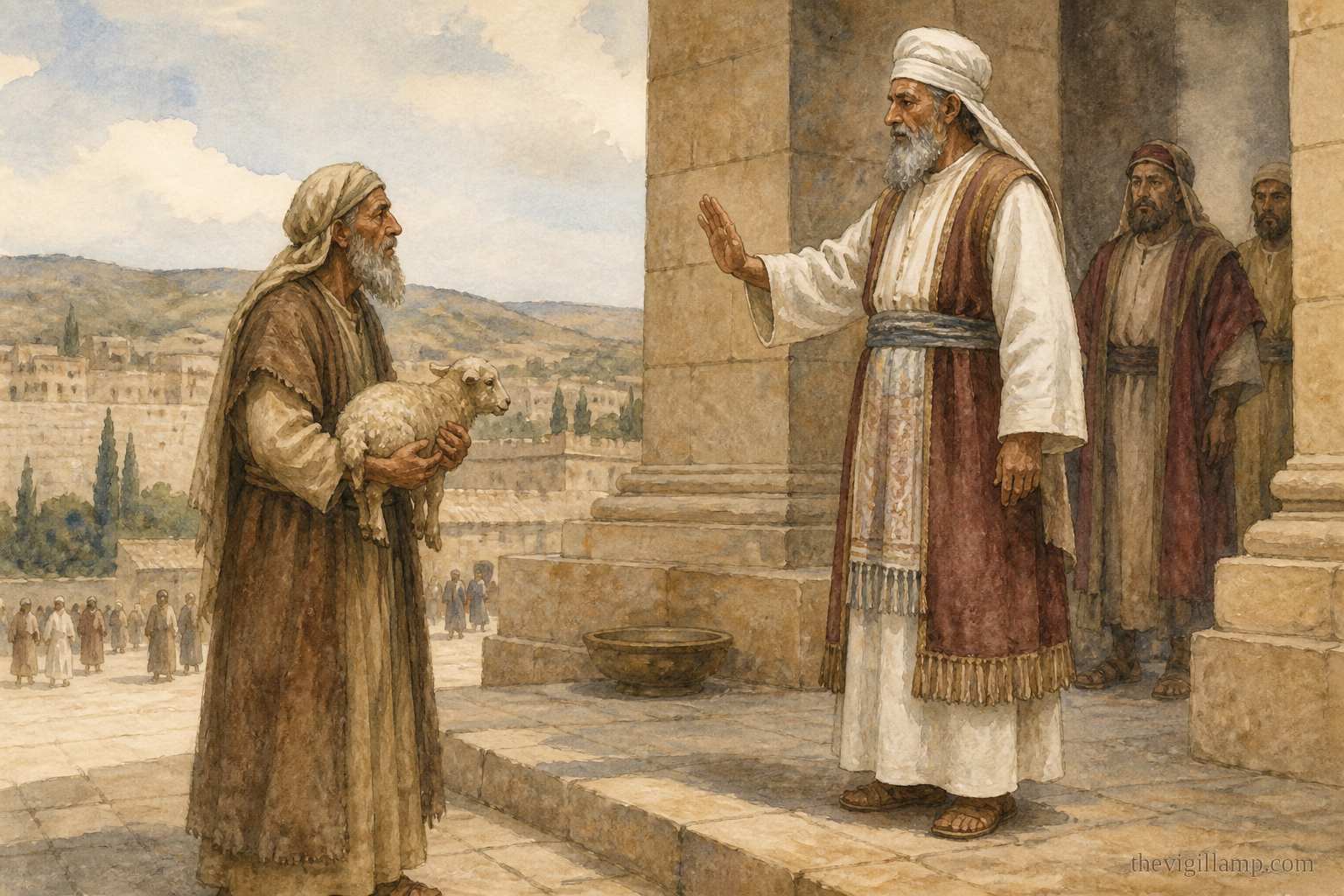
The elderly Joachim brought his sacrifice to offer to God. The High Priest would not accept it. He considered Joachim unworthy, because he was childless.
Joachim bringing his offering to the Temple; the High Priest will not receive it. No extra speech in the scene
Those are the Church's words. We will not invent others.
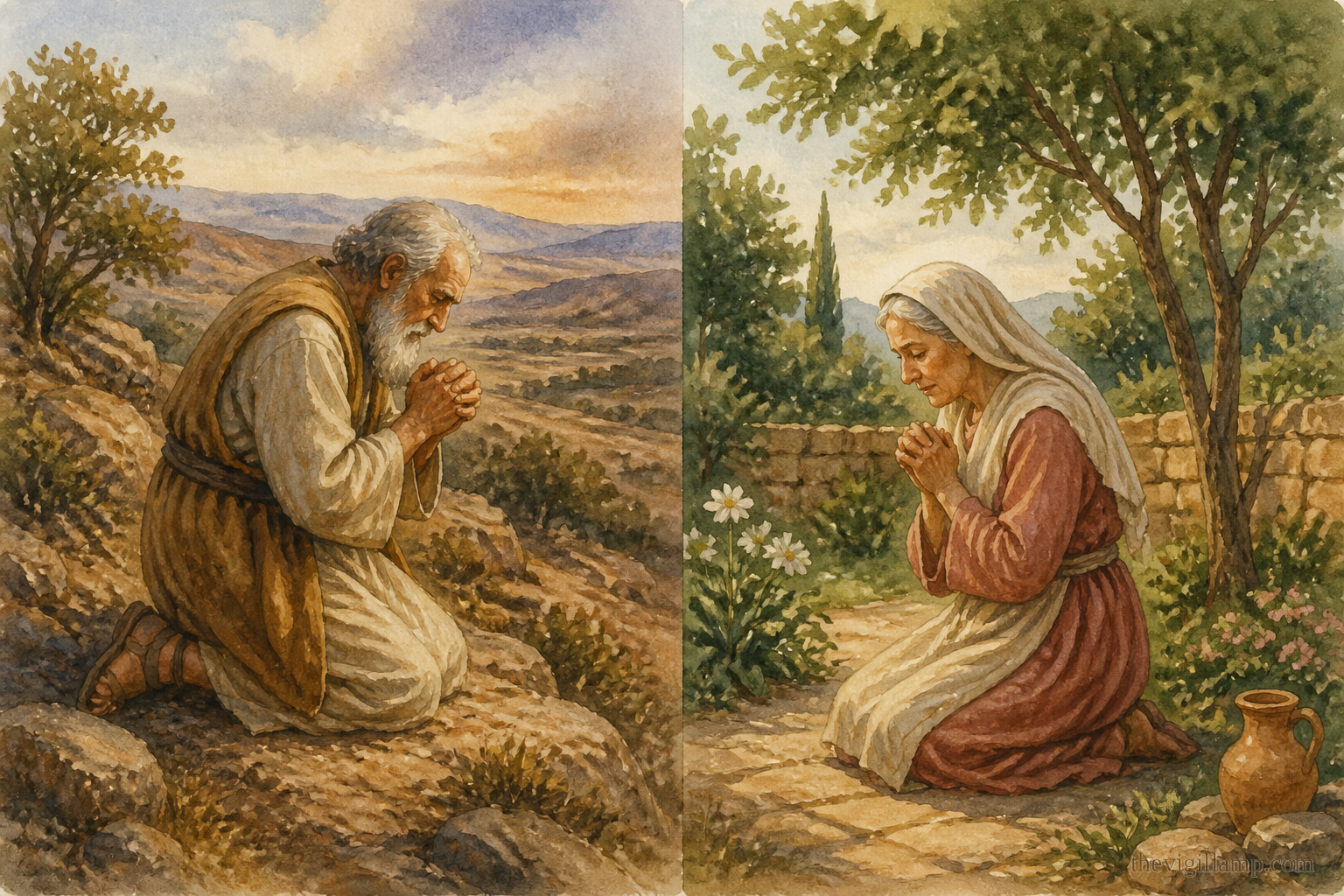
Joachim was in deep grief. He did not go home. He went into the wilderness, and there he prayed with tears to the Lord for a child.
Anna learned what had happened at the Temple. She wept. Never once did she complain against the Lord. She prayed, and asked God's mercy on her family.
Joachim praying in the wilderness; Anna praying in her garden. No extra speech invented
The Lord heard them when they had come to extreme old age, and when they had been prepared, by a long faithful life, for a calling almost too large to say: to be the parents of the Most Holy Virgin Mary, the future Mother of the Lord Jesus Christ.
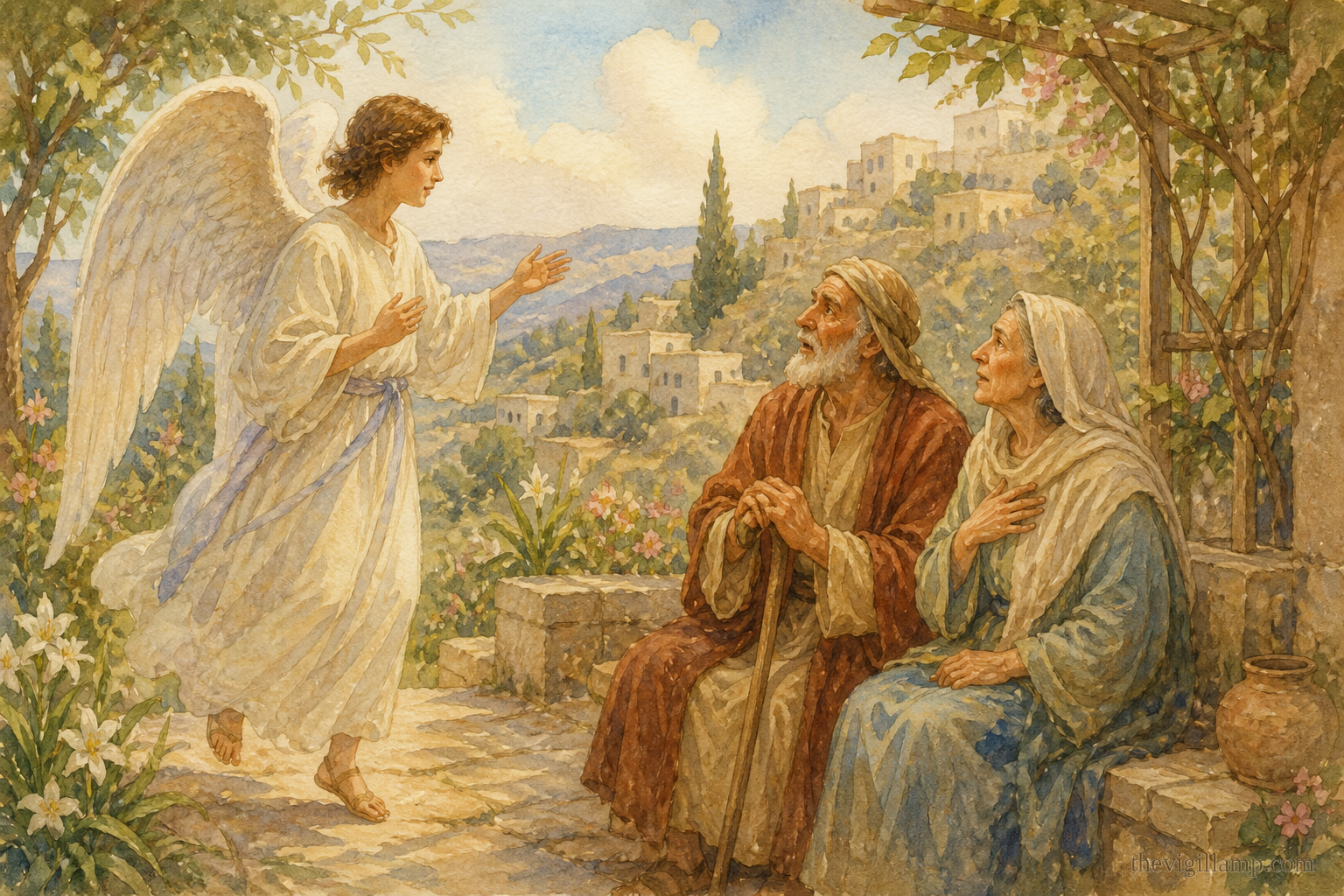
The Archangel Gabriel brought them the joyous message that their prayers were heard by God, and that of them would be born a most blessed daughter, Mary, through whom would come the Salvation of all the world. The Church also says the angel told them she would be blessed above all other women, that she would remain a virgin, that she would be dedicated to the Lord and live in the Temple, and that she would give birth to the Savior.
We will not invent the angel's sentences. The Church has told us what the message was.
The angel bringing Joachim and Anna the message that a daughter will be born. No invented speech in the scene
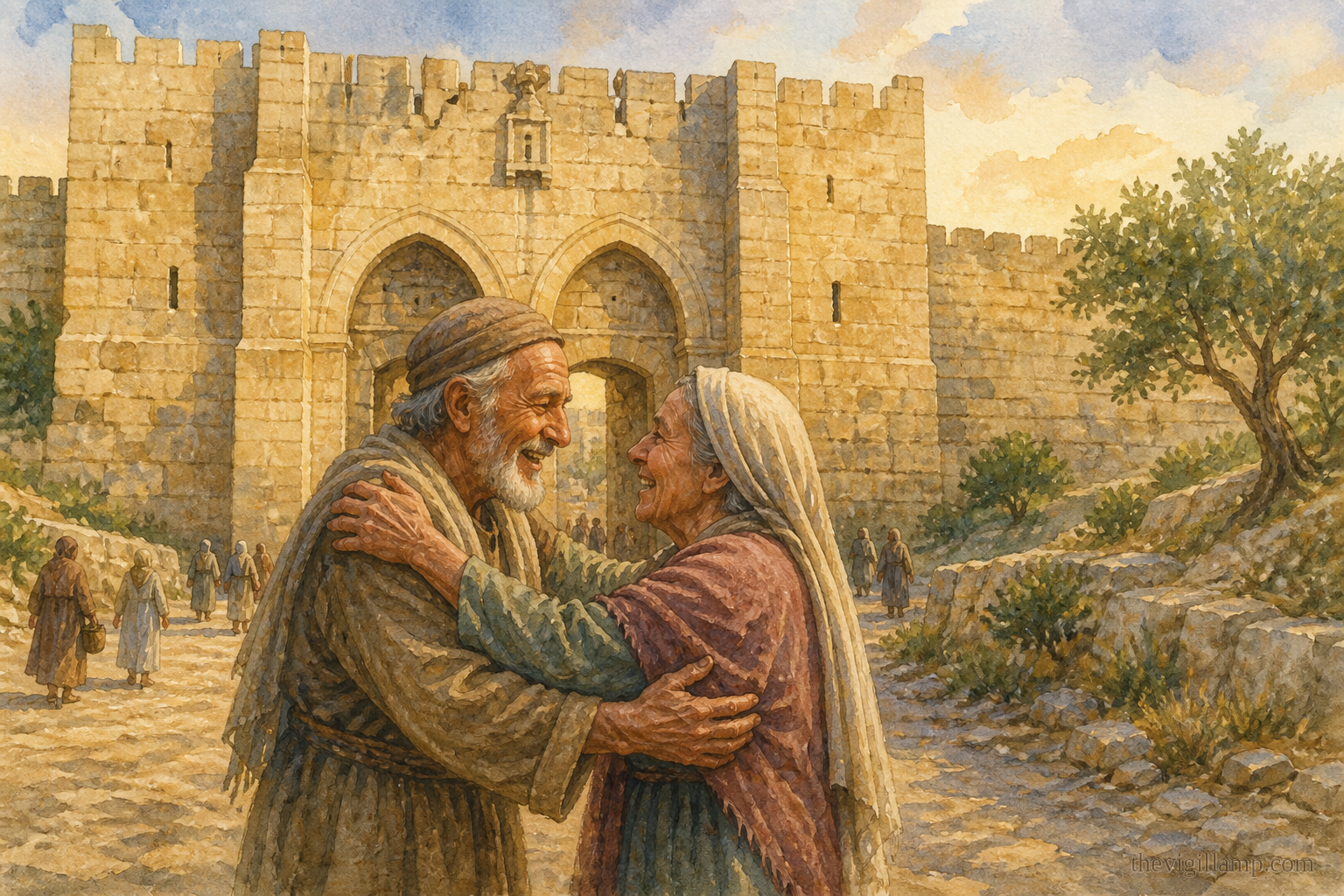
Obeying the instructions of the heavenly messenger, Joachim and Anna met at the Golden Gate in Jerusalem.
Joachim and Anna meeting at the Golden Gate. No extra speech invented
That is the scene on the old panel we looked at. Two people who had waited a long time, meeting at a gate. God had not forgotten them. He had been preparing them.
Then, as God promised, a daughter was born to them, and they named her Mary.
We will not tell that birth this morning as if the Great Feast had already come. Tomorrow the Church will keep it. This morning it is enough to know the name, and the promise, and the parents who said yes by waiting.
The child God was preparing would grow up to say a word the whole Church still lives by. When the same Archangel came to her, years later, in Nazareth, she said, "Behold the handmaid of the Lord; be it unto me according to thy word." That is Mary's faithful yes. This morning we do not tell the Annunciation. This morning we watch God preparing the girl who would say it — preparing a house, a gate, a shelter for His people.
The word we heard this morning is a weekday word, not a feast pair: "a man is not justified by the works of the law, but by the faith of Jesus Christ." Joachim's rejected gift did not open the door. Faith did — the faith that kept praying when the Temple said no.
And the Gospel is a woman who had suffered twelve years. She had spent all she had. She came in the press behind, and touched His garment. She said, "If I may touch but his clothes, I shall be whole."
He turned. He looked for her. He said, "Daughter, thy faith hath made thee whole; go in peace."
Do you hear it? A daughter. A reaching. A shelter. Go in peace.
That is how God prepares His people. He does not wait for them to be strong enough. He lets the small faith that reaches be enough, and He makes a place for them under the shelter of the God of heaven.
The Forefeast hymn already dares to speak as if the child were here: "The barren woman has conceived the Theotokos, the nourisher of our lives." The Church can say that today, because she is getting ready. She has not yet sung the Great Feast. She is standing at the gate.
And today, so many hundreds of years later, we say the names once more, out loud, together — Most Holy Theotokos, and holy and righteous Joachim and Anna — and they are praying for us still.
Movement Five
The Prayer
Troparion of the Forefeast · Tone 4
Podoben: "Joseph was amazed...." From the root of Jesse, and from the loins of David, the godly Mary is born to us today, for which the universe rejoices and is renewed, heaven and earth rejoice together. Praise her, you Fathers of the nations, Joachim rejoices and Anna celebrates shouting "The barren woman has conceived the Theotokos, the nourisher of our lives."
Kontakion of the Forefeast · Tone 3
Today the Virgin Theotokos Mary the bridal chamber of the Heavenly Bridegroom by the will of God is born of a barren woman, being prepared as the chariot of God the Word. She was fore-ordained for this, since she is the divine gate and the true Mother of Life.
The troparion and kontakion appointed by the Orthodox Church in America on the September 7 page of the Forefeast of the Nativity of the Mother of God. Wording is exact; slash marks were converted to line breaks only. These are the Forefeast hymns, not the Great Feast hymns of September 8. Martyr Sozon has appointed hymns on the same date page; they are not printed here.
Movement Six
Let's Talk About It Together
Talk about it:
Joachim and Anna waited a long time, and they did not stop praying when the Temple said no. What is one thing our family is still waiting for God to do?
Today is the Forefeast. The Church is getting the house ready, and has not yet sung the Great Feast. How does our house get ready for something holy?
The woman in the Gospel reached out and touched His garment, and He said, "Daughter, thy faith hath made thee whole; go in peace." When has God sheltered someone in our family — a small faith, a real help?
Movement Seven
Do This Together
Do this togetherAny time of day
Get the House Ready
Clear a small place on a table — a little "house," only as wide as a book. This is the place we are getting ready, the way the Church gets ready on a Forefeast.
Sit still together for a slow count of ten. No talking. Joachim went into the wilderness. Anna waited at home. The hard part is not the words. The hard part is staying.
Then one child says, slowly, the Forefeast's own shout: "The barren woman has conceived the Theotokos, the nourisher of our lives."
That child does one small, real good work right away: clear a plate, help a little brother, say something kind. God was preparing a shelter for His people. We can make a little shelter in this room.
Take turns. When everyone has had a turn, sit together and each name one way God has already sheltered this family — one help, one answered waiting, one door He opened. Write those words on scraps of paper and keep them under the lamp until next Sunday.
Little ones (2–4): help them sit still and say "thank You, God" while you count to five, then help them set one small thing in the ready place. · Make it stick: say the psalm together each night this week — "He that dwells in the help of the Highest, shall sojourn under the shelter of the God of heaven."
“Most Holy Theotokos, save us. Holy and Righteous Joachim and Anna, pray to God for us.”
And close, as the Church always closes, with the Lord's Prayer:
Our Father, Who art in heaven, hallowed be Thy Name. Thy Kingdom come, Thy will be done, on earth as it is in heaven. Give us this day our daily bread, and forgive us our trespasses, as we forgive those who trespass against us; and lead us not into temptation, but deliver us from the evil one. Amen.
Do together: Put out the lamp, or leave it burning a while. The lamp keeps watch until tomorrow. "Glory to God for all things. Amen."
A note on our storytellingEvery edition of The Vigil Lamp is an original retelling. The Forefeast is real, and the names, places, events, and directly quoted words in this edition are drawn from the Orthodox Church in America's traditional accounts of the Forefeast and of the Nativity of the Theotokos and of the Holy and Righteous Ancestors of God Joachim and Anna, from the Church's own appointed Forefeast hymns and weekday readings, from the King James Version of Mark 5 and Luke 1, and from the Septuagint of Genesis 28. Protoevangelium of James material is used only as the Church's traditional narrative already received in those lives, not as invented extra dialogue. No invented historical speech is presented as fact. The words of narration are our own, written to make a true story vivid and a joy for families to read aloud together.