The Nativity of our Most Holy Lady the Mother of God and Ever-Virgin Mary
A Great Feast
✦ ✦ ✦
Before you begin
Today's Vigil is for your family, not the other way around. If anything feels like too much, that's okay. Do the parts your family loves, and work your way up to the whole Vigil in one sitting.
Movement One
Light the Lamp
Do together: Light your lamp or a candle. Then say: "Today the Church keeps the Great Feast of the Nativity of our Most Holy Lady the Mother of God and Ever-Virgin Mary."
We begin the way the Church begins any new work
“O Lord Jesus Christ, the only-begotten Son of the eternal Father, Thou hast said, 'Without me you can do nothing.' In faith I embrace Thy words, O Lord, and bow before Thy goodness. Help me to complete the work I am about to begin for Thine own glory: in the Name of the Father, and of the Son, and of the Holy Spirit. Amen.”
Then all together:
“Through the prayers of our holy fathers, O Lord Jesus Christ our God, have mercy on us.”
The Orthodox prayer before beginning any work, offered for our family and for yours, each time we begin again.
Movement Two
Read the Icon
Before we hear her story, let's look at how the Church has always shown this birth, and learn to read what the icon is telling us.
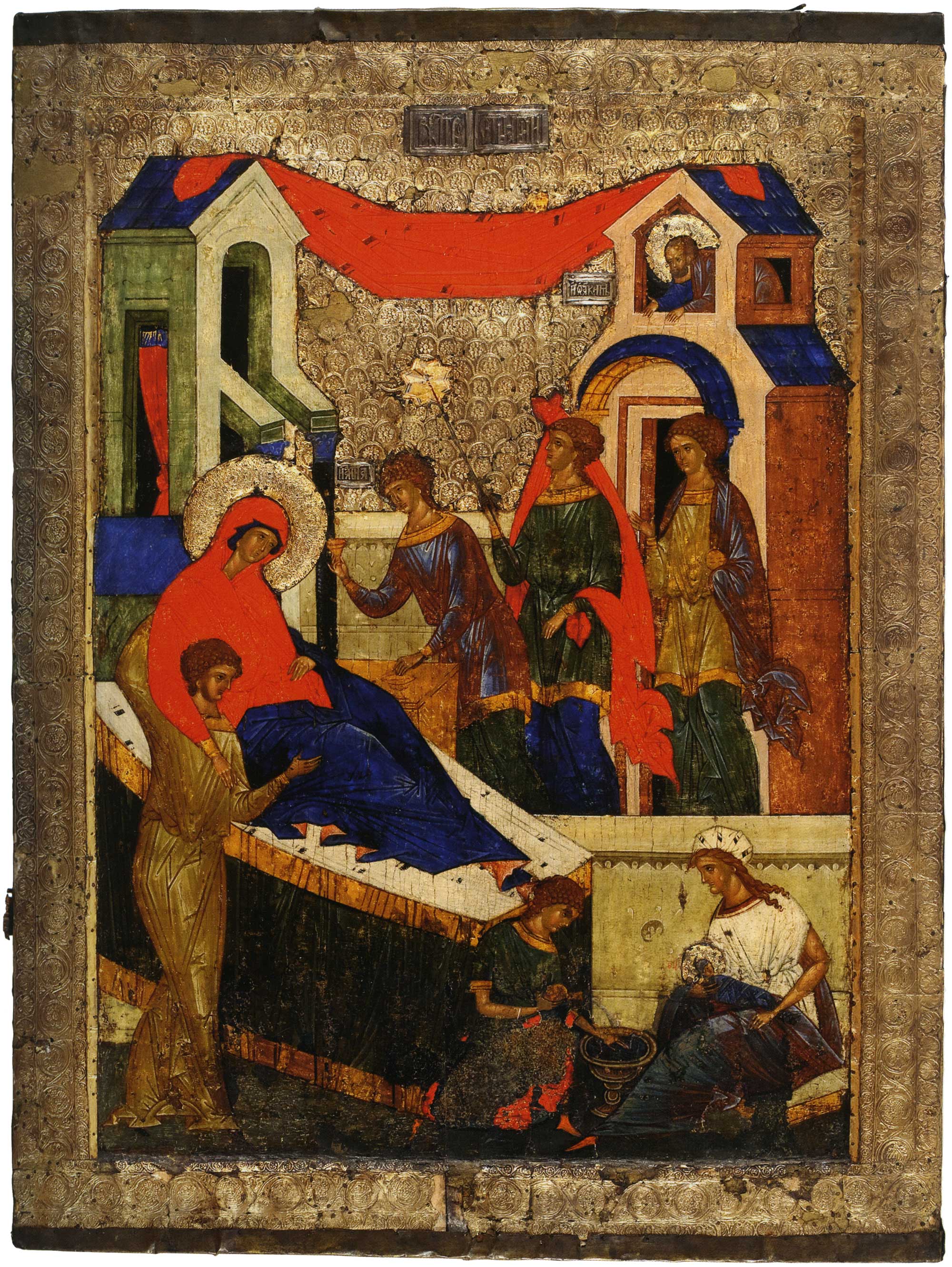
The Nativity of the Most Holy Theotokos · festival row of the Dormition Cathedral, Kirillo-Belozersky Monastery, 1497
What are we looking at?
An icon isn't a photograph, and it isn't a painting to admire. It's a window. Everything in it is there to teach us something true about this feast.
The gold behind them. It is thick and patterned with small circles. A wide gold border, worked with the same circles, frames the panel. Not a sky, not a street. Heaven's own light. The saints stand where God's light fills everything.
The two houses, and the red cloth. A pale house with a dark doorway stands on the left. A white house with a blue roof stands on the right. A long red cloth is draped from one roof toward the other. The Church paints that cloth when she wants us to know the scene belongs indoors — in a house, in a holy place — even though the gold is all around.
Anna, on the bed. Look for the largest figure. She is lying on a high couch, propped on pale cushions. A deep red mantle covers her. Under it a dark garment shows at the sleeves and the hem. A gold halo is around her head. She is resting. The long wait is over. The child has come.
The women who have come. They have no halos. One leans at the foot of the bed. Others come from the right in green and gold and red. One holds a small cup. The Church does not hide the ordinary work of a birth. Hands help. A house that waited a long time is full.
The child, below. In the lower right, two women tend a very small figure. One sits and holds her. The other kneels by a footed basin. The child is wrapped. A gold halo is already around her head. This is the newborn Mary. The Church shows her the way she shows other holy infants: a real baby, washed and held, and already named by heaven's light.
The man in the window. High in the right-hand house, in a small arched opening, an older man looks down. His hair and beard are grey. He wears a dark blue robe. A gold halo is around his head. A small dark plaque with old letters sits near him. We will not invent those letters. The Church knows this man as Joachim.
The name of the feast. At the top, set into the gold, a dark rectangular plaque holds old Slavonic letters. Time and the covering have made them hard to read from this photograph. We will not invent them. Every icon means to name what it shows. Even when the paint is thin, the feast and the name belong together.
Anonymous Russian icon painter, The Nativity of the Mother of God, about 1497, festival row of the iconostasis of the Dormition Cathedral, Kirillo-Belozersky Monastery. Public domain. Image via Wikimedia Commons, from icon-art.info. A later patterned gold covering and border are visible on this photograph. The mid-seventeenth-century Rostov festival-row panel of the same feast was inspected and is held as unused backup. Modern OCA files were not used.
The ReadingsMovement Three
The Scripture the Church appoints for this day. Open your Bible at home and read the passages aloud together, then listen for these words echoing through the feast and the rest of your day.
A Psalm to begin · Psalm 45 (46) : 5
“The flowings of the river gladden the city of God: the Most High has sanctified his tabernacle.”
The Septuagint (Brenton, 1851), the Old Testament of the Orthodox Church. In ordinary English Bibles this is Psalm 46:4. This verse is chosen for prayer today; it is not a separate lectionary appointment.
The Epistle · Philippians 2 : 5–11
“Let this mind be in you, which was also in Christ Jesus: Who, being in the form of God… took upon him the form of a servant, and was made in the likeness of men.”
Open your Bible and read the full passage together. Text: King James Version (public domain).
The Gospel · Luke 10 : 38–42; 11 : 27–28
“Yea rather, blessed are they that hear the word of God, and keep it.”
Open your Bible and read the full passage together. Text: King James Version (public domain).
These are the feast readings appointed by the Orthodox Church in America for the Nativity of the Theotokos on Tuesday, September 8, 2026. The same day's weekday pair is Galatians 2:21–3:7 and Mark 6:1–7. This edition carries the feast pair.
Nativity of the Theotokos · Read aloud
0:00
/484.754286
Movement Four
The Story
Yesterday the Church stood on the doorstep of this feast.
Today she opens the door.
The Church keeps more than one nativity. There is the Nativity of Christ, in the winter, in the cave at Bethlehem. That day is not today.
Today is the Great Feast of the Nativity of our Most Holy Lady the Mother of God and Ever-Virgin Mary. The Church calls it a day of universal joy. A girl-child has been born, and her name is Mary.
Do you hear what she is singing already? "Your Nativity, O Virgin, has proclaimed joy to the whole universe!"
That is today's word. Not the waiting. The joy.
The Most Holy Virgin Mary was born in the small city of Galilee, Nazareth. Her father was the righteous Joachim, of the tribe of the Prophet-King David. Her mother was the righteous Anna, of the tribe of the First Priest Aaron.
They had been a house without a child, because Saint Anna was barren. They grew old. They did not lose hope in God's mercy. They had strong faith that for God everything is possible, and that He would be able to overcome the barrenness of Anna even in her old age, as He had once overcome the barrenness of Sarah, the wife of the patriarch Abraham. They vowed that if the Lord gave them a child, they would dedicate that child to the service of God in the Temple.
Among their people a house without a child felt like a house God had forgotten. Childlessness was counted as a punishment. Joachim and Anna had to endure the hard words of their own countrymen. They never grumbled. They prayed. They trusted Him.
Then came a feast day at the Temple in Jerusalem.
The elderly Joachim brought his sacrifice to offer to God. The High Priest would not accept it. He counted Joachim unworthy, because Joachim had no child.
Those are the Church's words. We will not invent others.
Saint Joachim, in deep grief, went into the wilderness. There he prayed with tears to the Lord for a child. Saint Anna wept bitterly when she learned what had happened at the Jerusalem Temple. Never once did she complain against the Lord. She prayed to ask God's mercy on her family.
The Lord fulfilled their petitions when the pious couple had come to extreme old age, and had prepared themselves by a virtuous life for a sublime calling: to be the parents of the Most Holy Virgin Mary, the future Mother of the Lord Jesus Christ.
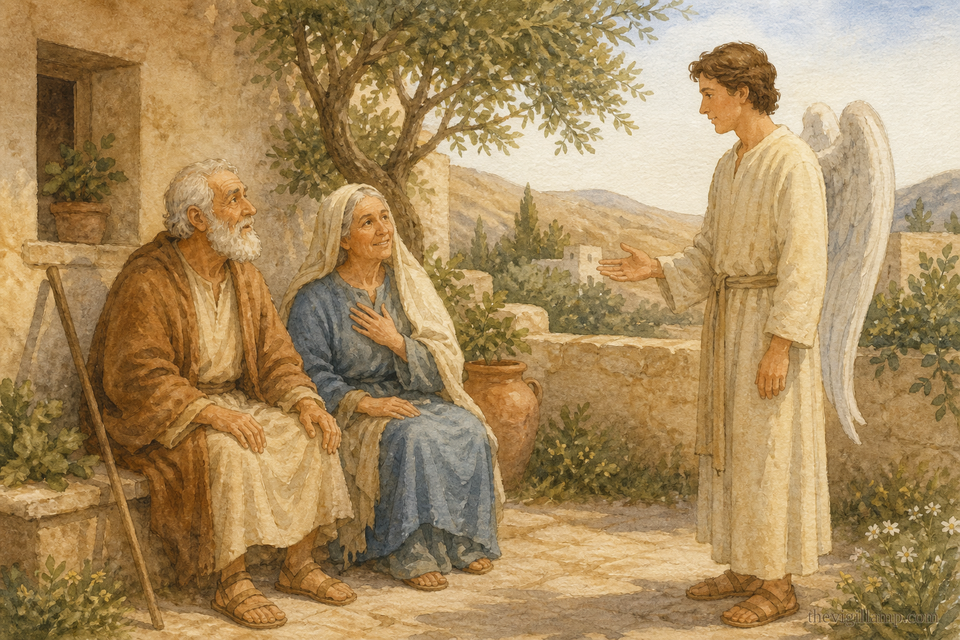
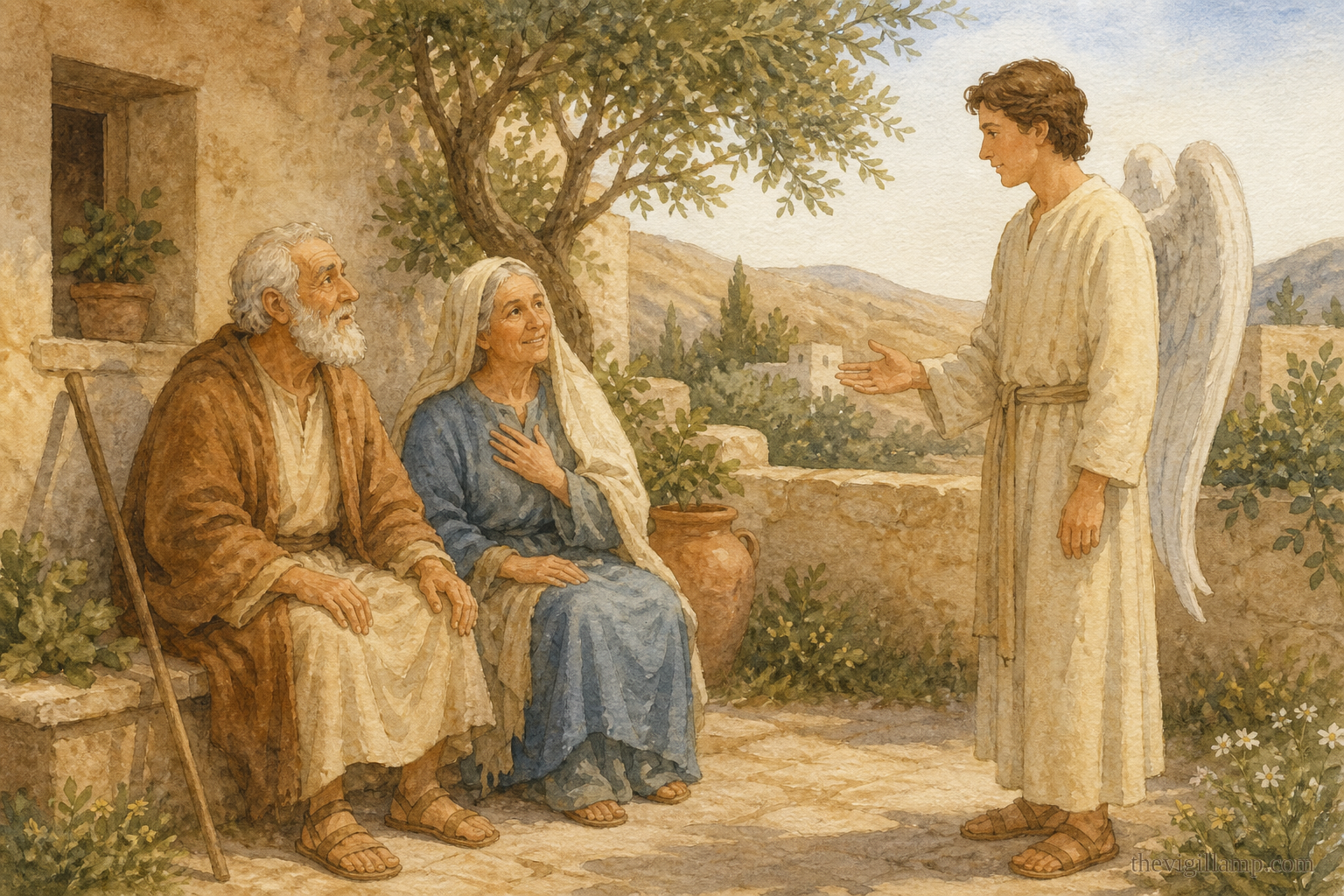
The Archangel Gabriel brought Joachim and Anna the joyous message that their prayers were heard by God, and that of them would be born a most blessed daughter, Mary, through whom would come the Salvation of all the World.
The Church also tells it this way: an angel told them that a daughter would be born who would be blessed above all other women; that she would remain a virgin; that she would be dedicated to the Lord and live in the Temple; and that she would give birth to the Savior.
We will not invent the angel's sentences. The Church has told us what the message was.
The Archangel Gabriel bringing Joachim and Anna the joyous message that their prayers are heard, and that a daughter will be born. No extra speech invented
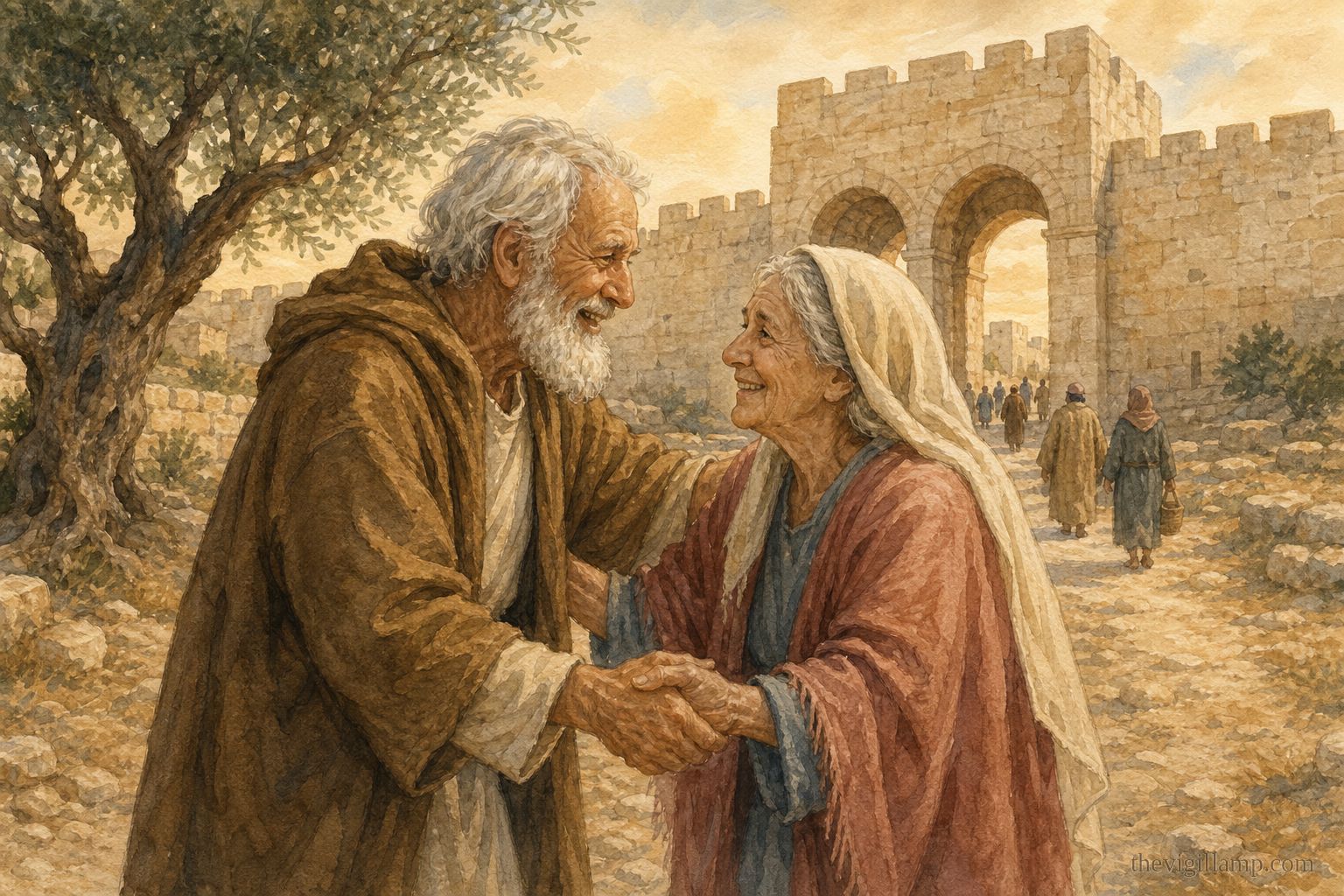
Obeying the heavenly messenger, Saints Joachim and Anna met at the Golden Gate in Jerusalem.
Joachim and Anna meeting at the Golden Gate, as God promised. No extra speech invented
Then, as God promised, a daughter was born to them.
That is today's feast. Not the wilderness. Not the doorstep. The birth.
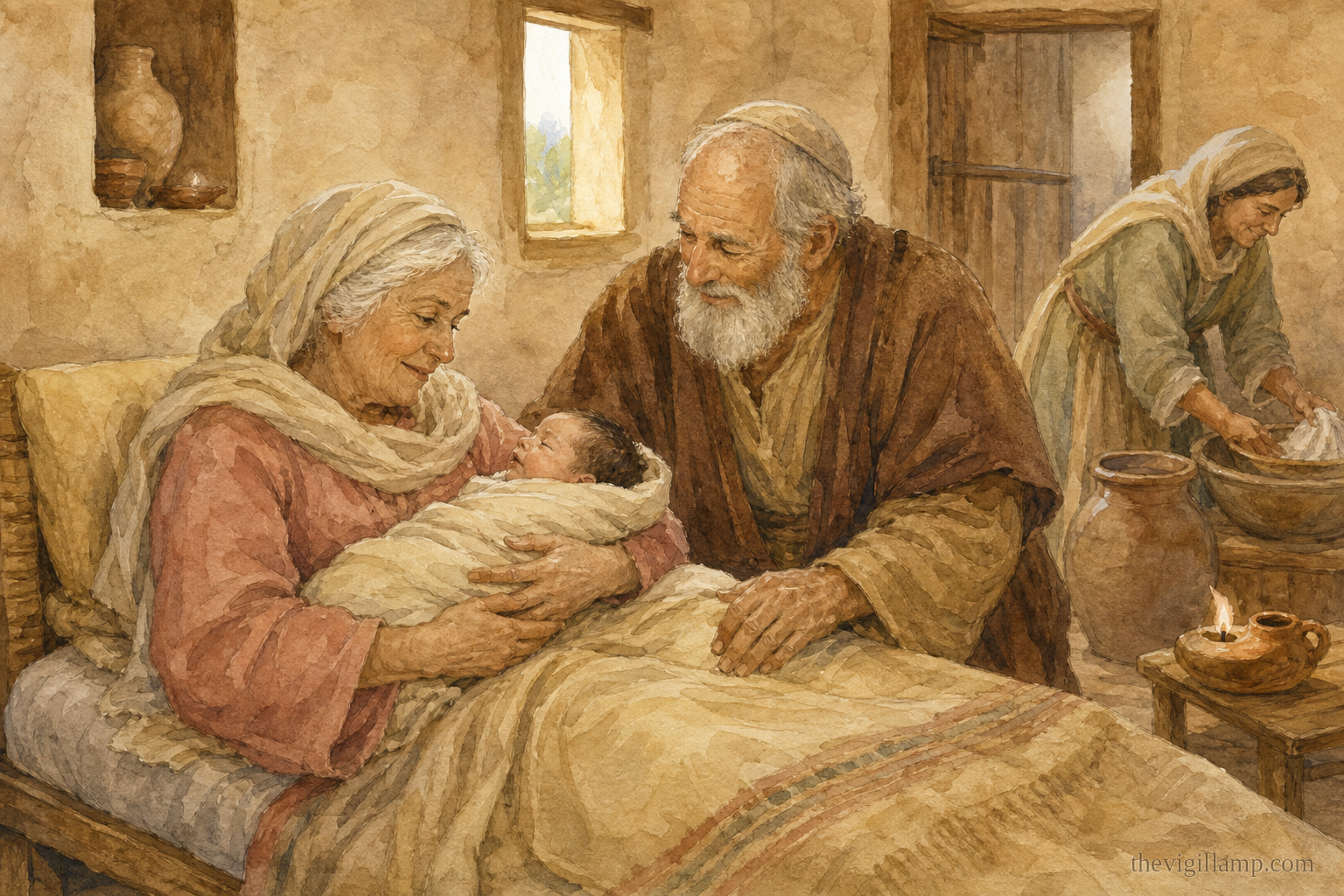
She was born in Nazareth, in the house God had been preparing. She was a real child. She had a mother who had waited a long time. She had a father who had prayed with tears. And now the wait was over.
They named her Mary.
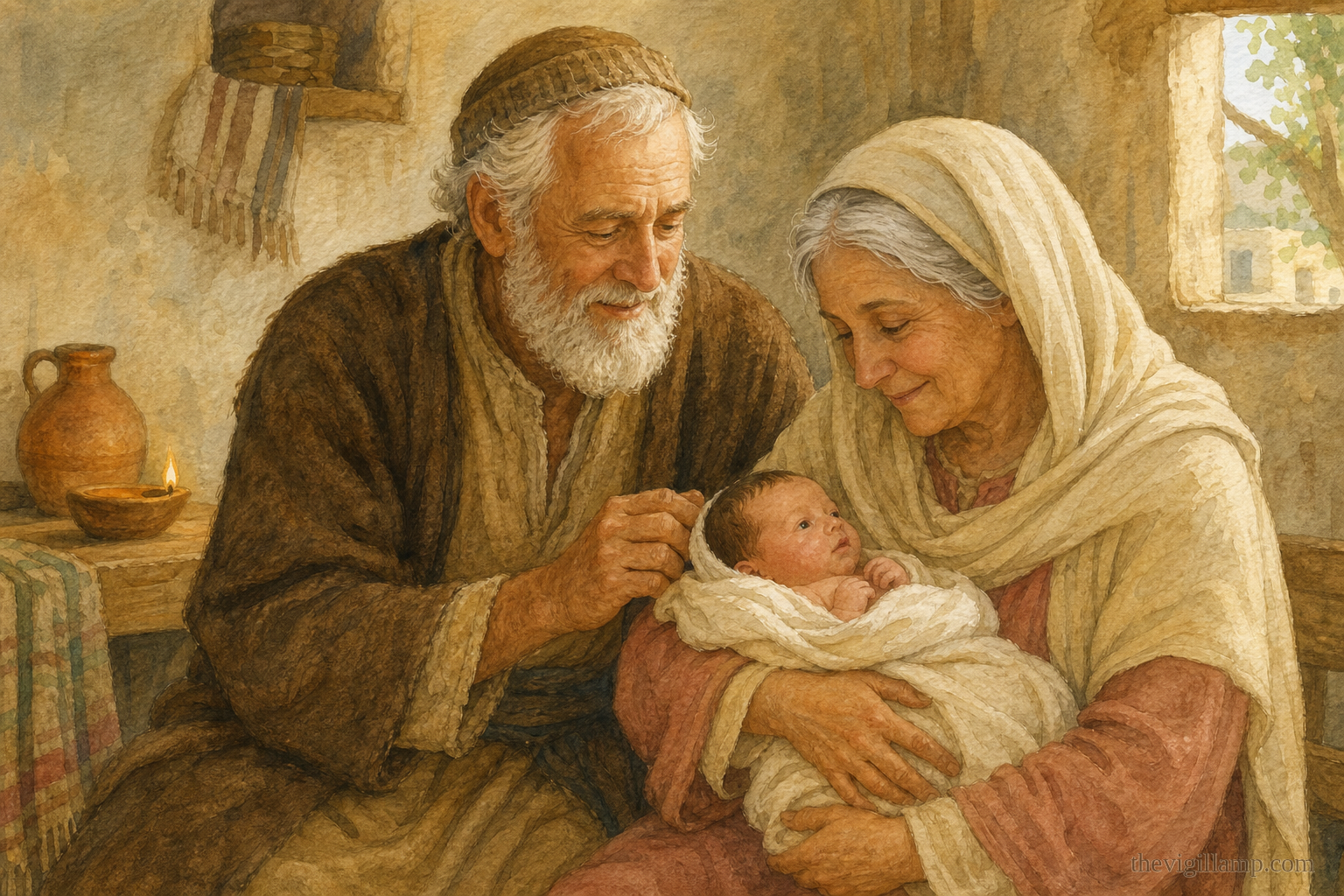
A daughter is born to Joachim and Anna in Nazareth. No extra speech inventedThey name the child Mary. The Church keeps this as a day of universal joy. No extra speech invented
Do you hear what the Church is singing now? Not only that an old house received a child. She is singing that the times themselves are turning. The great and comforting promises of God — the promises for the salvation of the human race — are about to be fulfilled. A girl-child has been born, and in her God is preparing a dwelling.
The Most Holy Virgin Mary surpassed in purity and virtue not only all mankind, but also the angels. She was manifest as the living Temple of God. So the Church sings in her festal hymns: "the East Gate… bringing Christ into the world for the salvation of our souls."
The kontakion of the feast already dares to shout it as a fact: "The barren woman gives birth to the Theotokos, the nourisher of our life."
That is why the Church calls this a day of universal joy. Joachim and Anna are freed from barrenness. Adam and Eve, from the corruption of death. And we, her people, celebrate and sing.
The psalm we heard this morning is not a lectionary appointment. It is a word to hold in the hand: "the Most High has sanctified his tabernacle." Mary is that tabernacle. God is making a holy place on earth, the way a careful father prepares a room before a guest arrives. He is sheltering His people by preparing the Mother.
And the feast readings are not an accident.
The Epistle says that Christ, being in the form of God, took upon Him the form of a servant, and was made in the likeness of men. Before He is laid in the manger, God is already at work. He is preparing the woman who will say yes.
The Gospel of the feast is the one the Church reads for her Mother. The Lord comes into a house. Martha is busy. Mary sits at His feet and hears His word. A woman in the crowd lifts up her voice: "Blessed is the womb that bare thee." And He answers, "Yea rather, blessed are they that hear the word of God, and keep it."
That is Mary's whole life, even before we hear her speak. She will hear. She will keep. Years from this night, when the same Archangel comes to Nazareth, she will say the words the Church has never forgotten: "Behold the handmaid of the Lord; be it unto me according to thy word."
We do not tell the Annunciation as if it were today's story. We only say: God prepared this yes a long time. He prepared Joachim. He prepared Anna. He prepared a house in Nazareth. He prepared the living Temple. And today He has given her — the holy girl-child Mary — and the joy has begun.
The Theotokos is revealed to all of us by grace as a merciful Intercessor and Mother, to whom we have recourse with filial devotion.
And today, so many hundreds of years later, on the day the Church calls a Great Feast, we say her name once more, out loud, together — Most Holy Lady the Theotokos — and she is praying for us still.
Movement Five
The Prayer
Troparion of the Nativity of the Theotokos · Tone 4
Your Nativity, O Virgin, has proclaimed joy to the whole universe! The Sun of Righteousness, Christ our God, has shone from you, O Theotokos! By annulling the curse, He bestowed a blessing. By destroying death, He has granted us eternal Life.
Kontakion of the Nativity of the Theotokos · Tone 4
By your Nativity, O Most Pure Virgin, Joachim and Anna are freed from barrenness; Adam and Eve, from the corruption of death. And we, your people, freed from the guilt of sin, celebrate and sing to you: "The barren woman gives birth to the Theotokos, the nourisher of our life."
The troparion and kontakion appointed by the Orthodox Church in America on the September 8 page of the Nativity of our Most Holy Lady the Mother of God and Ever-Virgin Mary. Wording is exact; slash marks were converted to line breaks only. The OCA cue "(Original Melody)" is a musical note and is not read as part of the hymn. These are the Great Feast hymns, not the Forefeast hymns of September 7.
Movement Six
Let's Talk About It Together
Talk about it:
Today the Church calls this a day of universal joy. What is one joy our family can name out loud — a person, a mercy, a beginning?
God prepared Mary a long time, and then He gave her. What is one thing He has already prepared in our house that we can thank Him for today?
The Gospel of the feast says, "blessed are they that hear the word of God, and keep it." What is one word we have heard — from Scripture, from the Church, from a parent — that we can keep this week?
Movement Seven
Do This Together
Do this togetherAny time of day
The House of Joy
Make a little house: a blanket over a table or two chairs, or a clear space beside the lamp. Yesterday the Church was getting the house ready. Today the child has come. This is not a cave and not a game of hiding. It is a room filled with joy.
One child goes into the quiet and says, slowly, the feast's own shout: "The barren woman gives birth to the Theotokos, the nourisher of our life."
While that child stays still, everyone else is quiet. Count slowly to ten. The hard part is not the words. The hard part is letting the joy be real, and staying.
Then come out, and do one small, real good work right away: clear a plate, help a little brother, say something kind. God prepared a dwelling. We can prepare a kindness.
Take turns. When everyone has had a turn, sit together and each name one joy God has already given this family — a person, a house, a mercy you did not make yourselves. Write those words on a scrap of paper and keep the papers under the lamp until next Sunday.
Little ones (2–4): help them sit still in the "house" and say "thank You, God" while you count to five. · Make it stick: say the psalm together each night this week — "the Most High has sanctified his tabernacle."
“Most Holy Theotokos, save us. Holy and Righteous Joachim and Anna, pray to God for us.”
And close, as the Church always closes, with the Lord's Prayer:
Our Father, Who art in heaven, hallowed be Thy Name. Thy Kingdom come, Thy will be done, on earth as it is in heaven. Give us this day our daily bread, and forgive us our trespasses, as we forgive those who trespass against us; and lead us not into temptation, but deliver us from the evil one. Amen.
Do together: Put out the lamp, or leave it burning a while. The lamp keeps watch until tomorrow. "Glory to God for all things. Amen."
A note on our storytellingEvery edition of The Vigil Lamp is an original retelling. The feast is real, and the names, places, events, and directly quoted words in this edition are drawn from the Orthodox Church in America's traditional account of the Nativity of the Theotokos, from the Church's account of the Holy and Righteous Ancestors of God Joachim and Anna, from the Gospel according to Luke in the King James Version, and from the Church's own appointed hymns and feast readings. The barrenness, the refused offering, the wilderness, the angel, the meeting at the Golden Gate, and the birth of Mary are told as the Church's tradition, without invented detail. No invented historical dialogue is presented as fact. The words of narration are our own, written to make a true story vivid and a joy for families to read aloud together.