
August 25 · Titus and Bartholomew
Titus
O Lord Jesus Christ our God, have mercy on us.”
Crete rises out of the sea with mountains at its heart and harbors along its shore. Long ago, before the Gospel had been preached there, Titus was born on that island into a respected pagan family.
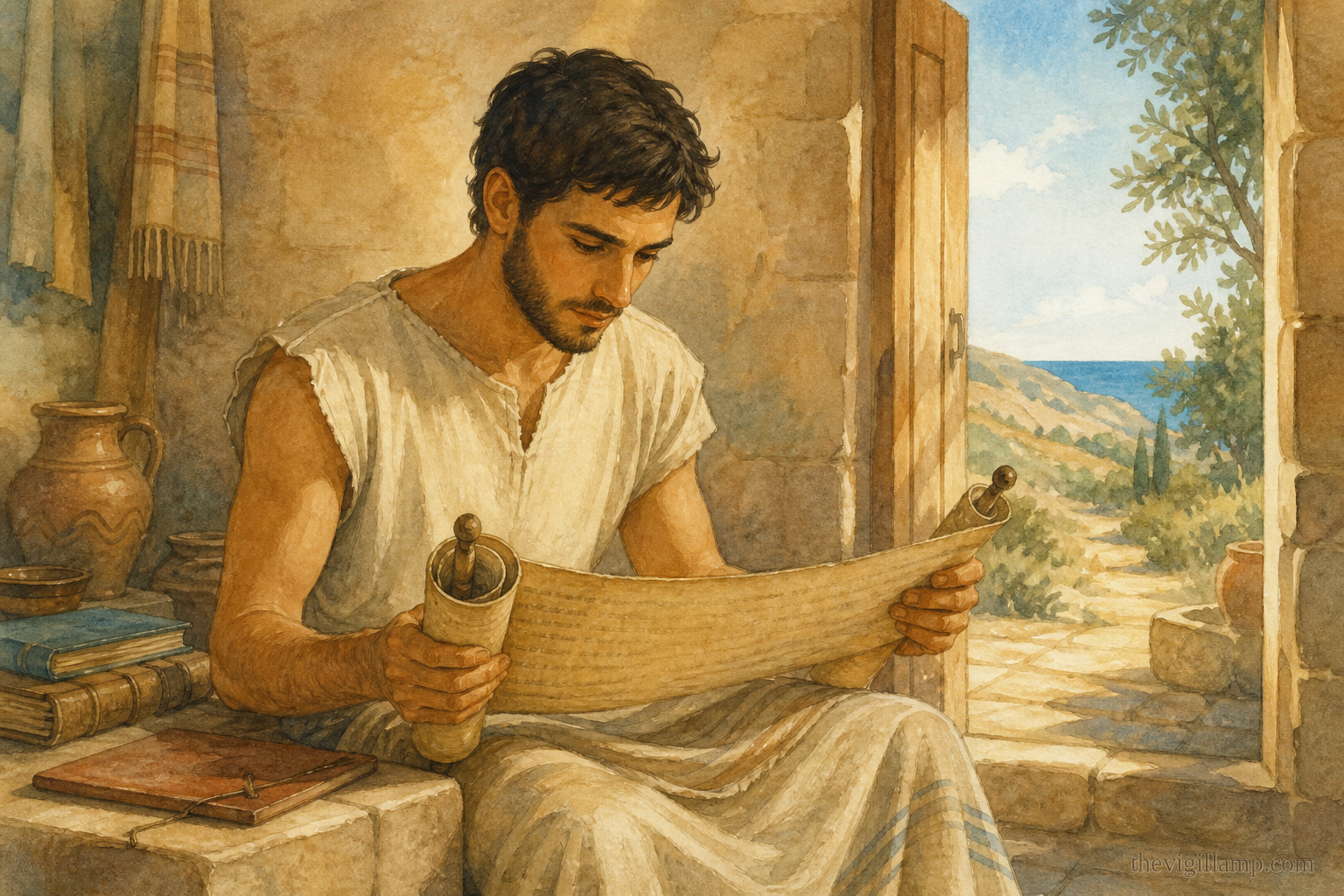
He learned the poems and philosophy of the Greeks. He read. He thought. He asked what wisdom was for. The Church remembers that even before he knew Christ, he tried to live cleanly and would not give himself to the passions around him.
But a shelf full of books can still leave a heart hungry.
When Titus was twenty, the traditional account says that he heard a voice in a dream urging him to look beyond Hellenistic wisdom and seek what could save his soul. He did not rush after the dream. He waited a year. Then he began to read the prophets of God, and the first book he opened was Isaiah.
Then news crossed the water: a great Prophet was teaching in Palestine and working wonders. The governor of Crete, who was Titus's uncle, sent the young man to learn what was happening.
So Titus left the island.
The OCA life preserves the Church's tradition that Titus saw the Lord Jesus in Jerusalem, heard Him preach, and believed; that he witnessed the Cross, the Resurrection, and the Ascension; and that at Pentecost he heard the apostles speak in many tongues — including the language of Crete.
Think of that for a moment. Titus had crossed the sea looking for the truth. Now, in Jerusalem, the mighty works of God were being proclaimed in the language of home.
The Apostle Paul baptized Titus. After that, Titus did not simply sit near a great teacher and listen. He became a fellow worker.
We meet him inside Saint Paul's own letters. Paul took Titus with him and Barnabas to Jerusalem. Some people insisted that a Gentile must first take on the whole Jewish law before he could belong fully to Christ. Titus was Greek, and Paul would not allow the freedom of the Gospel to be taken from him. Titus stood there as living proof: in Christ, a man from a pagan island could truly become a brother.
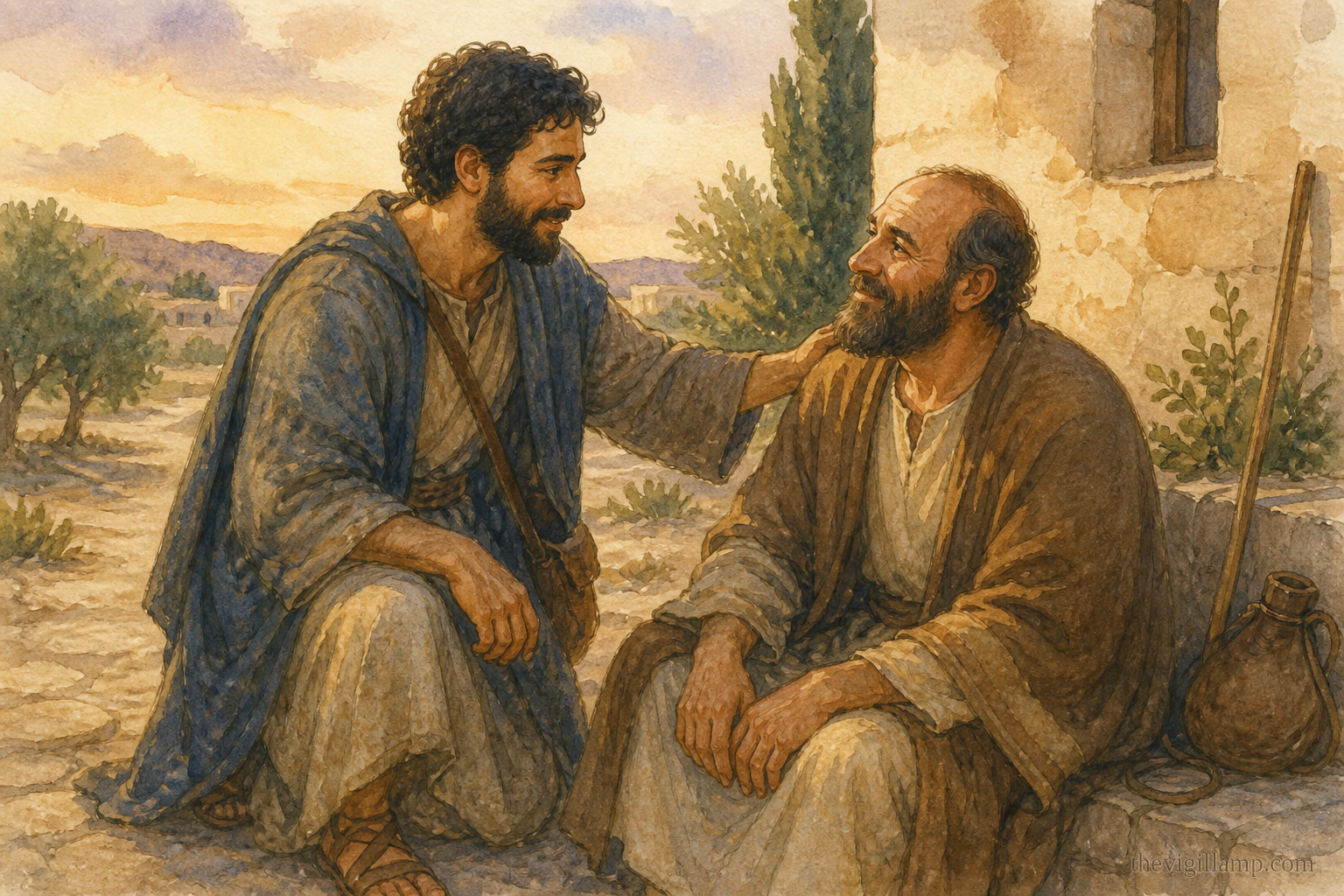
Paul trusted him with hard roads and tender work. The church in Corinth was troubled. Paul had written a severe letter, and he waited anxiously to learn how the Corinthians had received it. Then Titus came back.
Paul wrote that God “comforted us by the coming of Titus.” He wrote of Titus's joy. The people had listened; grief had begun to turn toward repentance; love had not been lost. Titus had carried truth to Corinth, and he carried comfort back to Paul.
That is the sort of messenger Titus was. Not a runner who tossed a letter at the door. He cared what happened after the words were read.
There was another task. Christians were gathering a generous gift for believers in need. Money can become tangled with suspicion, so Paul chose trustworthy companions to help carry it openly and honorably. Titus went willingly. In the very Epistle appointed for today, Paul says, “he went unto you of his own accord.” Then he gives Titus a name any Christian might hope to earn: “my partner and fellowhelper.”
Partner. Fellow worker. A man trusted with wounded friendships, the Church's gifts, and long roads.
At last Paul sent Titus back to Crete and placed the care of the Church there in his hands. Titus became its bishop. Paul later wrote him the letter we still call the Epistle to Titus and greeted him as “mine own son after the common faith.”
Paul's instructions were not grand words for display. Set the churches in order. Appoint faithful elders. Teach what is good. Let older and younger Christians learn how to live with wisdom. Remind everyone to be ready for good works. Avoid foolish quarrels. The Gospel was to become visible in households, friendships, choices, and mercy.
Titus had once left Crete to search for saving truth. Now he came home carrying it.
Imagine the island again: stone paths, high ridges, salt wind, one town beyond another. The bishop could not stand in every doorway at once. He would need faithful people in each place. He would need patience. He would need to teach, correct, encourage, and begin again.
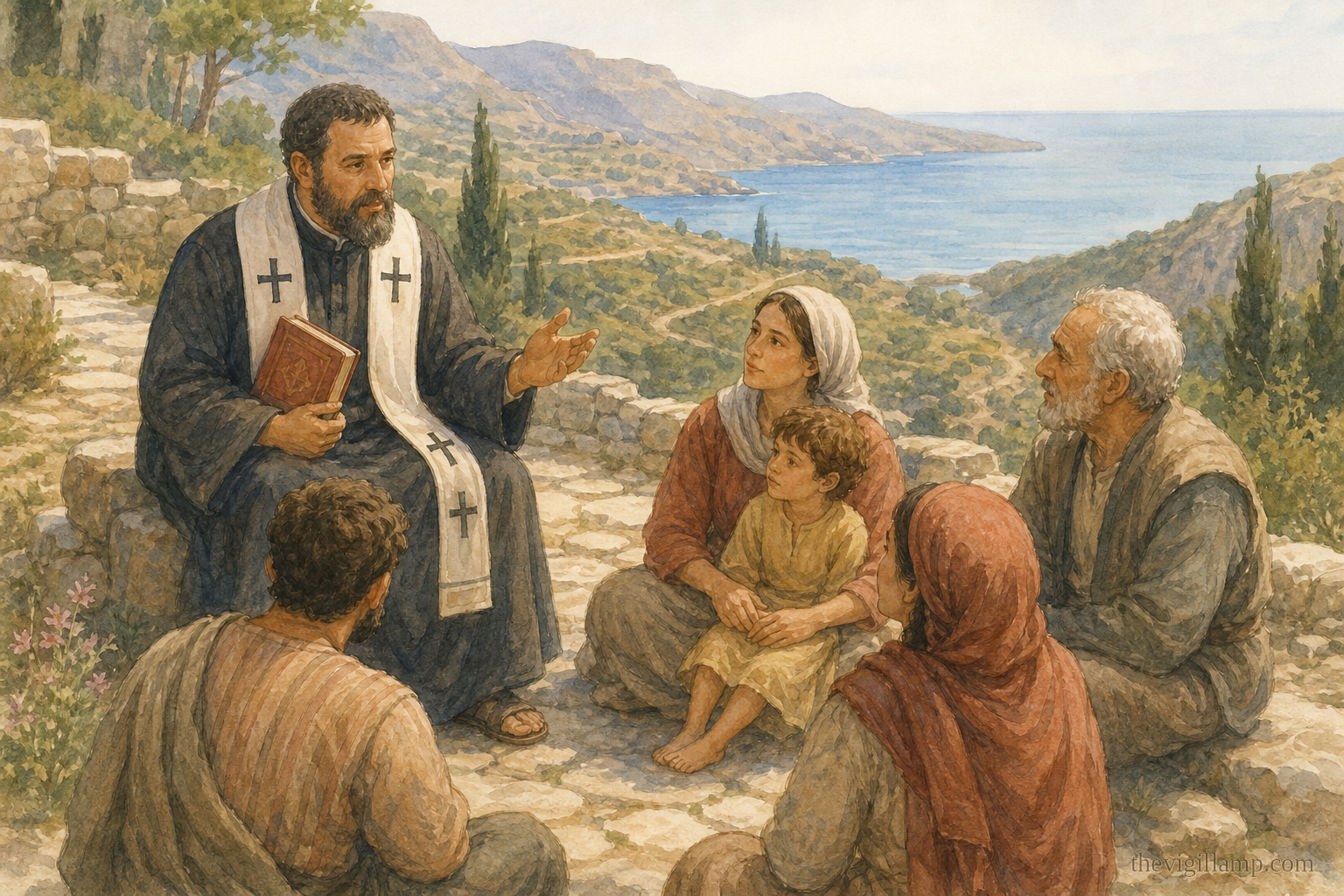
When Paul was taken to Rome to stand trial, the OCA life says Titus left Crete for a time to serve his spiritual father there. After Paul's martyrdom, Titus returned to Gortyna, the chief city of Crete, and went on shepherding his people.
The Church's traditional account also remembers signs that accompanied his preaching. At a pagan festival honoring Diana, Titus preached and prayed when the crowd would not listen; the idol fell and shattered. On another occasion, he prayed that a temple of Zeus would not be completed, and it collapsed. The point was not a contest of noise and stone. People were being called away from things made by hands and toward the living God.
Titus continued preaching Christ across the surrounding country. He lived to the age of ninety-seven and departed in peace. The OCA life says that at his death his face shone like the sun.
Yet August 25 holds another apostolic journey too — one that began long after an apostle's death.
The Church remembers today the return of the relics of the Apostle Bartholomew. He is the Bartholomew named in today's Gospel among the Twelve whom Jesus called to be with Him and sent out to preach.
At the end of the sixth century, the OCA account says, Bartholomew's relics were carried in a chest from Anastasiopolis while the city was under attack. Pagan priests overtook the Christians at the shore and threw the chest into the sea. Four chests holding the relics of other martyrs were cast in as well.
The chests did not sink. By the power of God, they traveled over the waves. Bartholomew's came ashore at Lipari, an island near Sicily. Bishop Agathon, warned of its coming, went with his clergy to the shore. They received the apostle's relics and bore them solemnly to the church.
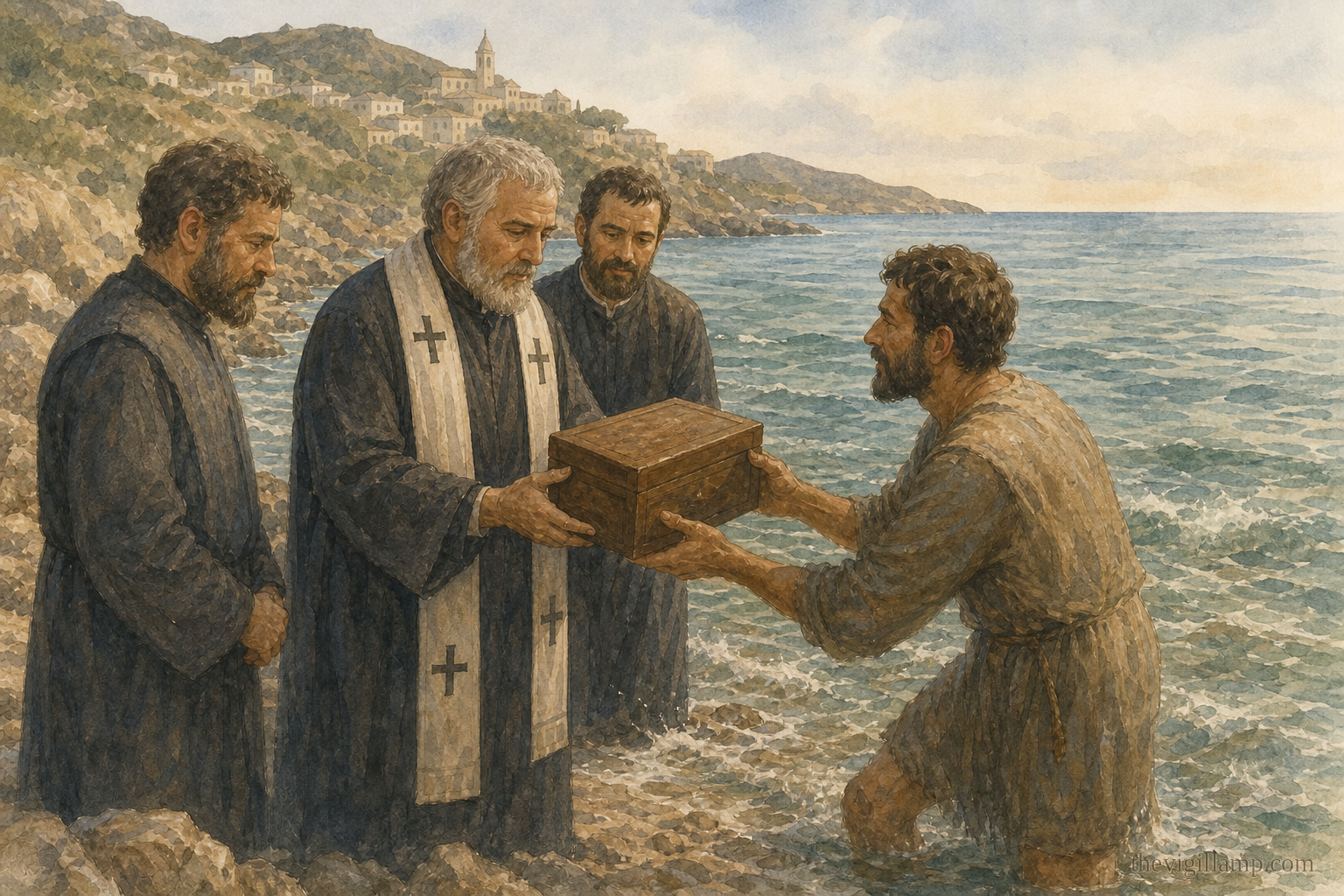
Two apostles, then, and two kinds of journey. Titus crossed the sea alive, searching for truth, and came home to give Crete the Gospel. Bartholomew had gone out at Christ's command; centuries later, even his relics crossed the sea and were welcomed with prayer.
And through both of them the words of the Psalm are heard again: “Their voice is gone out into all the earth.”
Today that voice has reached our room too.
- Put a small basket or bowl beside the lamp. This will be your “gift for the saints,” remembering the collection Titus helped the churches prepare.
- Give each person a scrap of paper. Write or draw one good work that someone in your home needs today: help with dishes, a kind word, a quiet apology, a glass of water, a prayer.
- Fold the papers and place them in the basket. Mix them gently.
- Each person takes one. Say together, “Ready for every good work.” Then do the work before the day ends, without announcing who did what.
- Gather again by the lamp. Do not compare who had the hardest task. Simply ask: Did our hidden work bring comfort to anyone?


pray to God for us.”
on earth as it is in heaven. Give us this day our daily bread,
and forgive us our trespasses, as we forgive those who trespass against us; and lead us not into temptation,
but deliver us from the evil one. Amen.