Do together: Light your lamp or a candle. Then say: “Today the Church begins her year, the Beginning of the Indiction, and remembers our Venerable Father Symeon the Stylite, and the Venerable Martha his mother.”
We begin the way the Church begins any new work
“O Lord Jesus Christ, the only-begotten Son of the eternal Father, Thou hast said, ‘Without me you can do nothing.’ In faith I embrace Thy words, O Lord, and bow before Thy goodness. Help me to complete the work I am about to begin for Thine own glory: in the Name of the Father, and of the Son, and of the Holy Spirit. Amen.”
Then all together:
“Through the prayers of our holy fathers, O Lord Jesus Christ our God, have mercy on us.”
The Orthodox prayer before beginning any work, offered for our family and for yours, each time we begin again.
Movement Two
Read the Icon
Before we hear his story, let’s look at how the Church has always shown him, and learn to read what the icon is telling us.
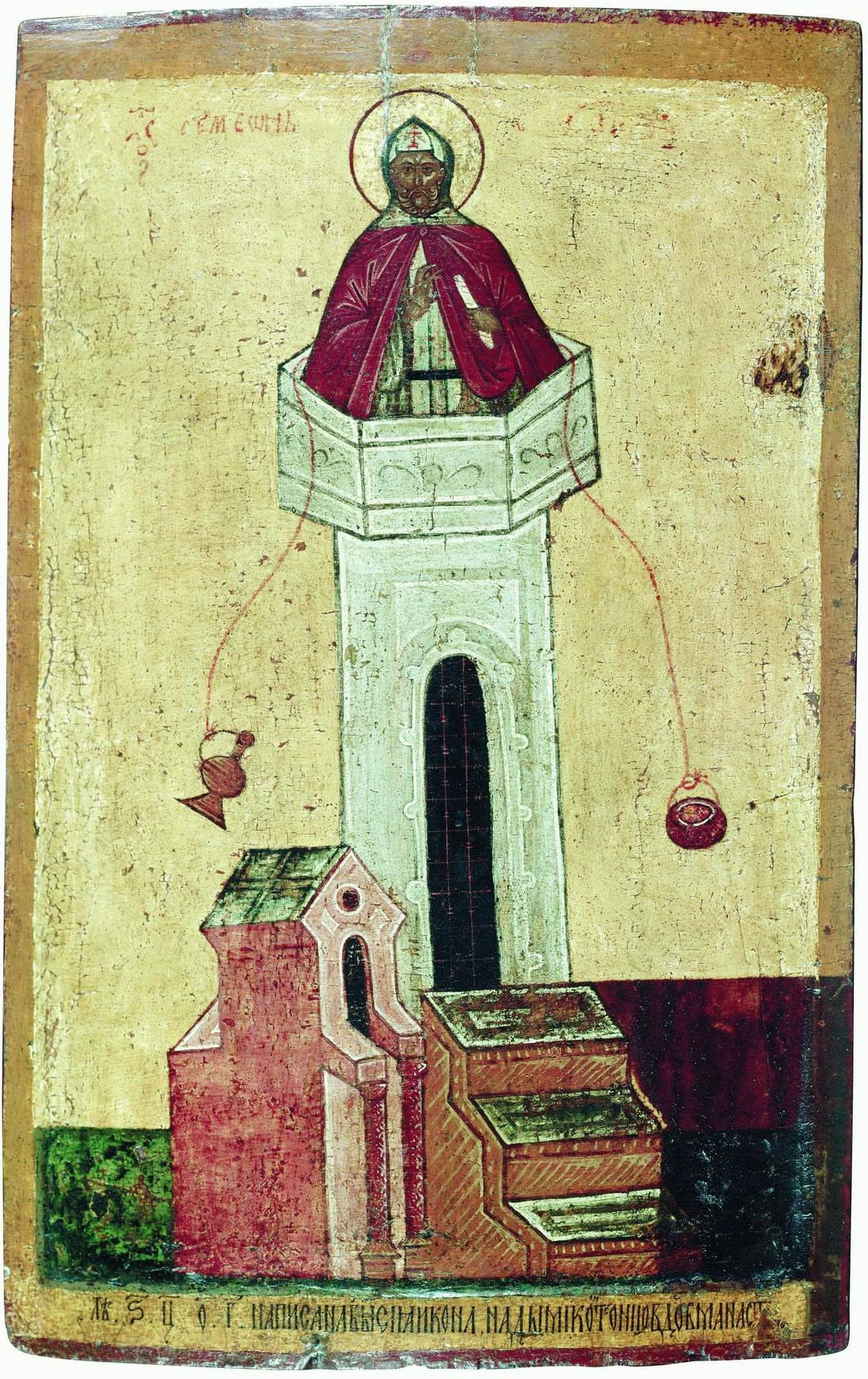
St. Symeon the Stylite, Venerable · traditional icon, Novgorod, 1465 · public domain
What are we looking at?
An icon isn’t a photograph, and it isn’t a painting to admire. It’s a window. Everything in it is there to teach us something true about the saint.
The gold behind him. Not a sky, not a room. Heaven’s own light. The saint stands where God’s light fills everything.
The white pillar. Tall and plain, with a little railing at the top. This is the strange house Symeon chose: a pillar in the open air, so that he could be alone with God.
His monastic hood and dark mantle. These are the clothes of a monk — a man who gave the whole world away. The hood is drawn over his head. He is still at prayer.
His two hands. The right is raised in blessing, the way a priest blesses. The left holds a small white scroll. Even on the pillar, he was not only hiding. He was still teaching, still blessing the people who stood on the ground.
The thin red cords. Look closely. Two ropes hang down the pillar. On one hangs a little jug. On the other, a small basket. The world still reached him. His disciples sent up water and a little food, and he sent down a word.
The name. In old Slavonic letters at the top, in red: СЕМЕОНЪ — Symeon. Every icon names its saint, so you always know whose face you’re looking at.
The panel is not labeled “the Elder.” Novgorod catalogs often treated the Elder (Sept 1) and the Younger (May 24) as one image. We use this icon for today’s feast and describe only what is on the panel. Source: Wikimedia Commons, Simeon Stylites icon 1465 (public domain).
The ReadingsMovement Three
The Scripture the Church appoints for this day. Open your Bible at home and read the passages aloud together, then listen for these words echoing through the saint’s story and the rest of your day.
A Psalm to begin · Psalm 64 (65) : 11
“Thou wilt bless the crown of the year because of thy goodness; and thy plains shall be filled with fatness.”
The Septuagint (Brenton, 1851), the Old Testament of the Orthodox Church.
The Epistle · 1 Timothy 2 : 1–7
“I exhort therefore, that, first of all, supplications, prayers, intercessions, and giving of thanks, be made for all men.”
Open your Bible and read the full passage together. Text: King James Version (public domain).
The Gospel · Luke 4 : 16–22
“The Spirit of the Lord is upon me, because he hath anointed me to preach the gospel to the poor… to preach the acceptable year of the Lord.”
Open your Bible and read the full passage together. Text: King James Version (public domain).
These are the readings appointed for the Church New Year, the Beginning of the Indiction. The Church also appoints, for Saint Symeon, Colossians 3:12–16 and Matthew 11:27–30. Each daily edition carries that day’s own.
Symeon the Stylite the Elder · Read aloud
0:00
/473.155918
Movement Four
The Story
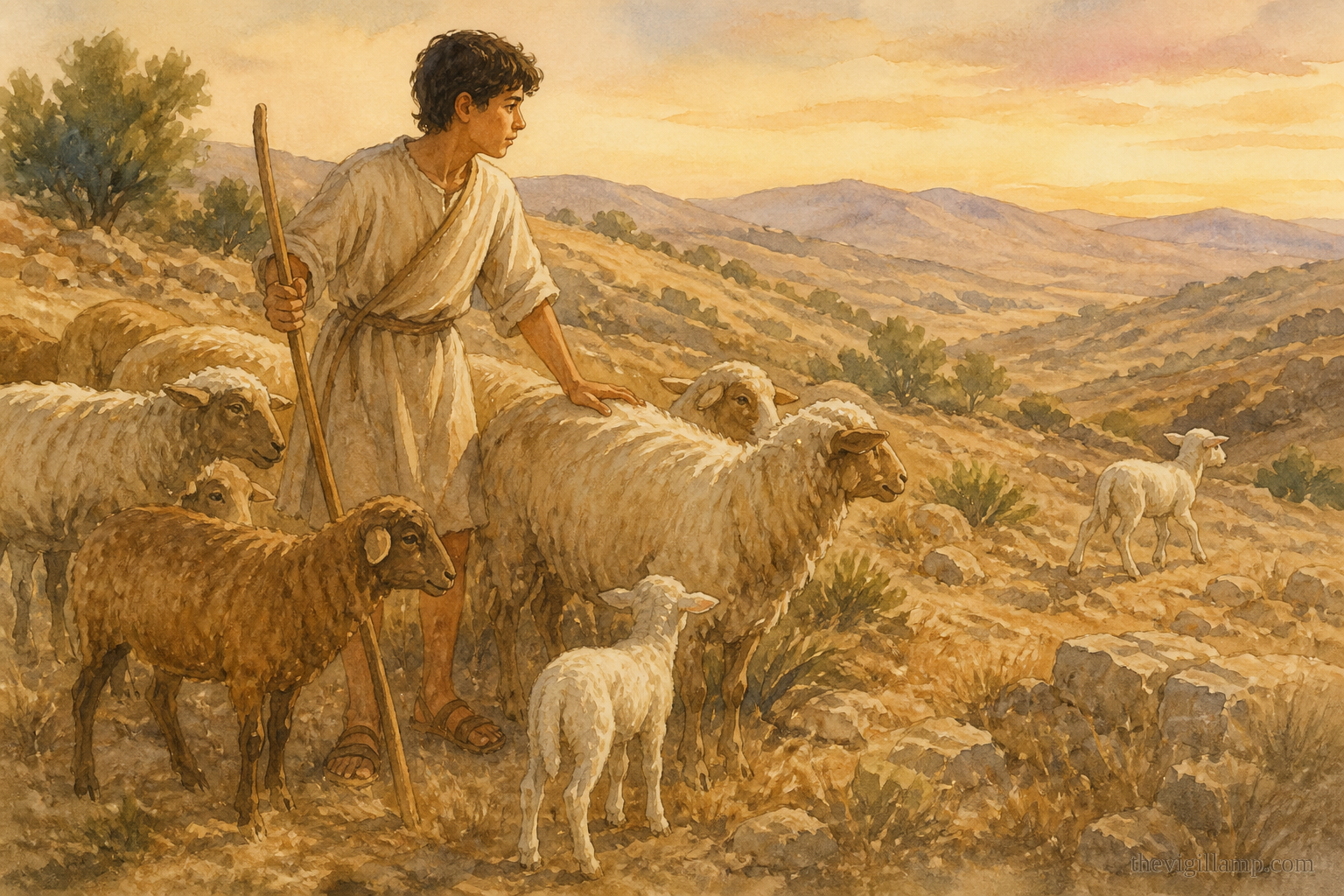
Long ago, in a little village called Sisan, on the border of Cilicia and Syria, there lived a boy named Symeon who kept his father's sheep.
He was thirteen, and he was good at it — not because the work was easy, but because he paid attention. He knew which lamb would stray. He knew which ewe was afraid of the dark. He stayed with them until every one was home.
The boy among the sheep
One Sunday he stood in church, and the priest read the words of the Lord Jesus — the ones we call the Beatitudes.
“Blessed are the poor in spirit, for theirs is the kingdom of heaven. Blessed are they that mourn. Blessed are the meek…”
Symeon heard those words the way a thirsty boy hears a well. He could not let them go.
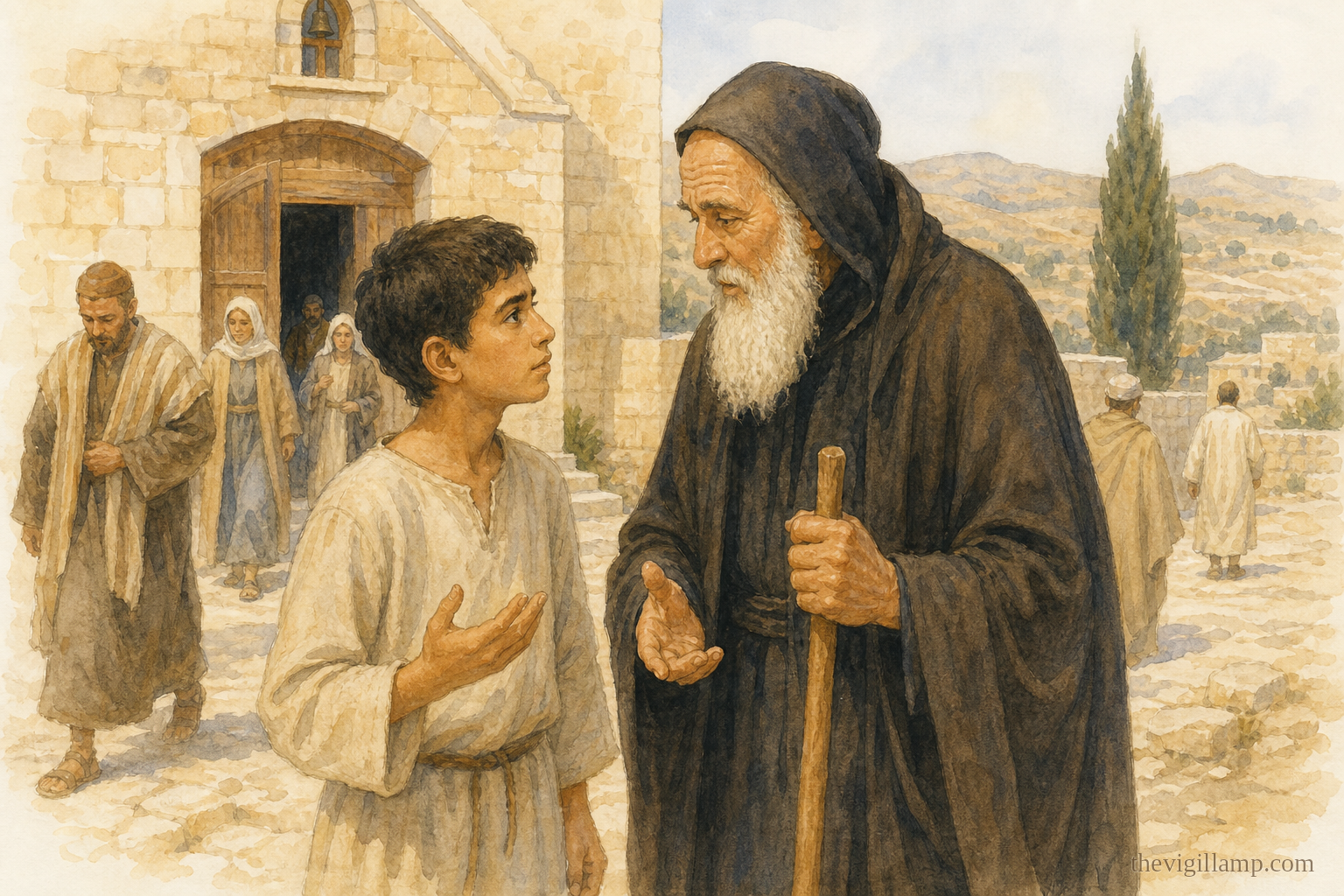
After the service he found an old monk, an Elder who had been praying longer than Symeon had been alive.
After liturgy, asking the Elder
“Father,” he said, “those words. Blessed are the poor. Blessed are the ones who weep. What do they mean? How does a person actually live them?”
The Elder did not laugh. He did not say, You are too young. He explained the words simply, the way you explain something true to a child who is ready. And the words went down into Symeon and stayed there, the way a seed stays in good ground.
When he was eighteen he went to the monastery and received the monastic tonsure — the haircut and the new clothes that say, I belong to God now. He did not ask his mother and father. He simply went.
At the monastery he prayed so hard, and ate so little, that the other brothers grew afraid for him. The igumen — the father of that house — called him in.
“Symeon,” he said. “You must ease this. Or you must go. I will not watch a young monk wear himself away.”
So Symeon went. He lived for a time in an empty well in the mountains, where no one could tell him to stop. After a while the igumen was told, in a dream, to bring him home again. He did. But Symeon did not stay long.
He found a stony cave near a village called Galanissa, and he lived there three years. One Great Lent he ate nothing at all, and drank nothing, for the whole forty days — and God held him up. After that, every Great Lent, he did the same. Twenty days he prayed standing. Twenty days he prayed sitting, so that his body would not give out.
Word got out. People came walking up the hill. They came because they were sick. They came because they wanted a word that was true. The quiet cave was not quiet anymore.
Symeon did a strange thing then — a thing almost no one had done before. He built a pillar, only six or eight feet high, and he climbed up, and he made a little cell on top, and he stayed.
He was not hiding from God. He was hiding from praise. He wanted the solitude back.
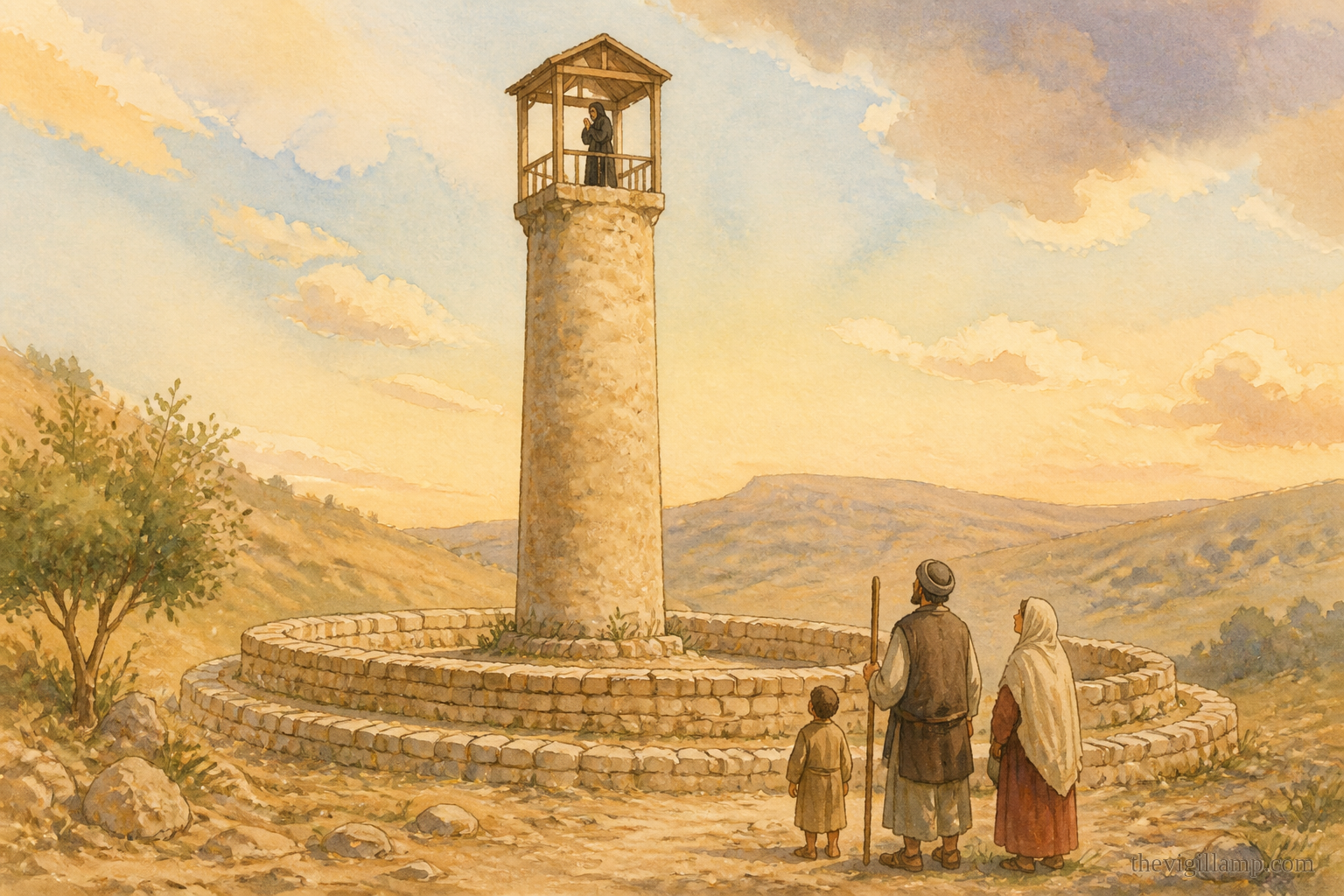
The pillar grew. Year by year they built it higher, because the crowds kept coming. At last it stood eighty feet in the air — as tall as a great tree, as tall as a church. Around it they raised a double wall, so the people could not press in and steal his prayer. Women were not allowed past that wall. Not even his own mother.
The pillar in the hills
The Patriarch of Antioch, Domninos, came all that way, and served the Divine Liturgy on the pillar, and gave Symeon the Holy Mysteries with his own hands.
Out in the desert, the old fathers heard about the man on the pillar. They were not sure. A new kind of holiness can be pride in a clever costume.
They sent messengers.
“Come down,” the messengers said. “The fathers tell you to come down.”
And if he would not come, they were to pull him down by force. But if he would come — if he would obey — they were to leave him there.
Symeon started down at once.
“Stay,” they said then. “Stay, and ask God to be your helper.”
He stayed.
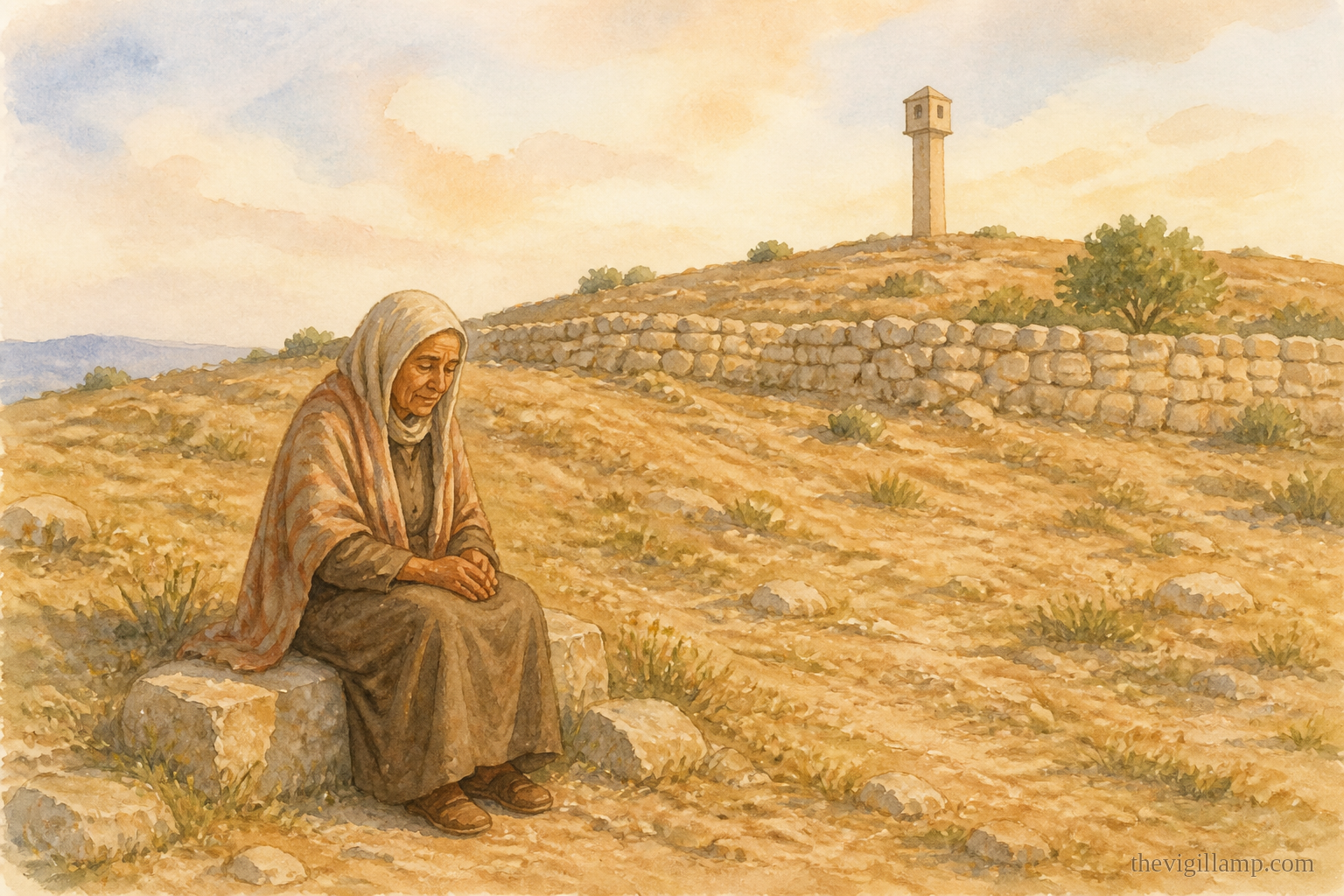
Then his mother found him.
Her name was Martha. She was a poor woman, and she had a husband's name, Sisotian, and she had a son she had not seen since he was a boy. She had been looking for a long time. She came to the wall, and she asked to see him.
Symeon sent word down.
“If we are worthy,” he said, “we shall see one another in the life to come.”
She asked again. He asked her to wait a little, in silence.
And she did. She sat down at the foot of the hill. She did not climb. She did not call. She waited, and she prayed.
Martha waiting at the foot of the hill
There she departed to the Lord.
When they told Symeon, he asked them to bring her body to the foot of the pillar. He prayed over his mother for a long time, and he wept. The people who were watching said a smile came onto her face.
He stood on that pillar forty-seven years. Eighty years, in all, he gave to the monastic life. Men who had never prayed to Christ were baptized, because they had seen a man who would not come down, and they knew that kind of strength does not come from a man alone.
One day he did not appear. For three days the people waited. His disciple Anthony climbed the pillar and found him stooped over, still at prayer — and he was gone. He had died the way he had lived. The Patriarch of Antioch, Martyrius, buried him near the pillar, with a great crowd of clergy and people. Anthony built a monastery there.
And today, so many hundreds of years later, on the day the Church begins her year again, we say his name once more, out loud, together — Venerable Symeon, and Venerable Martha his mother — and they are praying for us still.
Troparion of the Indiction · Tone 2
O Creator of the universe, Thou didst appoint times by Thy power; bless the crown of this year with Thy goodness, O Lord. Preserve in safety Thy rulers and cities: and through the intercessions of the Theotokos, save us!
Kontakion of the Indiction · Tone 4
O Creator and Master of time and the ages, Triune and Merciful God of all: grant blessings for the course of this year, and in Thy boundless mercy save those who worship Thee and cry out in fear: “O Savior, grant blessings to all mankind!”
Troparion of St. Symeon · Tone 1
You were a pillar of patient endurance, having imitated the forefathers, O Venerable One: Job in suffering, and Joseph in temptations. You lived like the bodiless ones while yet in the flesh, O Simeon, our Father. Beseech Christ God that our souls may be saved.
Kontakion of St. Symeon · Tone 2
Seeking the things of the Highest, and having made your pillar a fiery chariot, you were joined to the heights. Therefore, you have become a companion to the angels, O Venerable One, and with them you are praying incessantly to Christ God for us all.
The troparia and kontakia appointed by the Church for September 1 (Orthodox Church in America). Production editions use a public-domain or project-approved liturgical translation.
Talk about it: Symeon heard the Beatitudes one morning and could not let them go. Which words of Jesus have stayed with you — a line you keep hearing, even after you leave the room?
He would not come down from the pillar, not even for his own mother, and she waited in silence at the foot of the hill. What does it mean to love someone and still let them belong to God first?
Today the Church begins a new year, and asks God to bless the crown of it. What is one thing our family wants to begin again, with His blessing?
Do this togetherAny time of day
The Pillar and the New Year
Stack books, or set a low stool, in the middle of the room — a little “pillar,” only as high as is safe.
One child stands still on it (or beside it, if the stack is too tall) and says, slowly, “Blessed are the poor in spirit, for theirs is the kingdom of heaven.”
While that child stands still, everyone else is quiet. Count slowly to ten. The hard part is not the words. The hard part is staying.
Then come down, and do one small, real good work right away: clear a plate, help a little brother, say something kind. Symeon went up so he could pray. We come down so we can love the people in the room.
Take turns. When everyone has had a turn, sit together and each name one thing you want God to bless in this new Church year — one hope, one thank-You, one beginning. Write them on a scrap of paper and keep the papers under the lamp until next Sunday.
Little ones (2–4): just help them stand still and say “thank You, God” while you count to five. · Make it stick: say the psalm together each night this week — “Thou wilt bless the crown of the year because of thy goodness.”
“Holy Venerable Father Symeon, and Venerable Martha, pray to God for us.”
And close, as the Church always closes, with the Lord’s Prayer:
Our Father, Who art in heaven, hallowed be Thy Name. Thy Kingdom come, Thy will be done, on earth as it is in heaven. Give us this day our daily bread, and forgive us our trespasses, as we forgive those who trespass against us; and lead us not into temptation, but deliver us from the evil one. Amen.
Do together: Put out the lamp, or leave it burning a while. The lamp keeps watch until tomorrow. “Glory to God for all things. Amen.”
A note on our storytellingEvery edition of The Vigil Lamp is an original retelling. The saints are real, and the names, places, and events of this life are drawn faithfully from traditional and public-domain accounts — chiefly the life of Saint Simeon the Stylite the Elder and of the Venerable Martha as given by the Orthodox Church in America, and the Church’s own appointed hymns and readings for the Beginning of the Indiction. The words are our own, written to make a true story vivid and a joy for families to read aloud together.