Leavetaking of the Nativity of the Most Holy Theotokos
Hieromartyr Autonomus, Bishop in Italy
✦ ✦ ✦
Before you begin
Today's Vigil is for your family, not the other way around. If anything feels like too much, that's okay. Do the parts your family loves, and work your way up to the whole Vigil in one sitting.
Movement One
Light the Lamp
Do together: Light your lamp or a candle. Then say: "Today the Church keeps the Leavetaking of the Nativity of the Most Holy Theotokos, and remembers Hieromartyr Autonomus, Bishop in Italy."
We begin the way the Church begins any new work
“O Lord Jesus Christ, the only-begotten Son of the eternal Father, Thou hast said, 'Without me you can do nothing.' In faith I embrace Thy words, O Lord, and bow before Thy goodness. Help me to complete the work I am about to begin for Thine own glory: in the Name of the Father, and of the Son, and of the Holy Spirit. Amen.”
Then all together:
“Through the prayers of our holy fathers, O Lord Jesus Christ our God, have mercy on us.”
The Orthodox prayer before beginning any work, offered for our family and for yours, each time we begin again.
Movement Two
Read the Icon
Before we hear his story, let's look at how the Church has always shown him, and learn to read what this icon is telling us.
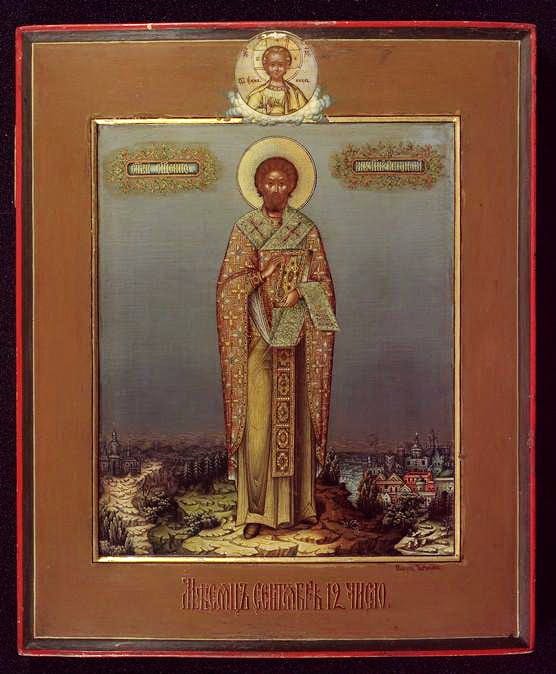
Hieromartyr Autonomus, Bishop in Italy · monthly menaion figure · Osip Semenovich Chirikov · Russia, nineteenth century · State Museum of the History of Religion
What are we looking at?
An icon isn't a photograph, and it isn't a painting to admire. It's a window. Everything in it is there to teach us something true about the saint.
The gold around his head. A round gold halo, quiet and whole. Not a crown he bought. Heaven's own light. The saint stands where God's light fills everything.
Autonomus, in the middle. He stands full-length, facing us. He is not falling. He is not hiding. On this panel he stands, and he teaches.
His bishop's clothes. A pale inner robe reaches his feet. Over it a reddish-brown vestment is worked with small gold crosses. Across his shoulders a white band hangs, marked with large dark crosses — the omophorion, the Church's way of naming a bishop. These are the clothes of a man set apart to serve the holy mysteries, and to keep the word.
His two hands. The left holds a Gospel book, gold and jeweled. The right holds a small open scroll. Even now the Church will not let us see him empty-handed. He was a teacher. He was a shepherd. The book and the scroll say the same thing: the word went out.
The little landscape. Behind him the painter has set water, and rocky ground, and houses with church-domes. We will not invent which city they are. This is not a map. The Church is telling us he did not stay in one room.
Christ above him. In a small round cloud at the top, the Lord is painted blessing. Autonomus does not stand by his own strength. The one who sent the Apostles is the one who sent him.
The name and the day. Church Slavonic writing stands in the upper corners, and along the lower border the twelfth of September is written. We will not invent letters we cannot clearly read. Every icon means to name its saint. The Church has already named him: Hieromartyr Autonomus, Bishop in Italy.
This is not yesterday's Theodora, and it is not the birth-chamber of four days ago. This is the bishop the Church remembers today.
Osip Semenovich Chirikov, Holy Hieromartyr Autonomus, nineteenth-century monthly menaion icon, tempera on wood; State Museum of the History of Religion. Public domain. Image via Wikimedia Commons, from the State Catalogue of the Museum Fund of the Russian Federation. The day's own miniature in the Menologion of Basil II was inspected: it is a martyrdom scene and is not shown to the family. The seventeenth-century TsAK September Menaion figure of the same saint was inspected and is held as unused backup. Modern OCA files were not used.
The ReadingsMovement Three
The Scripture the Church appoints for this day. Open your Bible at home and read the passages aloud together, then listen for these words echoing through the story and the rest of your day.
A Psalm to begin · Psalm 115 (116) : 4
“I will take the cup of salvation, and call upon the name of the Lord.”
The Septuagint (Brenton, 1851), the Old Testament of the Orthodox Church. In ordinary English Bibles this is Psalm 116:13. This verse is chosen for prayer today; it is not a separate lectionary appointment.
The Epistle · Philippians 2 : 5–11
“And being found in fashion as a man, he humbled himself, and became obedient unto death, even the death of the cross.”
Open your Bible and read the full passage together. Text: King James Version (public domain).
The Gospel · Luke 10 : 38–42; 11 : 27–28
“Yea rather, blessed are they that hear the word of God, and keep it.”
Open your Bible and read the full passage together. Text: King James Version (public domain).
These are the feast readings appointed by the Orthodox Church in America for the Leavetaking of the Nativity of the Theotokos on Saturday, September 12, 2026. The same Theotokos pair — Philippians 2:5–11 and Luke 10:38–42; 11:27–28 — was appointed on September 8, and the monthly lectionary lists it again today, labeled (Theotokos). Because this Saturday is also the Saturday before the Elevation of the Cross, OCA also appoints 1 Corinthians 2:6–9 and Matthew 10:37–11:1, labeled (Saturday Before). The ordinary Saturday pair, 1 Corinthians 4:17–5:5 and Matthew 24:1–13, is listed as well. No separate saint pair is listed for Autonomus. This edition carries the Leavetaking / Theotokos pair.
Autonomus · Read aloud
0:00
/531.435102
Movement Four
The Story
The joy is still in the house.
Four days ago the Church opened the door. She kept a Great Feast. She sang that a girl-child had been born, and her name is Mary. Then she gathered the parents. Then she remembered three sisters who would not come apart. Yesterday she named a woman who sinned, and was sorry, and did not turn back.
Today is not that day again.
Today is the Leavetaking. The Church has another word for this last day: Apodosis. It is not the feast thrown away. It is the feast given its last full hour. The hymns of the birth are sung once more as the feast's own.
And today the Church does another thing she loves to do while a Great Feast is still in the room.
She remembers a bishop who would not stop preaching.
The Church remembers more than one name on the twelfth of September. She remembers Venerable Bassian of Tiksnensk, and the translation of the relics of Righteous Simeon of Verkhoturye, and other holy names. Those are true days. We will not tell those whole lives this morning.
This morning she asks us to look at Autonomus.
His name is Autonomus. The Church calls him hieromartyr — a bishop who gave his life for Christ. He was a bishop in Italy. The year she gives for his offering is 313.
Do you hear what she is already singing for him? "By sharing in the ways of the Apostles, you became a successor to their throne."
That is today's word. Not a man who stayed home. A man who went, the way the Apostles went.
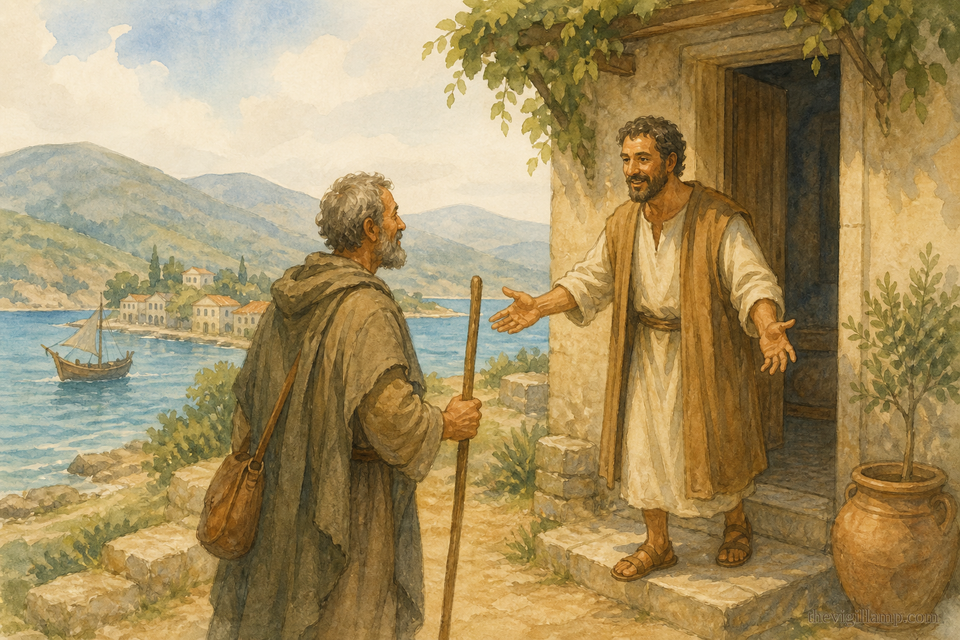
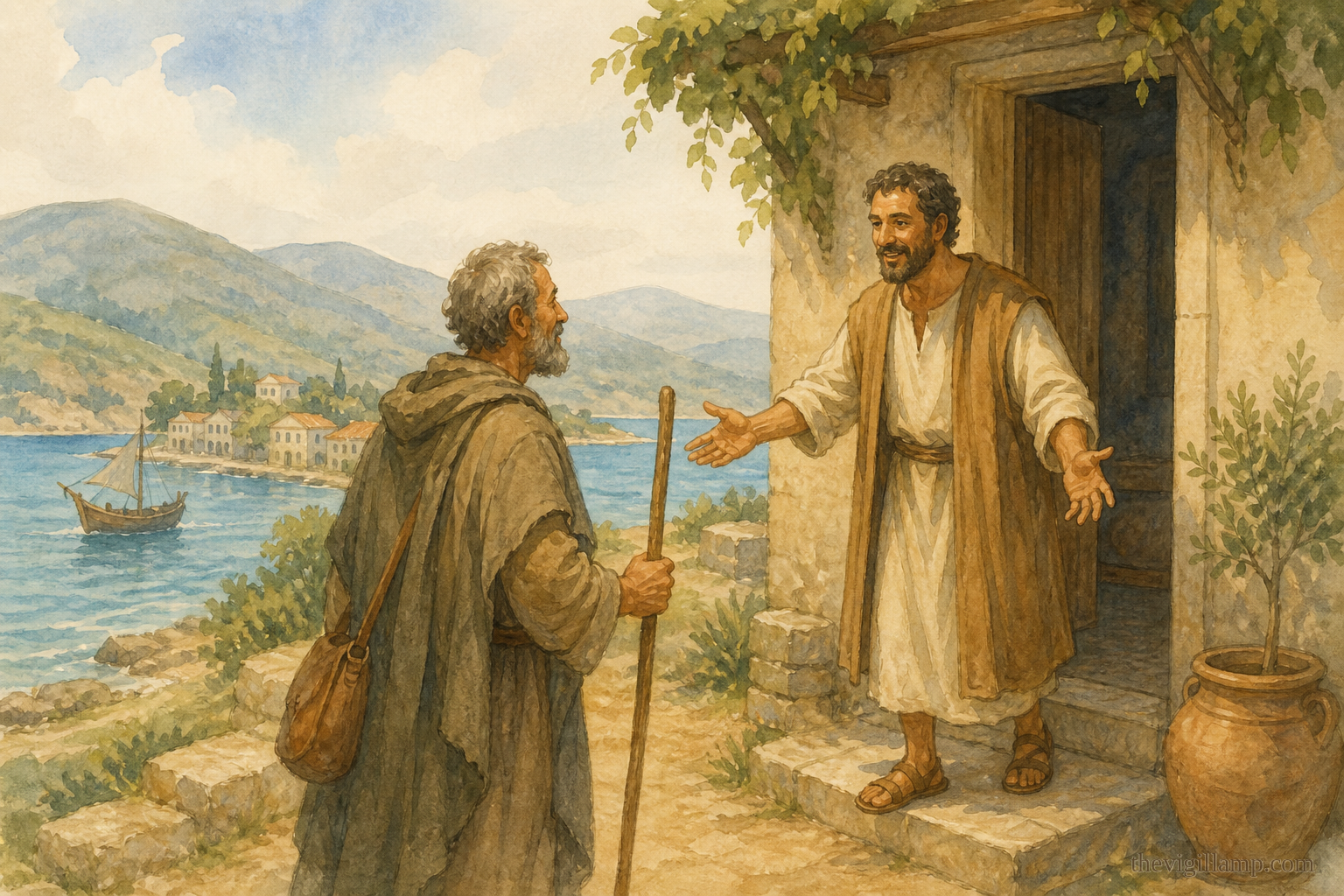
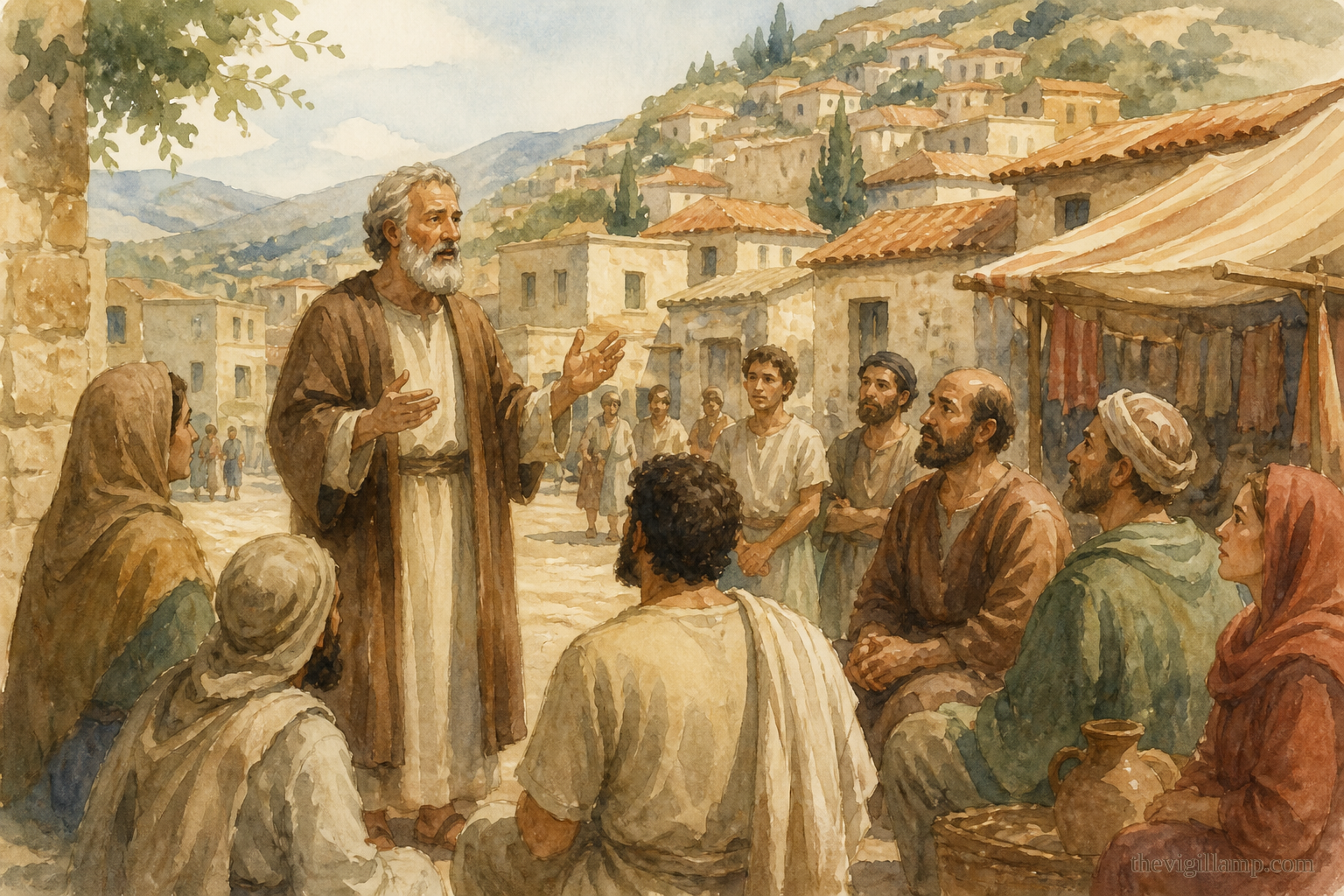
In the days of the emperor Diocletian there was a hard persecution against the Christians. Saint Autonomus left his own country. He resettled in Bithynia, in a place called Soreus, with a man named Cornelius.
He did not go there to hide the word.
He did his apostolic duty with zeal. He converted so many pagans to Christ that a large Church was formed.
Autonomus leaving Italy in the days of Diocletian, and being received in Bithynia by Cornelius. No extra speech invented
The house of Cornelius could not hold them all.
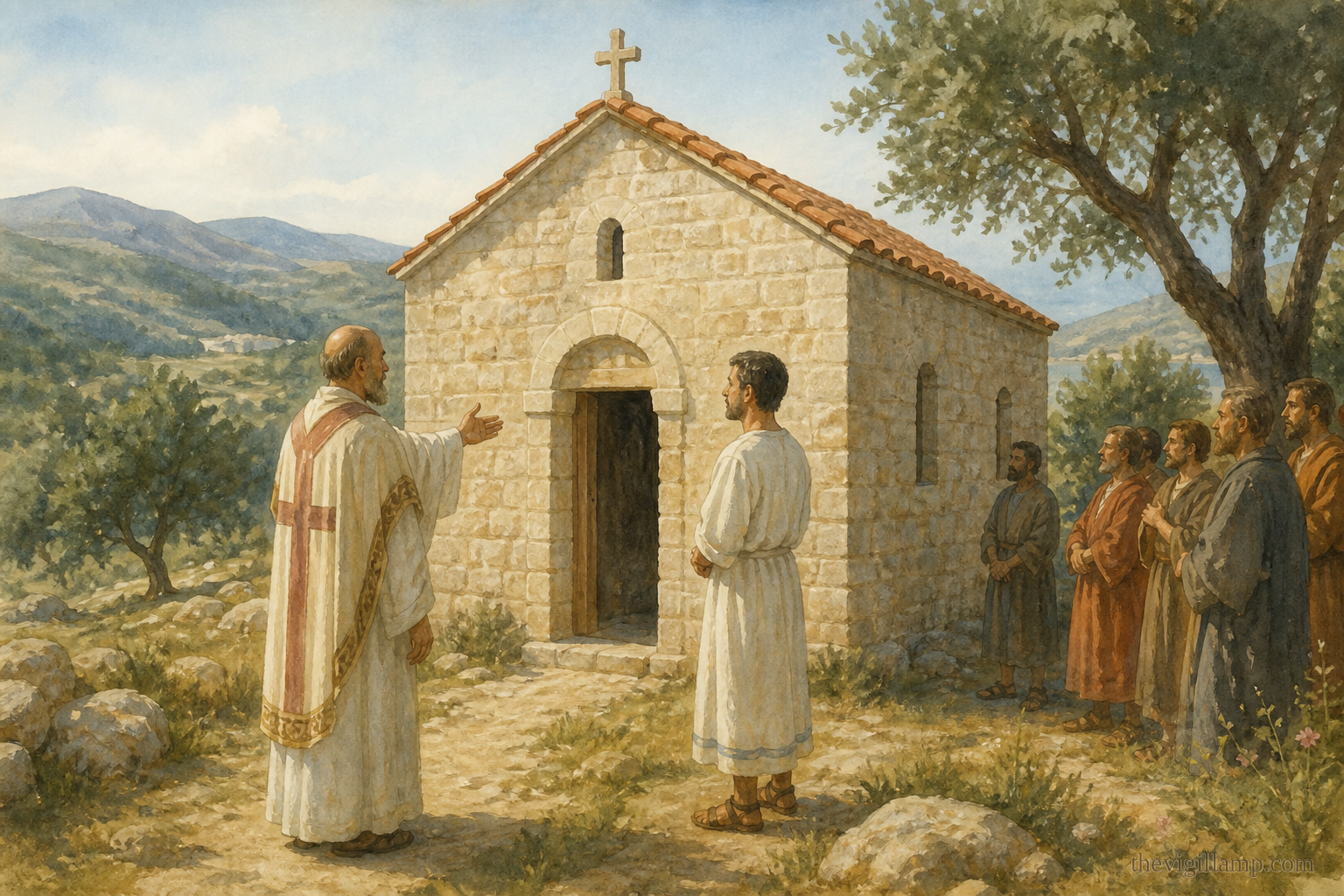
So Autonomus consecrated a temple in the name of the Archangel Michael. For that church he first ordained Cornelius as deacon, and then as presbyter.
Do you hear that? A church named for the captain of the heavenly hosts. A man of the house set apart to serve. The word had made a people, and the people needed a house.
Autonomus raising a church in the name of the Archangel Michael, and setting Cornelius to serve. No extra speech invented
Preaching about Christ, Saint Autonomus visited also Lykaonia and Isauria.
The emperor Diocletian gave orders to arrest him. The saint withdrew to Claudiopolis on the Black Sea. He did not go there to be finished. He went on preaching.
When he returned to Soreus, he had the priest Cornelius ordained bishop. Then Autonomus went to Asia. When he had returned from there, he began to preach in the vicinity of Limna, near Soreus.
The Church will not let us tell him as if he sat down after the first village.
Autonomus preaching the word in Lykaonia, Isauria, Claudiopolis, and Limna. No extra speech invented
Once, the newly-converted destroyed a pagan temple. The pagans decided to take revenge on the Christians.
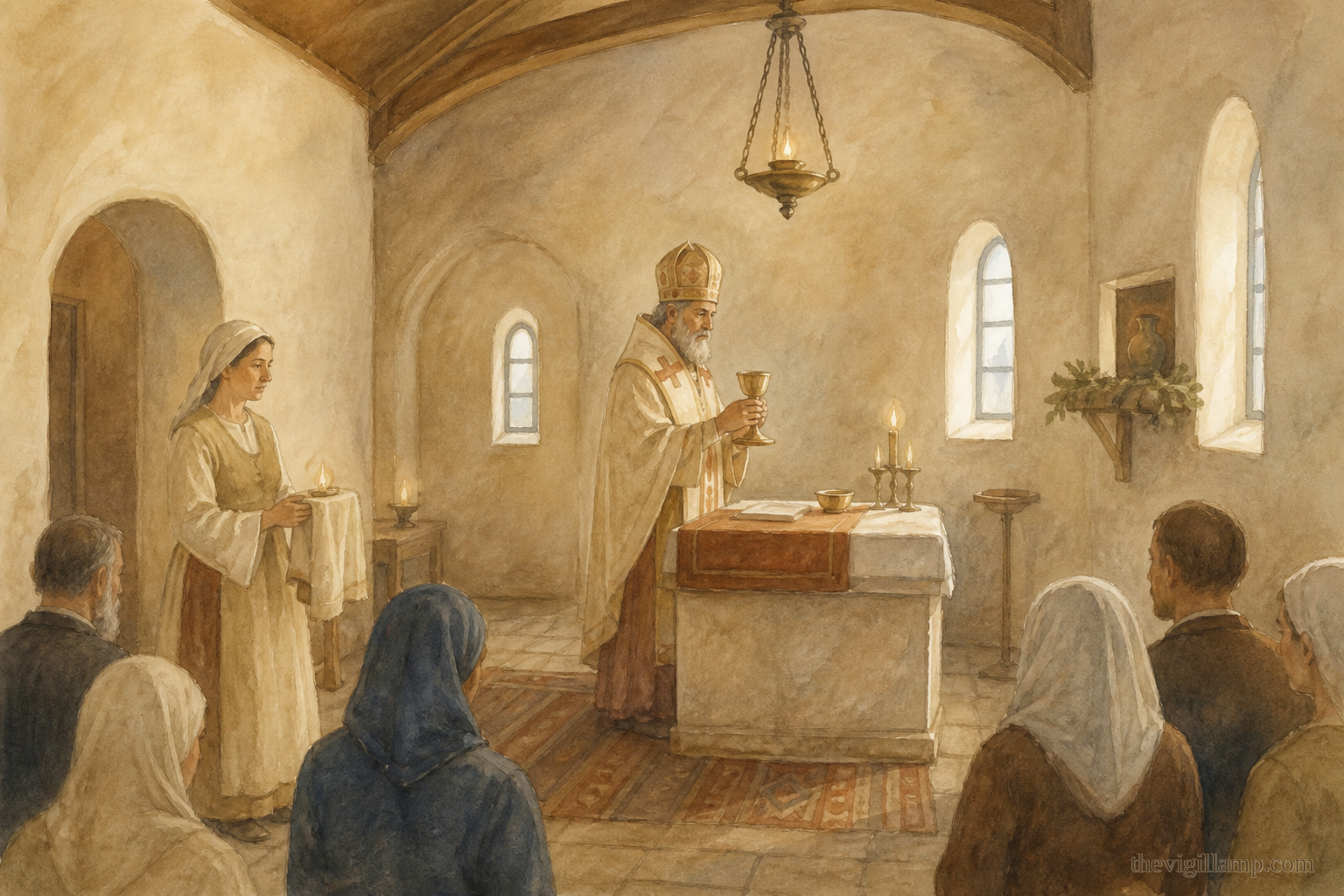
Seizing their chance, they rushed upon the church of the Archangel Michael when Saint Autonomus was serving Divine Liturgy there.
We will not linger on the manner of his sufferings. The Church knows them, and that is enough for us this morning.
He was serving the holy mysteries. He gave his life there. The Church says it this way: he became an acceptable sacrifice while partaking of the cup of Christ.
The deaconess Maria removed the body of the holy martyr and buried it.
Those are the Church's words. We will not invent others.
Autonomus serving the Divine Liturgy in the church he had raised; the deaconess Maria burying him. No extra speech invented
During the reign of Saint Constantine the Great, a church was built over his tomb. In the year 430, a certain priest had the old church pulled down. He did not realize the martyr's body had been buried beneath it. He rebuilt the church in a new spot.
After another sixty years the relics of the saint were found incorrupt, and a church was then built in the name of the Hieromartyr Autonomus.
Do you hear what the Church is singing now? Not only that he died. She is singing that he taught, and that he served.
"By teaching the word of truth without error, you defended the Faith, even to the shedding of your blood."
And again: "With reverence you served the divine mysteries, O wise one."
And again: "Hieromartyr Autonomus, entreat Christ God to save our souls."
The word we heard this morning is the Leavetaking word, the same pair the Church appointed on the Great Feast. "Yea rather, blessed are they that hear the word of God, and keep it." A woman in the crowd blessed the Mother. The Lord did not put the Mother down. He opened the blessing wider. Blessed are they that hear. Blessed are they that keep.
Autonomus heard. He kept. He went from country to country so other people could hear and keep.
And the Epistle says, "he humbled himself, and became obedient unto death, even the death of the cross." The Lord went all the way. The bishop who shared in the ways of the Apostles went all the way too — not because he was the Lord, but because he belonged to Him.
The same reading has another word, because this is still the Leavetaking: "Who, being in the form of God… took upon him the form of a servant, and was made in the likeness of men." Four days ago the Church named the child from whom that likeness would be taken. The joy is still in the house. Autonomus belongs to the same Lord who took flesh from her.
The psalm we held in the hand is not a lectionary appointment. It is a word that already knows his kontakion: "I will take the cup of salvation, and call upon the name of the Lord."
He took that cup at the altar. He called upon the Name. The Church will not let us tell the end as if the Liturgy were an accident.
That is why the Church will not let the Leavetaking stand without this bishop. While she is still singing the birth, she names a man who heard the word, and kept it, and would not stop.
And today, so many hundreds of years later, on the Leavetaking, we say his name once more, out loud, together — Hieromartyr Autonomus, Bishop in Italy — and he is praying for us still.
Movement Five
The Prayer
Troparion of Saint Autonomus · Tone 4
By sharing in the ways of the Apostles, you became a successor to their throne. Through the practice of virtue, you found the way to divine contemplation, O inspired one of God; by teaching the word of truth without error, you defended the Faith, even to the shedding of your blood. Hieromartyr Autonomus, entreat Christ God to save our souls.
Kontakion of Saint Autonomus · Tone 2
With reverence you served the divine mysteries, O wise one, and became an acceptable sacrifice while partaking of the cup of Christ. Now, as you stand before Him, holy martyr Autonomus, unceasingly intercede for us all.
Troparion of the Leavetaking · Tone 4
Your Nativity, O Virgin, has proclaimed joy to the whole universe! The Sun of Righteousness, Christ our God, has shone from You, O Theotokos! By annulling the curse, He bestowed a blessing. By destroying death, He has granted us eternal Life.
Kontakion of the Leavetaking · Tone 4
By Your Nativity, O Most Pure Virgin, Joachim and Anna are freed from barrenness; Adam and Eve, from the corruption of death. And we, your people, freed from the guilt of sin, celebrate and sing to you: The barren woman gives birth to the Theotokos, the nourisher of our life!
The troparion and kontakion of Saint Autonomus, and the troparion and kontakion of the Leavetaking, appointed by the Orthodox Church in America on the September 12 hymn pages. Wording is exact; slash marks were converted to line breaks only. These are today's appointed hymns. They are not the Forefeast hymns of September 7. The Leavetaking pair is the feast's own hymn, still appointed on this last day; it is not printed as if September 8 had come again as a second full feast. Hymns for Bassian, Simeon of Verkhoturye, Theodore, Coronatus, Athanasius, Dositheus, and the other same-day names are not printed here.
Movement Six
Let's Talk About It Together
Talk about it:
Autonomus left his own country so he could keep preaching. When does our family need to keep a good work even when it would be easier to stay put?
The Gospel of the Leavetaking says, "blessed are they that hear the word of God, and keep it." What is one word we have heard — from Scripture, from the Church, from a parent — that we can keep this week?
Today is the Leavetaking: the last day the Church sings the feast as the feast's own. What is one joy from these days we do not want to put down?
Movement Seven
Do This Together
Do this togetherAny time of day
The Word That Is Kept
Stand in the middle of the room as if it were a little church — only as ordinary as your own house. Today the Church remembers a bishop who served the holy mysteries in the church he had raised, and who would not stop teaching the word. This is not yesterday's turning at the gates, and it is not the Great Feast's little house of joy. It is a keeping.
Stand still together for a slow count of ten. No talking. Autonomus kept the word. The hard part is not the words. The hard part is remaining with them.
Then one child says, slowly, his own day's shout: "by teaching the word of truth without error, you defended the Faith."
That child does one small, real good work right away: clear a plate, help a little brother, say something kind. He went so other people could hear. We can keep one word in this room.
Take turns. When everyone has had a turn, sit together and each name one word you want to keep this week — a verse, a kindness you have been putting off, a true thing you do not want to drop when the feast's last hour is over. Write those words on scraps of paper and keep them under the lamp until next Sunday.
Little ones (2–4): help them stand still and say "thank You, God" while you count to five, then help them say "Autonomus." · Make it stick: say the psalm together each night this week — "I will take the cup of salvation, and call upon the name of the Lord."
“Holy Hieromartyr Autonomus, pray to God for us. Most Holy Theotokos, save us.”
And close, as the Church always closes, with the Lord's Prayer:
Our Father, Who art in heaven, hallowed be Thy Name. Thy Kingdom come, Thy will be done, on earth as it is in heaven. Give us this day our daily bread, and forgive us our trespasses, as we forgive those who trespass against us; and lead us not into temptation, but deliver us from the evil one. Amen.
Do together: Put out the lamp, or leave it burning a while. The lamp keeps watch until tomorrow. "Glory to God for all things. Amen."
A note on our storytellingEvery edition of The Vigil Lamp is an original retelling. The saints are real, and the names, places, events, and directly quoted words in this edition are drawn from the Orthodox Church in America's traditional account of Hieromartyr Autonomus, Bishop in Italy, from the Church's appointed leavetaking and saint hymns and feast readings, and from the King James Version of Philippians 2 and Luke 10–11. The leaving of Italy, the house of Cornelius, the church of the Archangel Michael, the journeys, the Liturgy, the offering of his life, the burial by Maria, and the later finding of his relics are told as the Church's tradition, without invented detail. No invented historical dialogue is presented as fact. The words of narration are our own, written to make a true story vivid and a joy for families to read aloud together.