
September 13 · Cornelius the Centurion
Forefeast of the Elevation of the Cross
O Lord Jesus Christ our God, have mercy on us.”
Yesterday the Church sang the last full hour of a Great Feast. She named a bishop who would not stop preaching.
Today is not that day again.
Today is a Sunday. The Church has a name for this Sunday: the Sunday before the Elevation of the Cross. Tomorrow she will lift the Cross up. Today she keeps the Forefeast — one day only — and she says the Cross is already rising, like the sun.
And today she does another thing she loves to do while a Great Feast is coming toward the house.
She commemorates a church. Not any church. The Church of the Resurrection at Jerusalem — the Holy Sepulchre — the house Constantine and Helen raised over the tomb.
The holy place of the Lord's suffering had been covered over a long time. Saint Constantine and his mother, the empress Helen, decided to build a church on the site of the Passion and the Resurrection. The Church of the Resurrection took ten years. Helen did not live to see it finished. On the thirteenth of September, in the year 335, the fathers consecrated it. Hierarchs came from many lands. The whole city of Jerusalem was consecrated with it. The Church ordained that this day should be kept, year after year.
We will not tell tomorrow's finding of the Cross this morning. That door opens in the morning. This morning we name the house they raised over the tomb, and we get ready.
The Church remembers more than one name on the thirteenth of September. She remembers the Martyrs Chronides, Leontius, and Serapion of Alexandria; the Martyrs Macrobius and Gordian at Tomi; Hieromartyr Julian of Galatia; Saint Peter of Atroe; Greatmartyr Ketevan, Queen of Georgia; and Venerable Hierotheus the Younger of Iveron. Those are true days. We will not tell those whole lives this morning.
This morning she asks us to look at Cornelius.
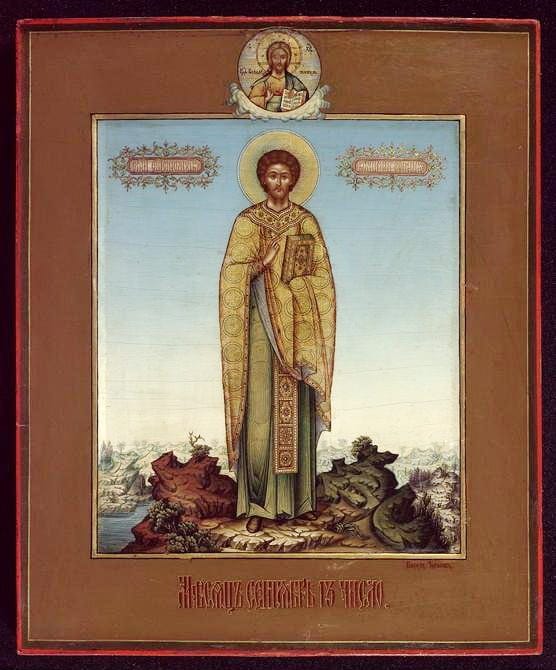
His name is Cornelius. He was a centurion — a captain of a hundred — of the band called the Italian band, living at Caesarea in Palestine. The Church calls him hieromartyr. The holy Evangelist Luke wrote his story down, and the Church has never put that book away.
"There was a certain man in Caesarea called Cornelius, a centurion of the band called the Italian band, a devout man, and one that feared God with all his house, which gave much alms to the people, and prayed to God alway."
Do you hear that? He did not yet know the Lord's name the way the Church would teach it. He prayed. He gave. His whole house feared God with him.
The Church says he had lived previously in Thracian Italy. He was a pagan. The Lord did not disdain his virtuous life.
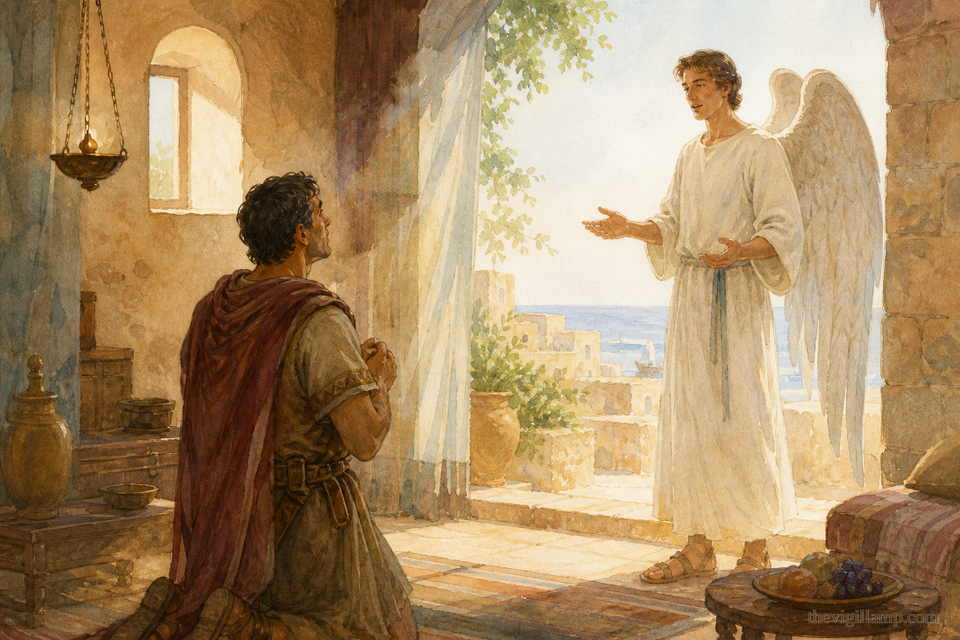
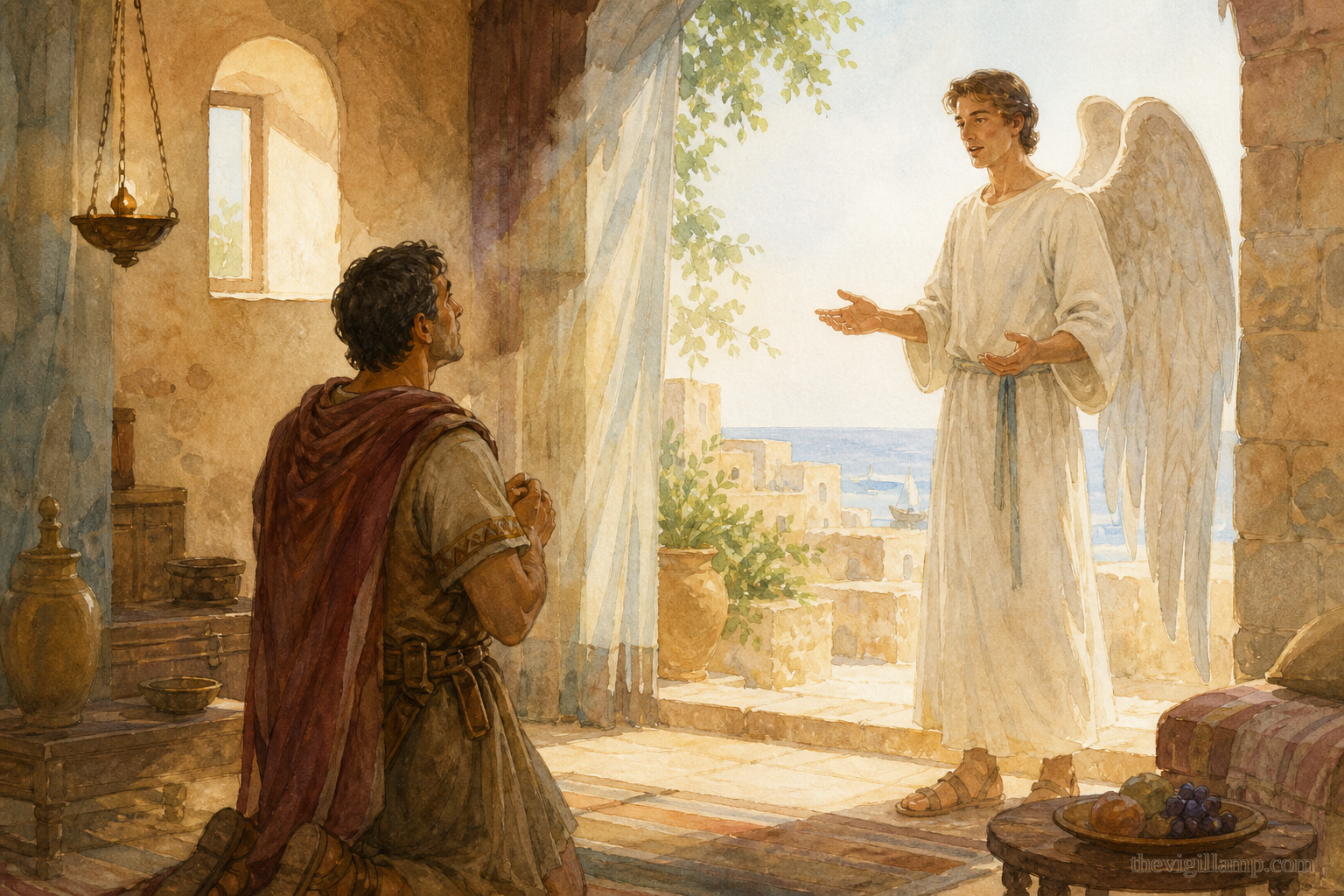
Once, about the ninth hour of the day, Cornelius was praying in his house. An angel of God came in to him, and said his name.
"Cornelius."
He was afraid, and said, "What is it, Lord?"
And the angel said unto him, "Thy prayers and thine alms are come up for a memorial before God. And now send men to Joppa, and call for one Simon, whose surname is Peter: he lodgeth with one Simon a tanner, whose house is by the sea side: he shall tell thee what thou oughtest to do."
Cornelius called two of his household servants, and a devout soldier of them that waited on him, and he sent them to Joppa.
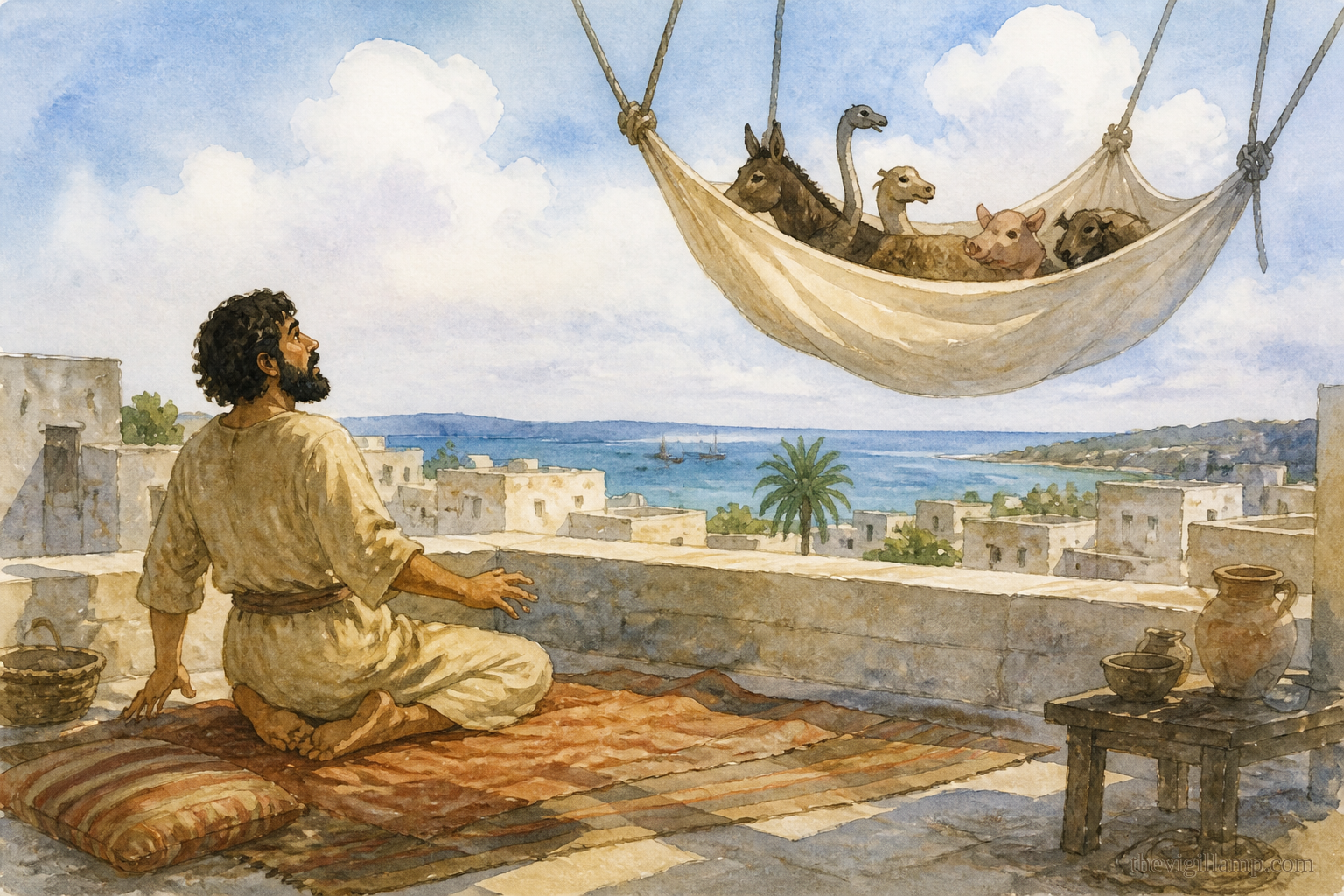
On the morrow, as those men drew nigh unto the city, Peter went up upon the housetop to pray about the sixth hour. He became very hungry. While they made ready, he fell into a trance, and saw heaven opened, and a certain vessel descending, as it had been a great sheet knit at the four corners, let down to the earth — and in it all manner of fourfooted beasts, and wild beasts, and creeping things, and fowls of the air.
There came a voice to him, "Rise, Peter; kill, and eat."
But Peter said, "Not so, Lord; for I have never eaten any thing that is common or unclean."
And the voice spake unto him again the second time, "What God hath cleansed, that call not thou common."
This was done thrice. And the vessel was received up again into heaven.
While Peter thought on the vision, the Spirit said unto him, "Behold, three men seek thee. Arise therefore, and get thee down, and go with them, doubting nothing: for I have sent them."
Peter went down. "Behold, I am he whom ye seek: what is the cause wherefore ye are come?"
And they said, "Cornelius the centurion, a just man, and one that feareth God, and of good report among all the nation of the Jews, was warned from God by an holy angel to send for thee into his house, and to hear words of thee."
He lodged them. On the morrow he went with them, and certain brethren from Joppa. The morrow after, they entered into Caesarea. Cornelius had called together his kinsmen and near friends, and he was waiting.
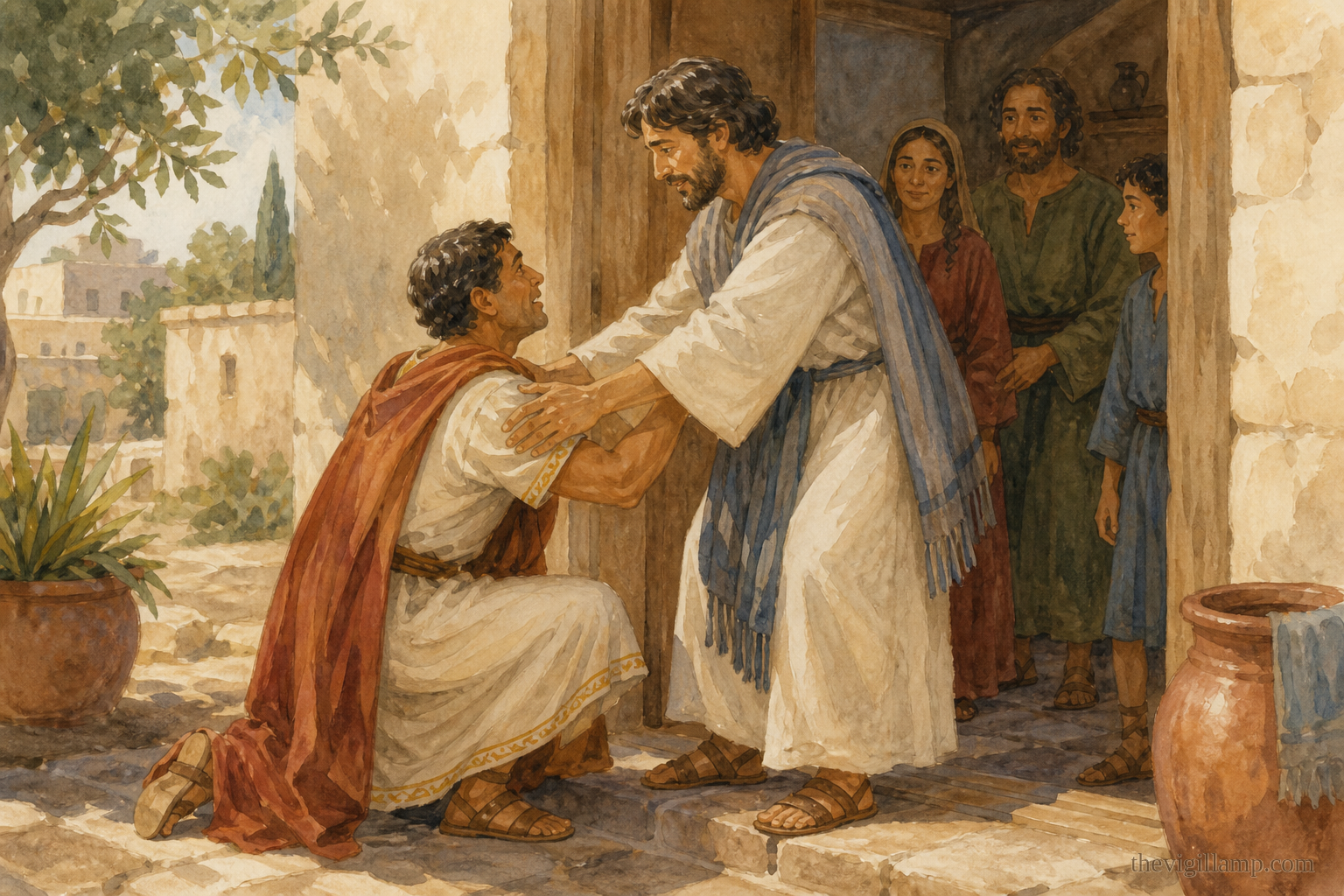
As Peter was coming in, Cornelius met him, and fell down at his feet, and worshipped him.
But Peter took him up, saying, "Stand up; I myself also am a man."
He went in, and found many that were come together.
"Ye know how that it is an unlawful thing for a man that is a Jew to keep company, or come unto one of another nation; but God hath shewed me that I should not call any man common or unclean. Therefore came I unto you without gainsaying, as soon as I was sent for: I ask therefore for what intent ye have sent for me?"
And Cornelius said, "Four days ago I was fasting until this hour; and at the ninth hour I prayed in my house, and, behold, a man stood before me in bright clothing, and said, Cornelius, thy prayer is heard, and thine alms are had in remembrance in the sight of God. Send therefore to Joppa, and call hither Simon, whose surname is Peter. Immediately therefore I sent to thee; and thou hast well done that thou art come. Now therefore are we all here present before God, to hear all things that are commanded thee of God."
Then Peter opened his mouth.
"Of a truth I perceive that God is no respecter of persons: but in every nation he that feareth him, and worketh righteousness, is accepted with him."
He told them the word God sent unto the children of Israel, preaching peace by Jesus Christ — He is Lord of all. How God anointed Jesus of Nazareth with the Holy Ghost and with power. How He went about doing good. How they slew Him and hanged Him on a tree. How God raised Him up the third day. That through His name whosoever believeth in Him shall receive remission of sins.
While Peter yet spake these words, the Holy Ghost fell on all them which heard the word. They of the circumcision which believed were astonished, because that on the Gentiles also was poured out the gift of the Holy Ghost.
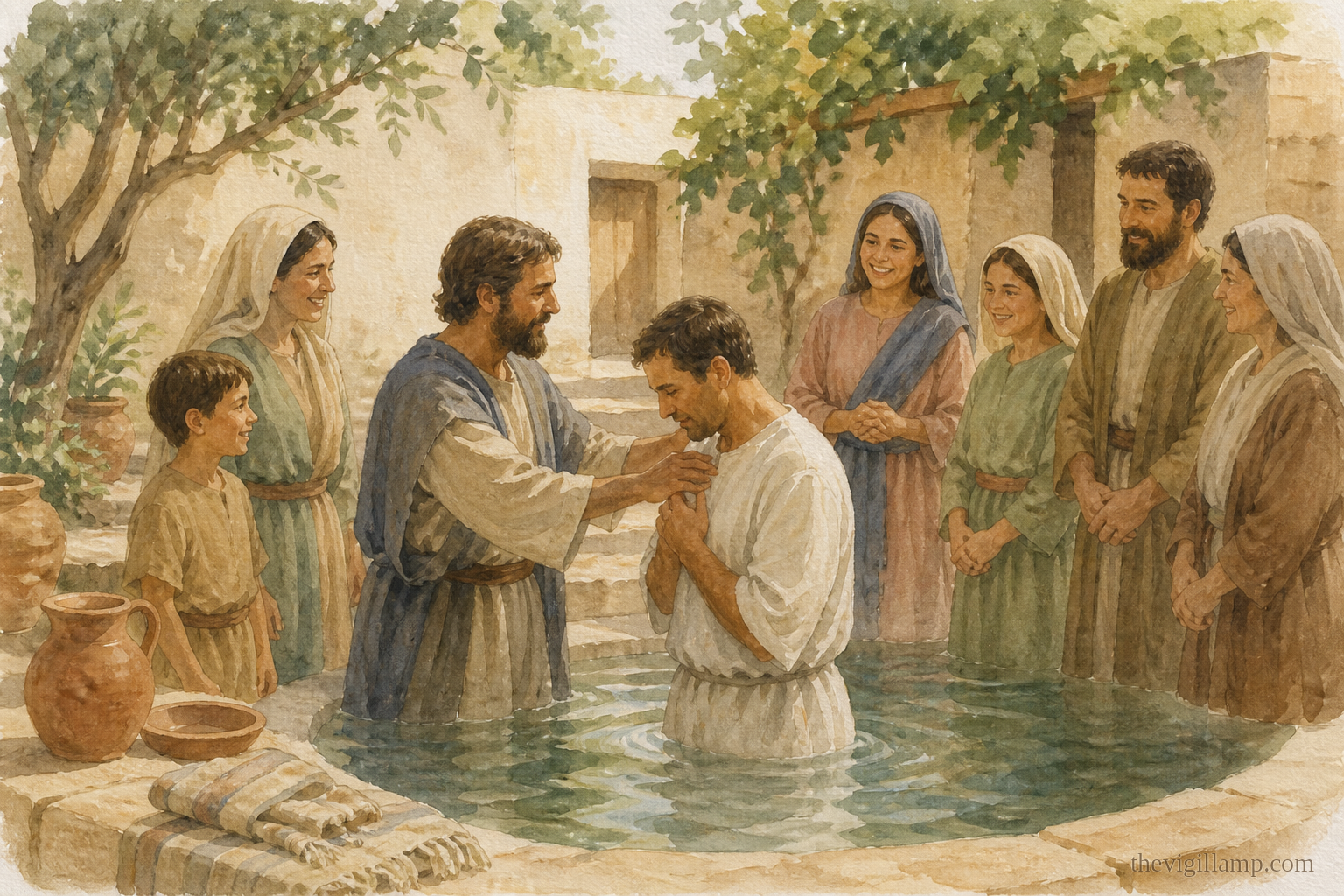
Then answered Peter, "Can any man forbid water, that these should not be baptized, which have received the Holy Ghost as well as we?"
And he commanded them to be baptized in the name of the Lord.
He was the first pagan to receive Baptism. The whole household with him.
The Church does not stop the story at the font.
She says he retired from the world and went preaching the Gospel together with the Apostle Peter, who made him a bishop. When Peter, with his helpers Saints Timothy and Cornelius, was in Ephesus, they learned of a particularly vigorous idol-worship in the city of Skepsis. Lots were drawn. Cornelius was chosen.
In that city lived a prince named Demetrius. The Church says Cornelius answered that he had come to lead them from darkness to the True Light, and that he served the Lord, and had come to announce the Truth. We will not invent other words for him. Those are the Church's words.
They showed him the gods. He entered the pagan temple, turned toward the east, and uttered a prayer to the Lord. There was an earthquake. The temple of Zeus, and the idols in it, were destroyed.
We will not linger on the prison, or on the ruins. The Church knows them, and that is enough for us this morning. She says the prince's household was brought out alive, and Demetrius, and all his relatives and comrades, accepted holy Baptism. Cornelius lived a long time in that city. He converted the pagan inhabitants to Christ, and made Eunomios a presbyter. He died in old age, and was buried not far from the temple he had destroyed.
Do you hear what the Church is singing now? Not only that he prayed. She is singing that he was the first-fruit.
"O Blessed Cornelius, you were distinguished in works of righteousness. You received the enlightenment of godliness, and were a fellow-laborer with the Apostles."
And again: "The Church, receiving you as a blessed first-fruit of the Gentiles, is enlightened by your holy life."
The word we heard this morning is the Sunday Before word. "But God forbid that I should glory, save in the cross of our Lord Jesus Christ." Tomorrow the Church will lift that Cross up. Today she will not let us glory in anything else — not in a centurion's rank, not in a household's goodness, not even in being first. Glory in the Cross.
And the Gospel says, "For God so loved the world, that he gave his only begotten Son." The world. Not one nation only. The sheet came down three times. The Spirit fell on the Gentiles in that house. God so loved the world.
The same reading has another word, because this is the Forefeast: "And as Moses lifted up the serpent in the wilderness, even so must the Son of man be lifted up." The Cross is already rising, like the sun. Let us prepare to welcome it with faith.
The psalm we held in the hand is not a lectionary appointment. It is a word that already knows his kontakion: "All the ends of the earth shall remember and turn to the Lord: and all the kindreds of the nations shall worship before him."
Caesarea was one of those ends. A centurion's house was one of those kindreds. The Church will not let us tell him as if the nations were an accident.
And the Dedication belongs here too. "For every house is builded by some man; but he that built all things is God." They raised a church over the tomb. God had already opened a house in Caesarea, and baptized a household, and sent a bishop out.
That is why the Church will not let this Sunday stand without this man. While she is getting ready to lift the Cross, she names the first of the Gentiles. While she commemorates the church over the tomb, she names the house that opened.
And today, so many hundreds of years later, on the Forefeast, on the Dedication, on the Sunday before the Elevation, we say his name once more, out loud, together — Hieromartyr Cornelius the Centurion — and he is praying for us still.
you were distinguished in works of righteousness.
You received the enlightenment of godliness,
and were a fellow-laborer with the Apostles,
for you shared in their work,
preaching Christ's incarnation to all.
With them pray that all who honor your memory may be saved!
the Church, receiving you as a blessed first-fruit of the Gentiles,
is enlightened by your holy life,
for you are a perfect seer of the Mysteries!
the life-creating Cross of Your goodness, O Lord,
which You have granted to us
although we are unworthy.
Through the Theotokos, save all Orthodox Christians, O only Lover of mankind.
and mystically makes all things holy and pure.
Let us prepare to welcome it with faith.
to be like the splendor of the heavenly firmament, O Lord.
Through the prayers of the Theotokos,
strengthen it for ever and ever
and accept our supplication
which we ceaselessly offer to You therein,
the life and resurrection of all.
which enlightens all the faithful.
Standing within it we cry: "Establish this house, O Lord."
- Stand in the middle of the room as if it were Cornelius's house — only as ordinary as your own house. Today the Church remembers a centurion who prayed, and gave, and opened his door. This is not yesterday's keeping of the word, and it is not tomorrow's lifting of the Cross. It is a house that opened.
- One child waits as Cornelius. Everyone else is quiet. Count slowly to ten. The hard part is not the waiting. The hard part is being ready when the knock comes.
- A grown-up knocks, as Peter. The child opens. The grown-up says, slowly, the day's own words: "Stand up; I myself also am a man."
- That child does one small, real good work right away: clear a plate, help a little brother, set something aside for someone who needs it. Cornelius gave alms. We can open one door in this room.
- Take turns. When everyone has had a turn, sit together and each name one person — far away, or next door, or not yet known to us — you want God to remember with us this week. Write those names on scraps of paper and keep them under the lamp until next Sunday.


pray to God for us.
Most Holy Theotokos, save us.”
on earth as it is in heaven. Give us this day our daily bread,
and forgive us our trespasses, as we forgive those who trespass against us; and lead us not into temptation,
but deliver us from the evil one. Amen.