The Universal Exaltation of the Precious and Life-Giving Cross
A Great Feast
✦ ✦ ✦
The Church also keeps this as a day of strict fasting. Your family should follow the rule of your parish and household, or the blessing of your priest.
Before you begin
Today's Vigil is for your family, not the other way around. If anything feels like too much, that's okay. Do the parts your family loves, and work your way up to the whole Vigil in one sitting.
Movement One
Light the Lamp
Do together: Light your lamp or a candle. Then say: "Today the Church keeps the Great Feast of the Universal Exaltation of the Precious and Life-Giving Cross."
We begin the way the Church begins any new work
“O Lord Jesus Christ, the only-begotten Son of the eternal Father, Thou hast said, 'Without me you can do nothing.' In faith I embrace Thy words, O Lord, and bow before Thy goodness. Help me to complete the work I am about to begin for Thine own glory: in the Name of the Father, and of the Son, and of the Holy Spirit. Amen.”
Then all together:
“Through the prayers of our holy fathers, O Lord Jesus Christ our God, have mercy on us.”
The Orthodox prayer before beginning any work, offered for our family and for yours, each time we begin again.
Movement Two
Read the Icon
Before we hear this feast, let's look at how the Church has always shown this lifting-up, and learn to read what the icon is telling us.
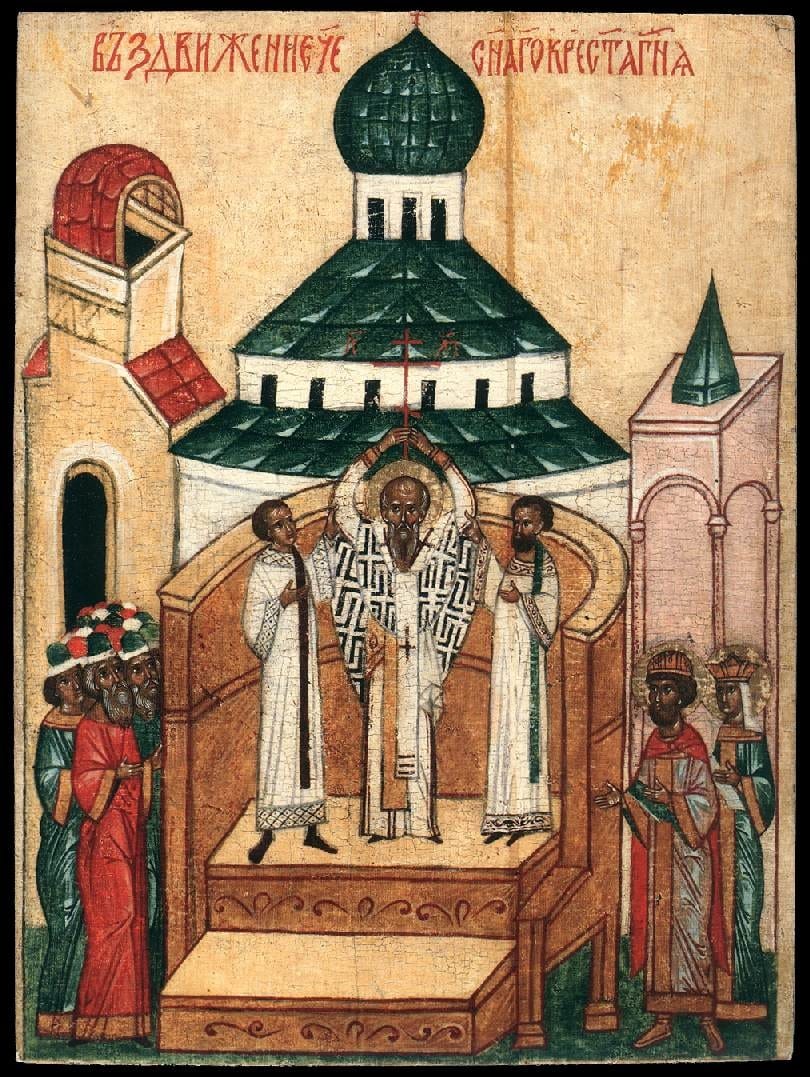
The Universal Exaltation of the Precious and Life-Giving Cross · northern Russia, about the 1490s · Ikonen-Museum Recklinghausen
What are we looking at?
An icon isn't a photograph, and it isn't a painting to admire. It's a window. Everything in it is there to teach us something true about this feast.
The gold behind them. It is pale and worn, the color of old light on wood. Not a street. Not a battlefield. Heaven's own light. The saints stand where God's light fills everything.
The church, and the green dome. A white church rises behind the people. Its roof is dark green, stacked in tiers, and a green onion dome sits on a white drum. A small red cross stands on the very top. The Church is telling us this lifting-up belongs in a holy house — the house they raised over the Tomb.
The bishop in the middle. Look for the largest figure. He stands on a raised wooden platform with a curved rail, two or three steps high. A gold halo is around his head. His beard is grey. He wears white holy clothes marked with dark crosses, and a long pale band hangs down the front. With both hands he lifts a slender red Cross high over his head. The Cross has three bars. This is the lifting-up. This is what the feast is named for. The Church knows this man as Patriarch Macarius of Jerusalem.
The two who stand with him. On the platform, one on each side, younger men in white look up toward the Wood. They are not lifting it. They are helping the one who lifts it. The Church does not hide the ordinary work of a feast. Hands help. A Cross is held where the people can see.
The people on the left. Four men stand on a strip of green ground. The one in front wears a bright red robe. The others wear green and dark blue. Some have hats. They have no crowns. Their faces are turned upward. One hand is raised. They are looking. That is what the people did.
The two with crowns, on the right. A man stands nearest the platform. A gold crown sits on his head. A red mantle is over his shoulders. His hand is open toward the Cross. A little behind him a woman stands, a gold crown over a white veil, a dark green robe, her hands held close. Gold light is around their heads. We will not invent their names from the paint. The Church knows them as Constantine and Helen — the emperor who saw the Sign, and the mother who went looking.
The name of the feast. At the top, in red Slavonic letters, the Church means to name what she is showing. Time and the worn gold have made some of the letters hard to read from this photograph. We will not invent them. Every icon names its feast. This one is the lifting-up of the Precious Cross of the Lord.
This is not yesterday's doorstep. Yesterday the Church stood at the Forefeast, and named the house over the Tomb. Today she opens the feast itself. The Cross is in the air.
Anonymous Russian icon painter, The Exaltation of the Cross, about the 1490s, northern Russia; egg tempera on wood, 48 × 36 cm; Ikonen-Museum Recklinghausen. Public domain. Image via Wikimedia Commons, from the Web Gallery of Art. A mid-nineteenth-century Palekh panel and a sixteenth-century panel now in the Museum of Christian Culture, Saint Petersburg, were inspected and are held as unused backup. Modern OCA files were not used.
The ReadingsMovement Three
The Scripture the Church appoints for this day. Open your Bible at home and read the passages aloud together, then listen for these words echoing through the feast and the rest of your day.
A Psalm to begin · Psalm 98 (99) : 5
“Exalt ye the Lord our God, and worship at his footstool; for he is holy.”
The Septuagint (Brenton, 1851), the Old Testament of the Orthodox Church. In ordinary English Bibles this is Psalm 99:5. This verse is chosen for prayer today; it is not a separate lectionary appointment. The Church herself keeps returning to this line on the feast.
The Epistle · 1 Corinthians 1 : 18–24
“For the preaching of the cross is to them that perish foolishness; but unto us which are saved it is the power of God.”
Open your Bible and read the full passage together. Text: King James Version (public domain).
The Gospel · John 19 : 6–11, 13–20, 25–28, 30–35
“And he bearing his cross went forth into a place called the place of a skull, which is called in the Hebrew Golgotha.”
Open your Bible and read the full passage together. Text: King James Version (public domain).
These are the feast readings appointed by the Orthodox Church in America for the Universal Exaltation of the Precious and Life-Giving Cross on Monday, September 14, 2026. The same day's weekday pair is Galatians 4:28–5:10 and Mark 6:54–7:8. This edition carries the feast pair.
Exaltation of the Cross · Read aloud
0:00
/554.605714
Movement Four
The Story
Yesterday the Church stood on the doorstep of this feast.
Today she opens the door.
Today is the Great Feast of the Universal Exaltation of the Precious and Life-Giving Cross. The Church lifts up the Wood on which the Lord saved the world, and she teaches us to look at it without shame.
Do you hear what she is singing already? "O Lord, save Your people, and bless Your inheritance."
That is today's word. Not the hiding. The lifting-up.
The Church also remembers that on this same date Saint John Chrysostom fell asleep in the Lord, in the year 407. Because today is the Great Feast of the Cross, she keeps his memory on another day — the thirteenth of November. This morning we tell the Cross.
She remembers more than one name on the fourteenth of September. She remembers the monastic martyrs Macarius of Dionysiou and Joseph of Dionysiou; the Lesna Icon of the Mother of God; and the repose of Saint Anthimus, Bishop of Georgia. Those are true days. We will not tell those whole lives this morning.
This morning she asks us to look at the Wood.
For a long time the holy places were hidden.
The pagan emperors of Rome tried to make people forget the ground where our Lord Jesus Christ suffered and rose from the dead. The Emperor Hadrian ordered that Golgotha and the Lord's Sepulchre be covered over. A temple to a pagan goddess, and a statue of a pagan god, were set on top of the holy ground, so that no one would remember what had happened there.
The Church did not forget.
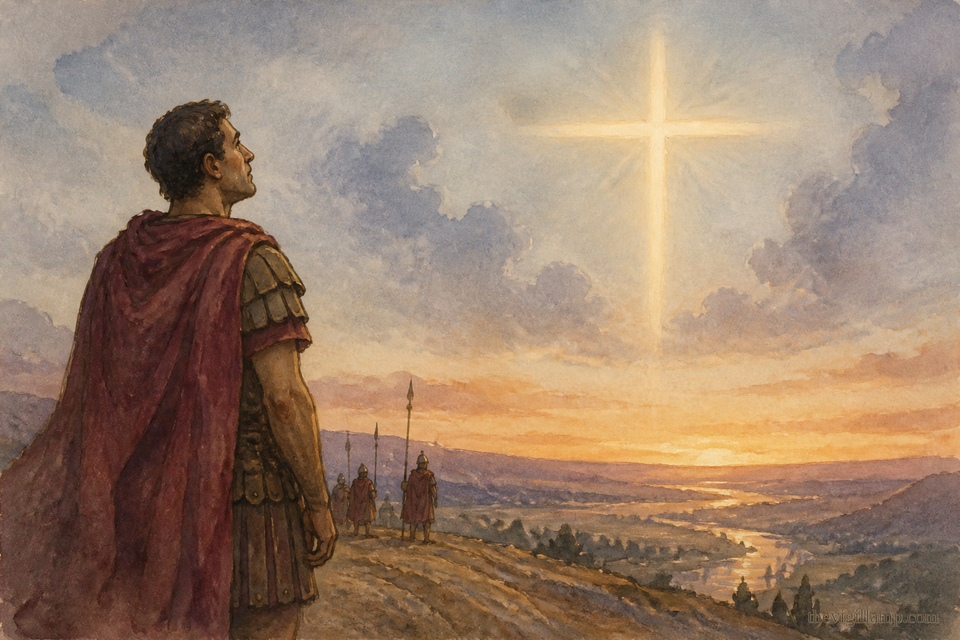
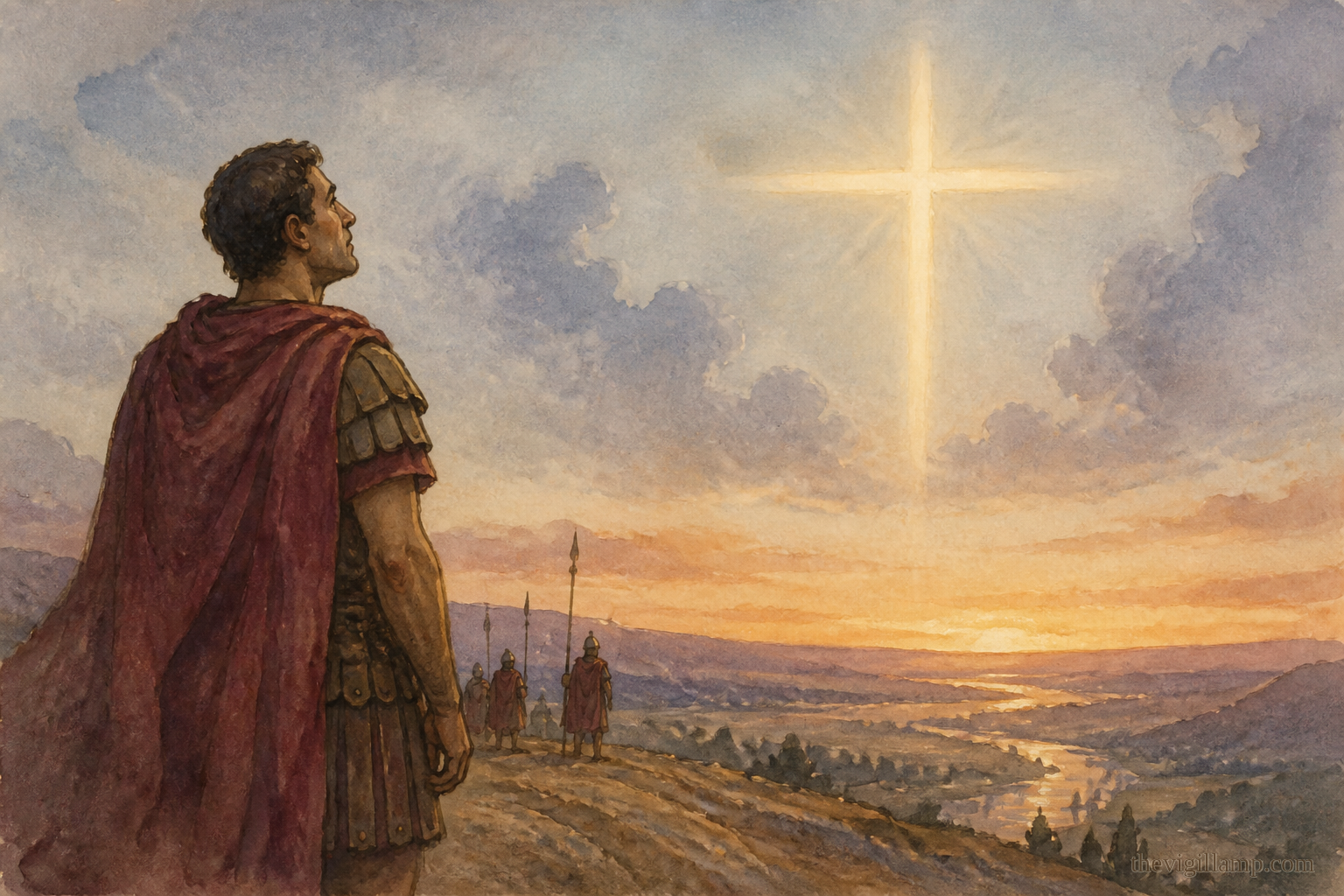
More than two hundred years later, God raised up the Emperor Constantine. He was not yet the only ruler of the wide Roman world. In the year 312 he went to war, and he saw in the heavens the Sign of the Cross, and written beneath it: "By this you shall conquer."
Those are the Church's words. We will not invent others.
Constantine sees the Sign of the Cross in the heavens, and the words written beneath it. No extra speech invented
Constantine became a friend of the Church. After his wars, he was the sole ruler of the great empire. He wanted the holy places opened again. He wanted the Cross itself found — the Cross on which the Lord had been crucified.
He sent his mother.
The pious Empress Helen was already old. She went to Jerusalem with a letter for Saint Macarius, the Patriarch of Jerusalem. Although she was no longer young, she set about the work with joy. She went to the holy places of the Lord's life on earth. She asked the Christians. She asked the people of the city. For a long time the search found nothing.
Then they were directed to the place. An elderly man named Jude said the Cross was buried where the pagan temple stood.
They took the temple down. They prayed. They began to dig.
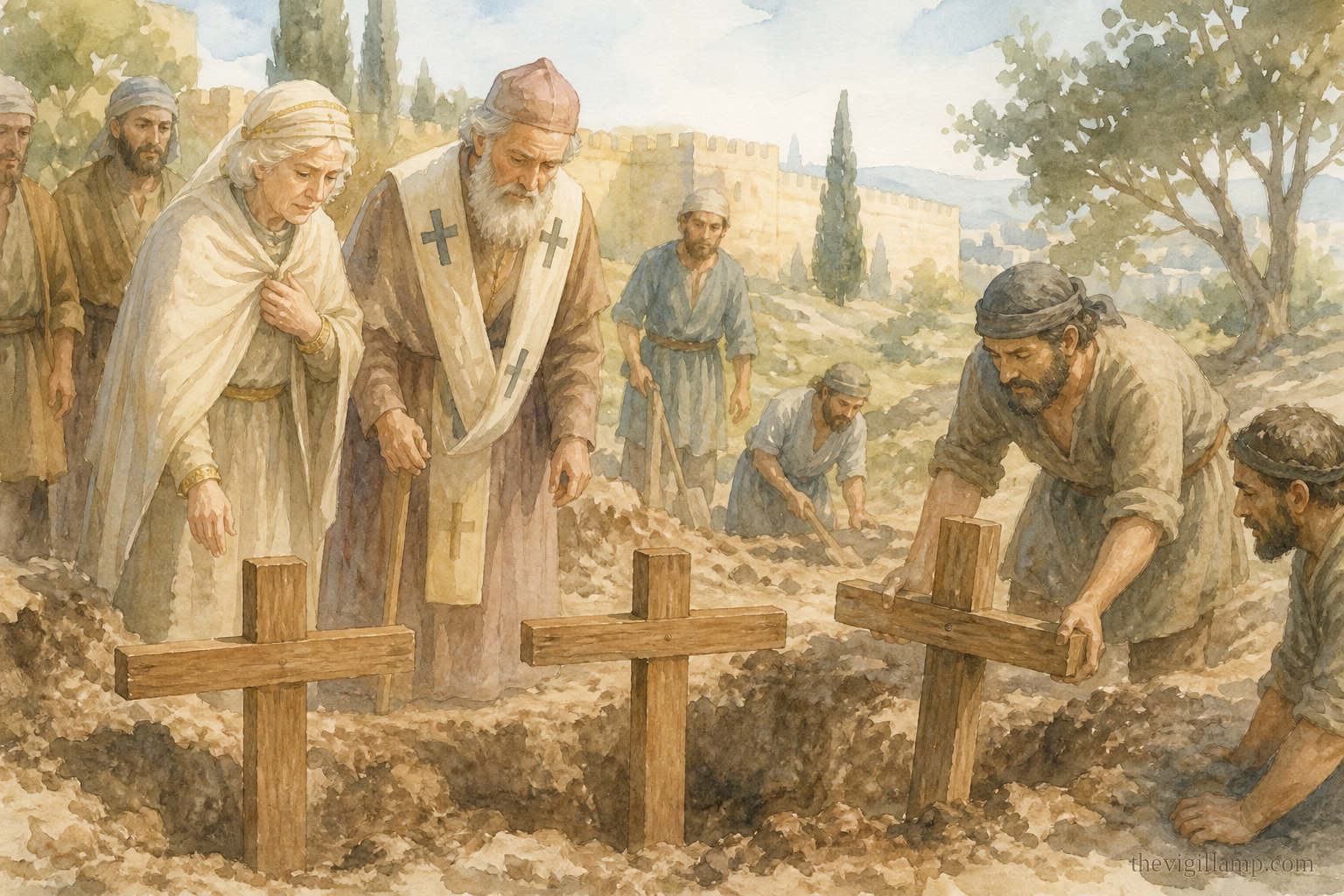
The Tomb of the Lord was uncovered. Not far from it were three crosses, the board with the inscription Pilate had ordered, and four nails.
Three crosses. Which one was the Lord's?
The Church tells it this way: Patriarch Macarius touched the crosses, one by one, to a man who had died. When the true Cross touched him, he lived again. Everyone knew then which Wood was the Life-Giving Cross.
The Church also tells of another mercy at that same finding: a woman who was close to death was made well by the shadow of the Holy Cross.
Those are the Church's words. We will not invent others. We will not turn them into a contest, or add speeches no one wrote down.
Helen and Patriarch Macarius uncover the three crosses; the true Cross is known. No extra speech invented
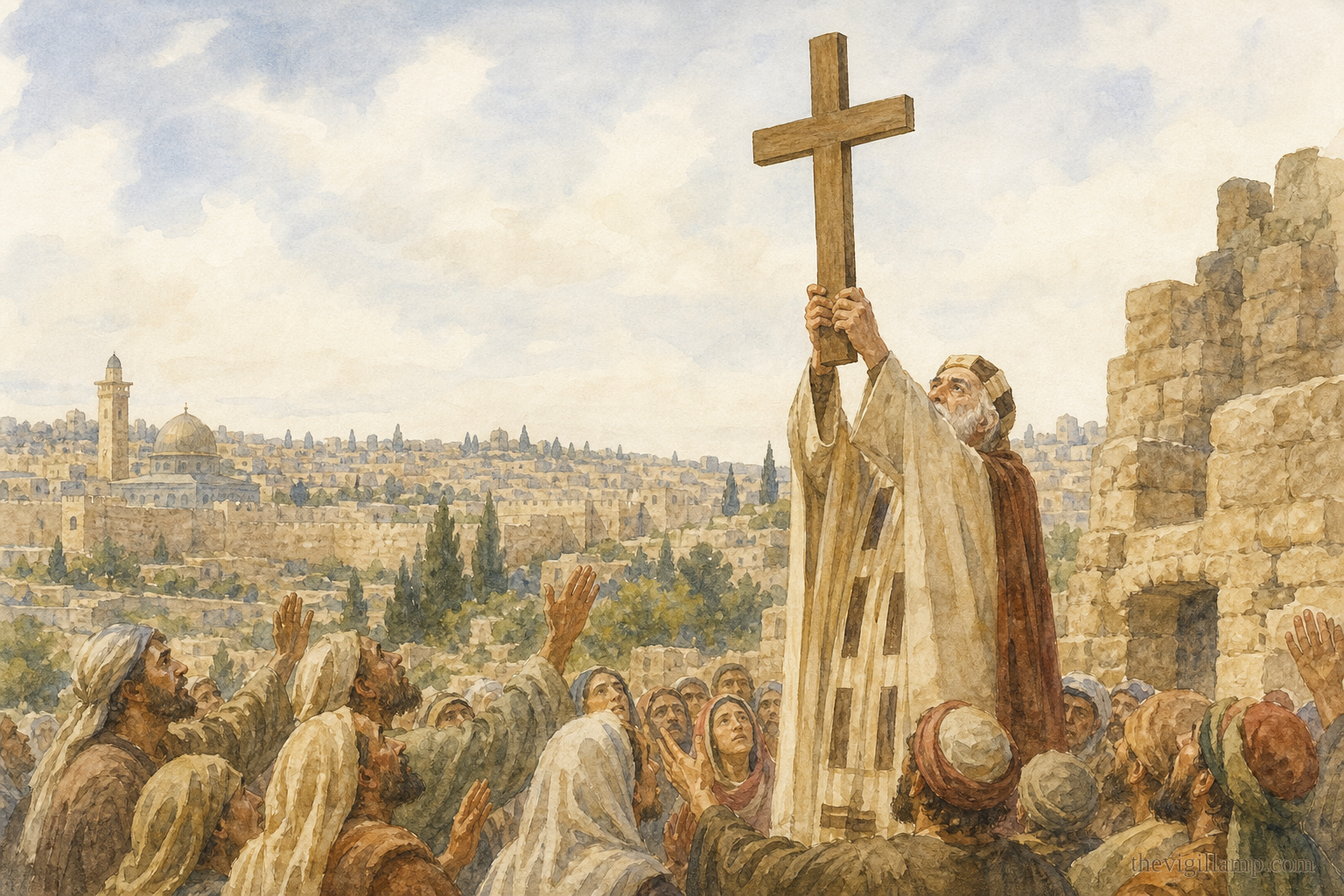
Christians came in a great crowd. They asked Saint Macarius to lift the Cross up, so that even those far off might look at it with reverence.
Then the Patriarch and the other fathers raised the Holy Cross. The people bowed before the Honorable Wood, and they said, "Lord, have mercy."
This happened in the year 326.
Patriarch Macarius lifts up the Holy Cross; the people say, "Lord, have mercy." No extra speech invented
Do you hear what the Church is doing? She is not hiding the Cross in the ground. She is lifting it where the people can see. The thing that once looked like the end of the story is being held up as the beginning of life.
Empress Helen went on to the other holy places. The Church says she built more than eighty churches — at Bethlehem, where Christ was born; on the Mount of Olives, where He went up into heaven; at Gethsemane, where He prayed, and where the Mother of God was laid. She took part of the Life-Giving Wood, and the nails, with her to Constantinople.
Constantine ordered a great church in Jerusalem in honor of the Resurrection of Christ, large enough to hold both the Life-Giving Tomb and Golgotha under one roof. Helen did not live to see it finished. She died in the year 327. The church was consecrated on September 13, in the year 335. On the next day, September 14, the Church established this feast — the Exaltation of the Honorable and Life-Giving Cross.
The Church remembers one more homecoming on this same day.
Long after Helen, the Cross was taken far away in a war, and the holy Patriarch of Jerusalem was taken with it. For fourteen years the Life-Giving Wood was gone from the city. Then a Christian emperor, Heraclius, brought it home.
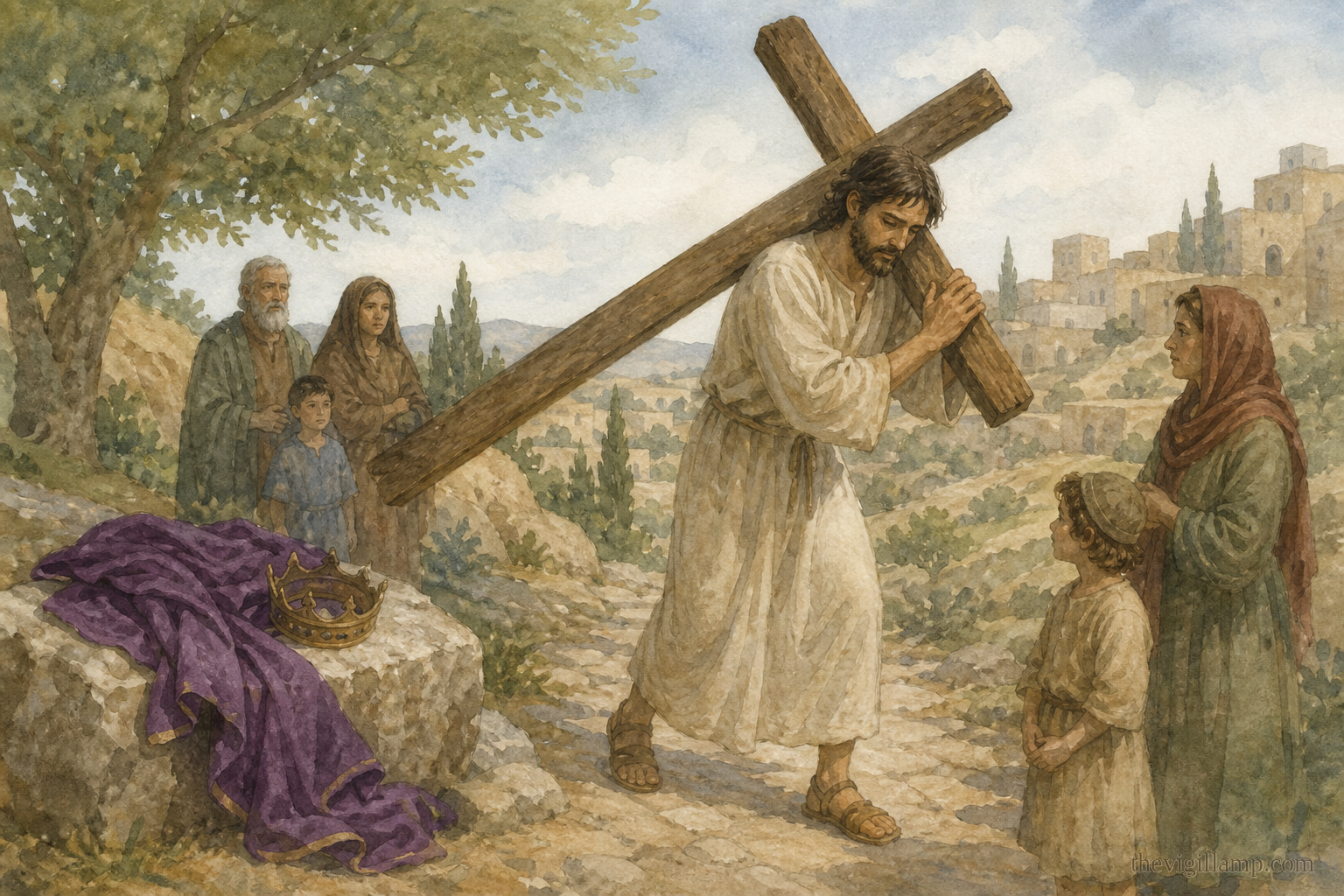
He wanted to carry the Cross into the church of the Resurrection in his crown and his purple. Near the way up to Golgotha he could not go forward. The holy Patriarch Zachariah told him why: an angel of the Lord was blocking the way. The Lord who bore the Cross for the salvation of the world had walked that road in humility. So the emperor put off his crown and his purple. He took up the Cross in plain clothes. Then he could walk.
The emperor puts off his crown and his purple and carries the Cross home in plain clothes. No extra speech invented
Those are the Church's words. We will not invent others.
Saint Andrew of Crete says it this way, in a sermon on this very feast: "The Cross is exalted, and everything true is gathered together, the Cross is exalted, and the city makes solemn, and the people celebrate the feast."
The psalm we heard this morning is not a lectionary appointment. It is a word the Church herself keeps singing today: "Exalt ye the Lord our God, and worship at his footstool; for he is holy." The Cross is that footstool. God is not asking us to look away. He is asking us to lift our eyes.
And the feast readings are not an accident.
The Epistle says that the preaching of the Cross looks like foolishness to some, and to us who are being saved it is the power of God. The world still does not know what to do with a King who wins by giving Himself away.
The Gospel of the feast is the one the Church reads at the Cross itself. The Lord bears His Cross. He goes out to the place called Golgotha. His Mother stands there. He says, "It is finished." A witness sees, and tells the truth, so that we may believe.
We do not turn that hour into a picture of hurt for children. We say what the Church says: He carried it. He finished it. The Wood that looked like defeat is the power of God.
Before Thy Cross, we bow down in worship, O Master, and Thy holy Resurrection we glorify.
That is the Church's own bow. Not only that a Cross was found. That the Lord who hung upon it is alive, and the Wood is being held up as life.
The people in Jerusalem asked the Patriarch to lift the Cross so the ones far off could see. We are the ones far off. Hundreds of years later, on the day the Church calls a Great Feast, we say the same words they said — "Lord, have mercy" — and the Cross is being lifted for us still.
Movement Five
The Prayer
Troparion of the Exaltation of the Cross · Tone 1
O Lord, save Your people, and bless Your inheritance. Grant victories to the Orthodox Christians over their adversaries. And by virtue of Your Cross, preserve Your habitation.
Kontakion of the Exaltation of the Cross · Tone 4
As You were voluntarily raised upon the cross for our sake, grant mercy to those who are called by Your Name, O Christ God; make all Orthodox Christians glad by Your power, granting them victories over their adversaries, by bestowing on them the Invincible trophy, Your weapon of Peace.
The troparion and kontakion appointed by the Orthodox Church in America on the September 14 page of the Universal Exaltation of the Precious and Life-Giving Cross. Wording is exact; slash marks were converted to line breaks only. These are the Great Feast hymns, not the Forefeast hymns of September 13. Hymns for Saint John Chrysostom, Macarius of Dionysiou, Joseph of Dionysiou, the Lesna Icon, and Saint Anthimus are not printed here.
Movement Six
Let's Talk About It Together
Talk about it:
The Cross looked like the end of the story. The Church lifts it up as the power of God. When has something hard in our house turned out to be a place He was already at work?
Helen was old, and she still went looking. What is one good work our family can still begin, even if we think we started late?
When the Cross was lifted, the people said, "Lord, have mercy." When can our family say those words this week — at the table, at bedtime, or when someone is afraid?
Movement Seven
Do This Together
Do this togetherAny time of day
The Cross Lifted Up
Take a simple Cross — two clean sticks tied with string, or a Cross your house already has. This is not a game of soldiers. It is a sign being held where the family can see.
One person lifts it slowly. Everyone else looks up and says, together, three times: "Lord, have mercy."
Then each person makes the sign of the Cross, slowly: forehead, heart, shoulder, shoulder. The hard part is not the motion. The hard part is meaning it.
Do one small, real good work right away: clear a plate, help a little brother, give up the first turn, say something kind. The Lord won by giving Himself away. We can give one kindness away.
Take turns lifting. When everyone has had a turn, sit together and each name one place the Cross already stands in this house — a wall, a doorway, a mercy you did not make yourselves. Write those words on a scrap of paper and keep the papers under the lamp until next Sunday.
Little ones (2–4): help them make the sign of the Cross and say "Lord, have mercy" while you count to five. · Make it stick: say the psalm together each night this week — "Exalt ye the Lord our God, and worship at his footstool; for he is holy."
“Most Holy Theotokos, save us. Holy Equal-to-the-Apostles Constantine and Helen, pray to God for us.”
And close, as the Church always closes, with the Lord's Prayer:
Our Father, Who art in heaven, hallowed be Thy Name. Thy Kingdom come, Thy will be done, on earth as it is in heaven. Give us this day our daily bread, and forgive us our trespasses, as we forgive those who trespass against us; and lead us not into temptation, but deliver us from the evil one. Amen.
Do together: Put out the lamp, or leave it burning a while. The lamp keeps watch until tomorrow. "Glory to God for all things. Amen."
A note on our storytellingEvery edition of The Vigil Lamp is an original retelling. The feast is real, and the names, places, events, and directly quoted words in this edition are drawn from the Orthodox Church in America's traditional account of the Universal Exaltation of the Precious and Life-Giving Cross, from the Gospel according to John and the First Epistle to the Corinthians in the King James Version, and from the Church's own appointed hymns and feast readings. The hidden places, the Sign in the heavens, Helen's search, the three crosses, the lifting-up in 326, the dedication in 335, and the later homecoming of the Cross are told as the Church's tradition, without invented detail. No invented historical dialogue is presented as fact. The words of narration are our own, written to make a true story vivid and a joy for families to read aloud together.