
September 29 · Kyriakos the Anchorite
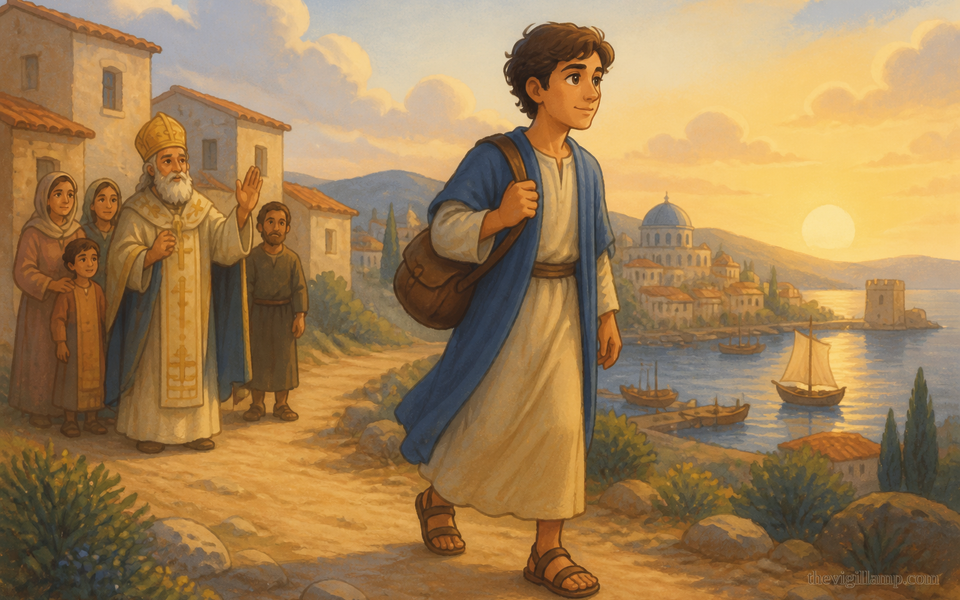
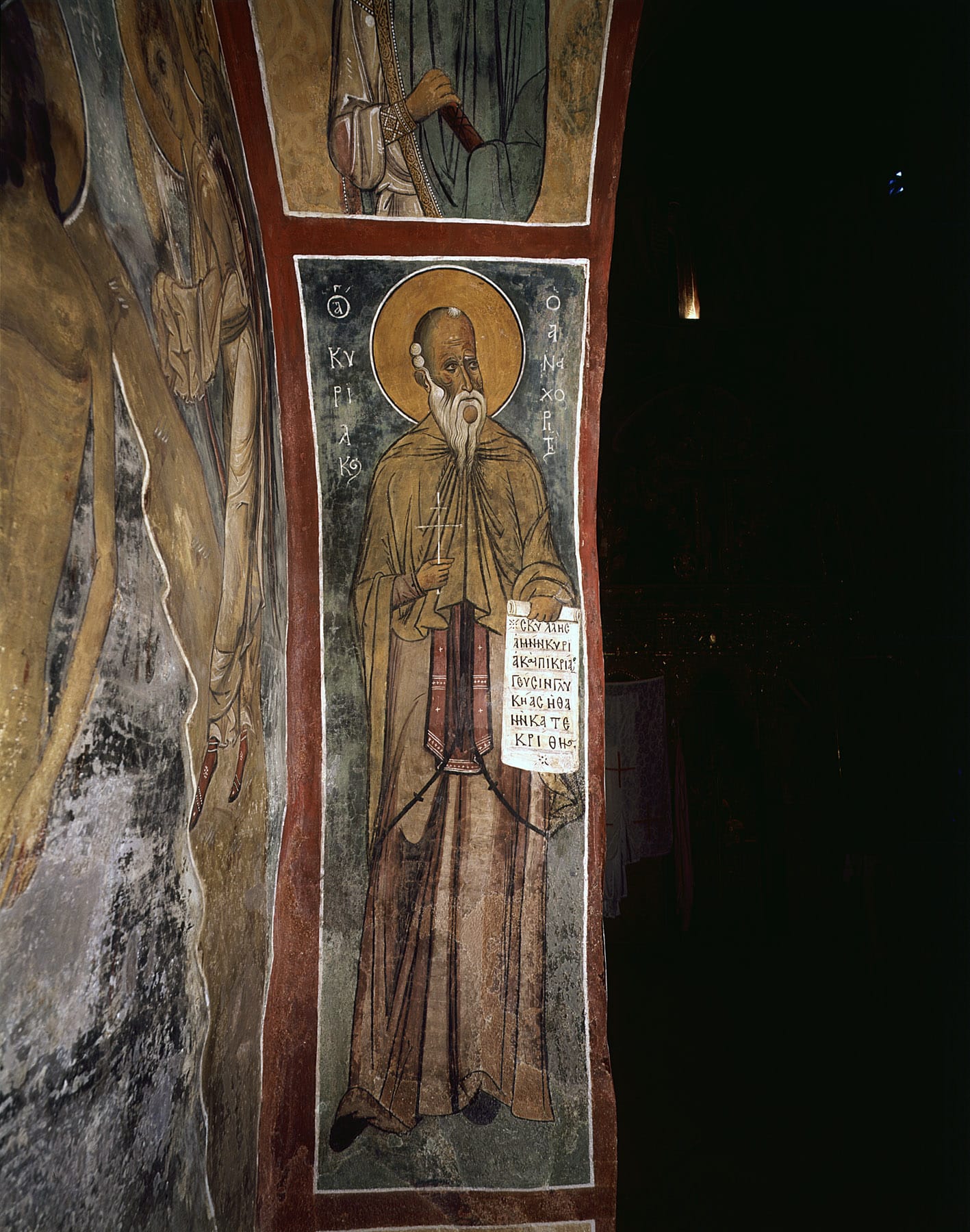
Venerable Kyriakos the Anchorite
O Lord Jesus Christ our God, have mercy on us.”
Yesterday the Church remembered a confessor of the desert.
She named Chariton, who kept the Name and then kept three houses of prayer in the rock.
Today is not that day again.
Today is Tuesday. And on this Tuesday she does another thing she loves to do.
She remembers a man who heard Follow Me, and went.
The Church remembers more than one holy name on the twenty-ninth of September. She remembers the Martyrs Dadas, Gabdelas, and Kazdoa of Persia. She remembers Theophanes the Merciful of Gaza. And she remembers others. Those are true days. We will not tell those whole lives this morning.
This morning she asks us to look at Kyriakos.
His name is Kyriakos. The Church also writes Kyriákos. Families may hear Cyriacus, or Cyriacus the Anchorite, or Kyriakos of Palestine. All those names are one man on this page. The Church remembers him as an anchorite — a monk who kept walking farther into the quiet, so that he could be alone with God.
Do you hear what she is already singing for him? "You were shown to be a citizen of the desert, an Angel in the body and a wonderworker."
That is today's word. Not a man who hid the Name in a locked room. A citizen of the desert. An angel still in a body. A man whose quiet became a long life.
He was born in the Greek city of Corinth, to the priest John and his wife Eudokia.
Do you hear those names? A priest's house. A mother's name. A boy who grew up where the Scriptures were already open.
Bishop Peter of Corinth was a family relative. He saw that Kyriakos was a quiet and sensible child, and he made him a Reader in church.
A Reader. Not yet a priest. Not yet a monk. A boy who stood in church and read the holy words aloud, so that other people could hear them.
His constant reading of the Holy Scriptures awakened in him a love for the Lord, and made him long for a pure and holy life.
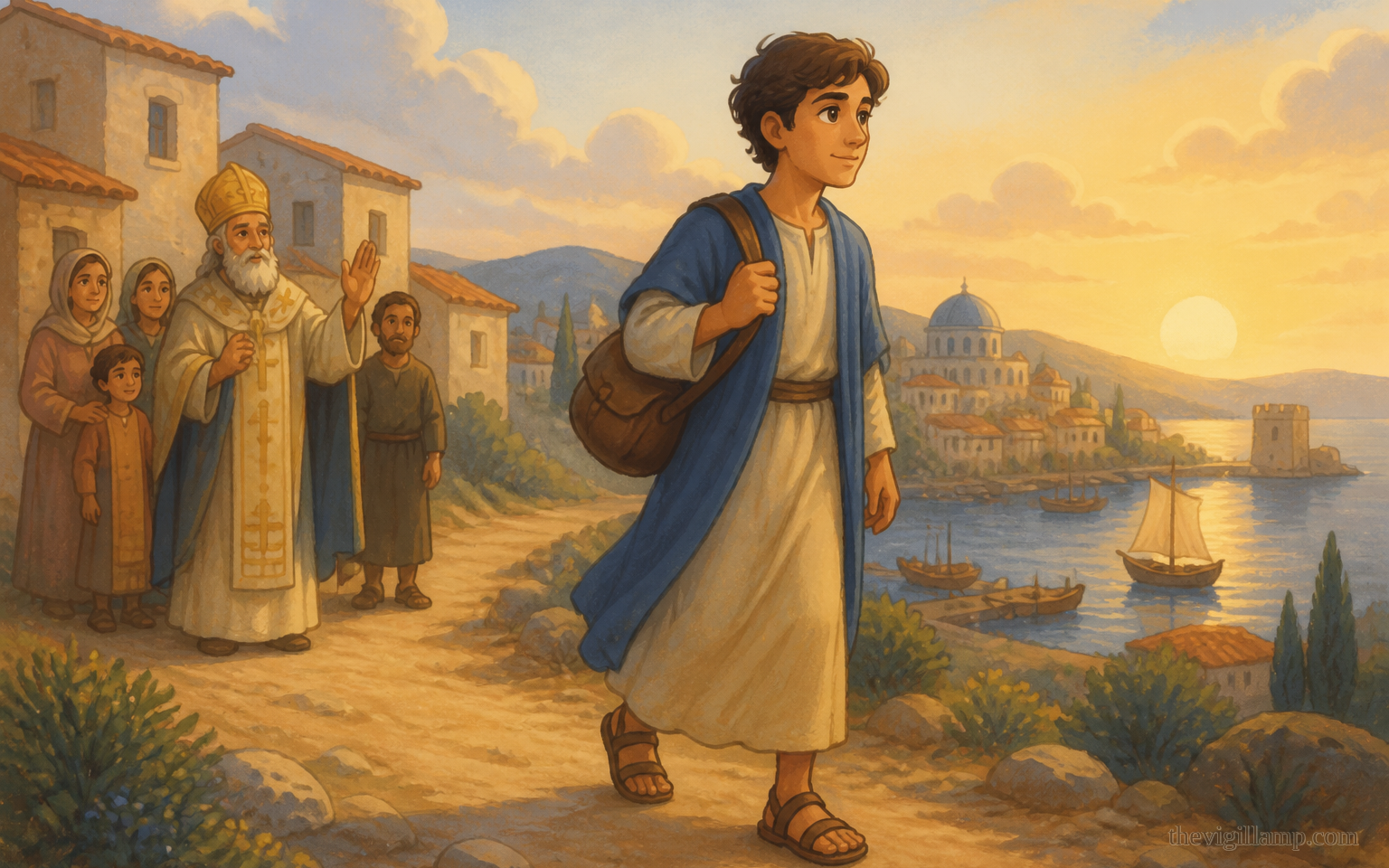
When he was not yet eighteen years old, Kyriakos was deeply moved during a Church Service by the words of the Gospel: "If any man will come after Me, let him deny himself and take up his cross and follow Me."
Those are the Lord's own words. The Church kept them for him. We will not invent others.
He believed that these words applied to him, so he went straight to the harbor without stopping at home, got onto a ship, and went to Jerusalem.
Do you hear that? He did not go back to pack. He did not stop to explain. He heard Follow Me, and he went.
After visiting the holy places, Kyriakos lived for several months at a monastery not far from Sion, in obedience to the Igoumen Abba Eustorgios.
Later, with the latter's blessing, he made his way to the wilderness Lavra of Saint Euthymios the Great.
Saint Euthymios, discerning great gifts of God in Kyriakos, tonsured him into the monastic schema and placed him under the guidance of Saint Gerasimos, who trained him in asceticism at the Monastery of Saint Theoktistos by the Jordan.
Saint Gerasimos, taking into account the fact that Kyriakos was very young, ordered him to live in a cenobitic monastery with the brethren.
A cenobium is a house where monks live together. He was young. They would not send him into the deep quiet yet. They taught him how to stay.
The young monk easily fulfilled his monastic obediences: he prayed fervently, he slept little, and ate food only every other day, sustaining himself with bread and water.
The Church tells us how he lived. We will not make a rule for this house out of a monk's supper.
It was customary for the monks to go into the Rouva wilderness during Great Lent, and return to the Monastery on Palm Sunday. Seeing the young monk's strict abstinence, Saint Gerasimos decided to take him along with him. In complete solitude, the ascetics redoubled their efforts. Every Sunday Saint Gerasimos imparted the Holy Mysteries to his disciple.
After the repose of Saint Gerasimos, the twenty-seven-year-old Kyriakos returned to the Lavra of Saint Euthymios, who was no longer among the living.
Father Kyriakos asked for a solitary cell and there he devoted himself to ascetical contests in silence, speaking only to the monk Thomas.
But Thomas was sent to Alexandria where he was consecrated as a bishop, and Saint Kyriakos spent another ten years in complete silence.
Do you hear that? Ten years. A friend sent away. A cell. And the quiet was not empty. It was full of God.
At the age of thirty-seven, he was ordained to the diaconate.
When a rift occurred between the monasteries of Saint Euthymios and Saint Theoktistos, Saint Kyriakos withdrew to the Souka Monastery of Saint Chariton — the confessor we remembered yesterday.
We will not tell that whole day again. We say the name of the house, the way Kyriakos entered it, and we go on.
At this Monastery they received even tonsured monks as novices, and Saint Kyriakos was also received this way. He toiled humbly at various monastic obediences.
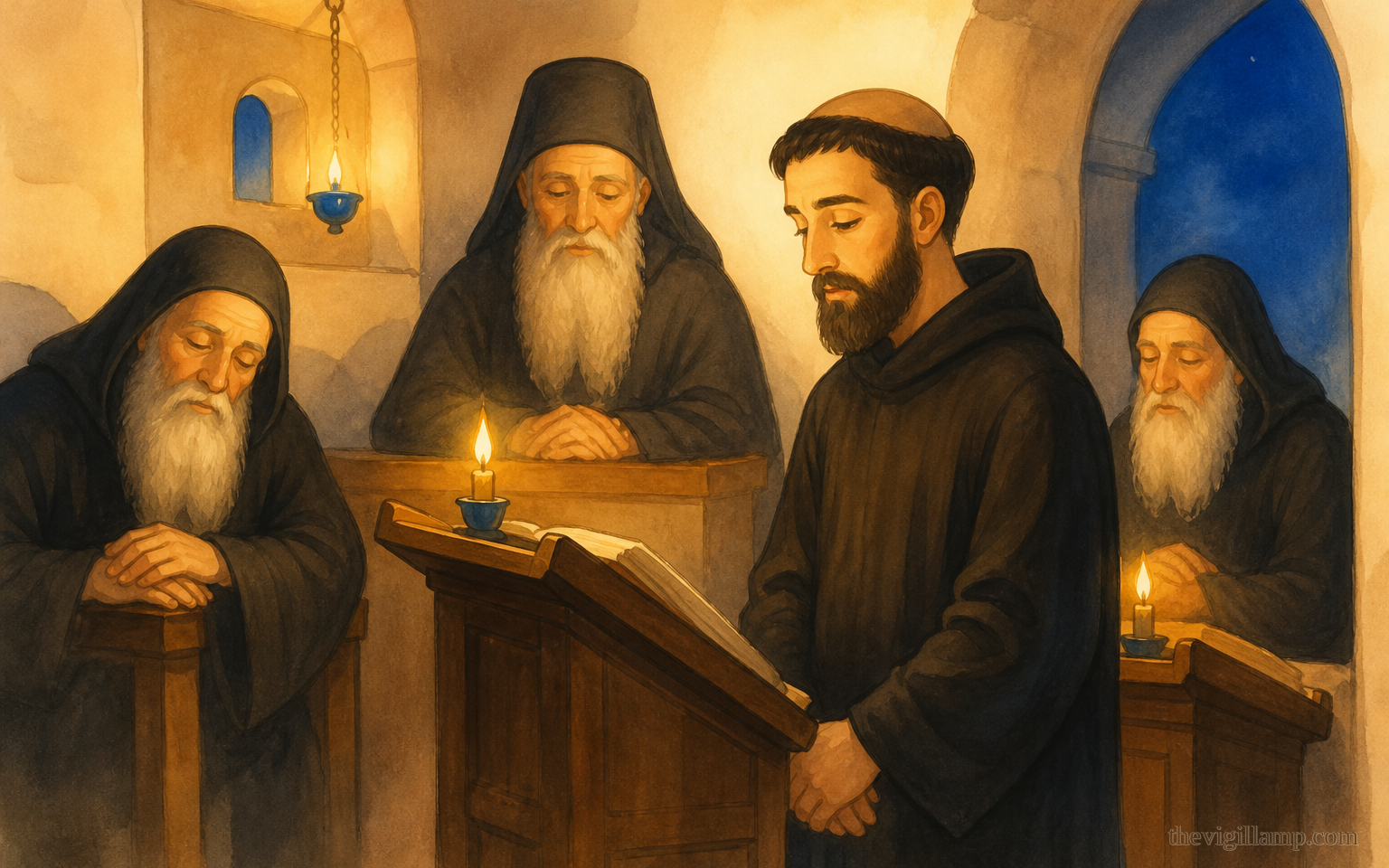
After several years, Saint Kyriakos was ordained as a priest, and was chosen as the canonarch, serving in this obedience for eighteen years.
A canonarch is the lead chanter — the one who keeps the tones and the order, so that the house of prayer does not lose its way.
In all, Saint Kyriakos spent thirty years at that monastery.
Strict fasting and a complete lack of evil distinguished Saint Kyriakos even among the older ascetics of the Lavra. Each night he read the Psalter in his cell, interrupting his reading only to go to church at midnight. The ascetic slept very little.
When he reached the age of seventy, Kyriakos went to the Natoufa wilderness, taking his disciple John with him.
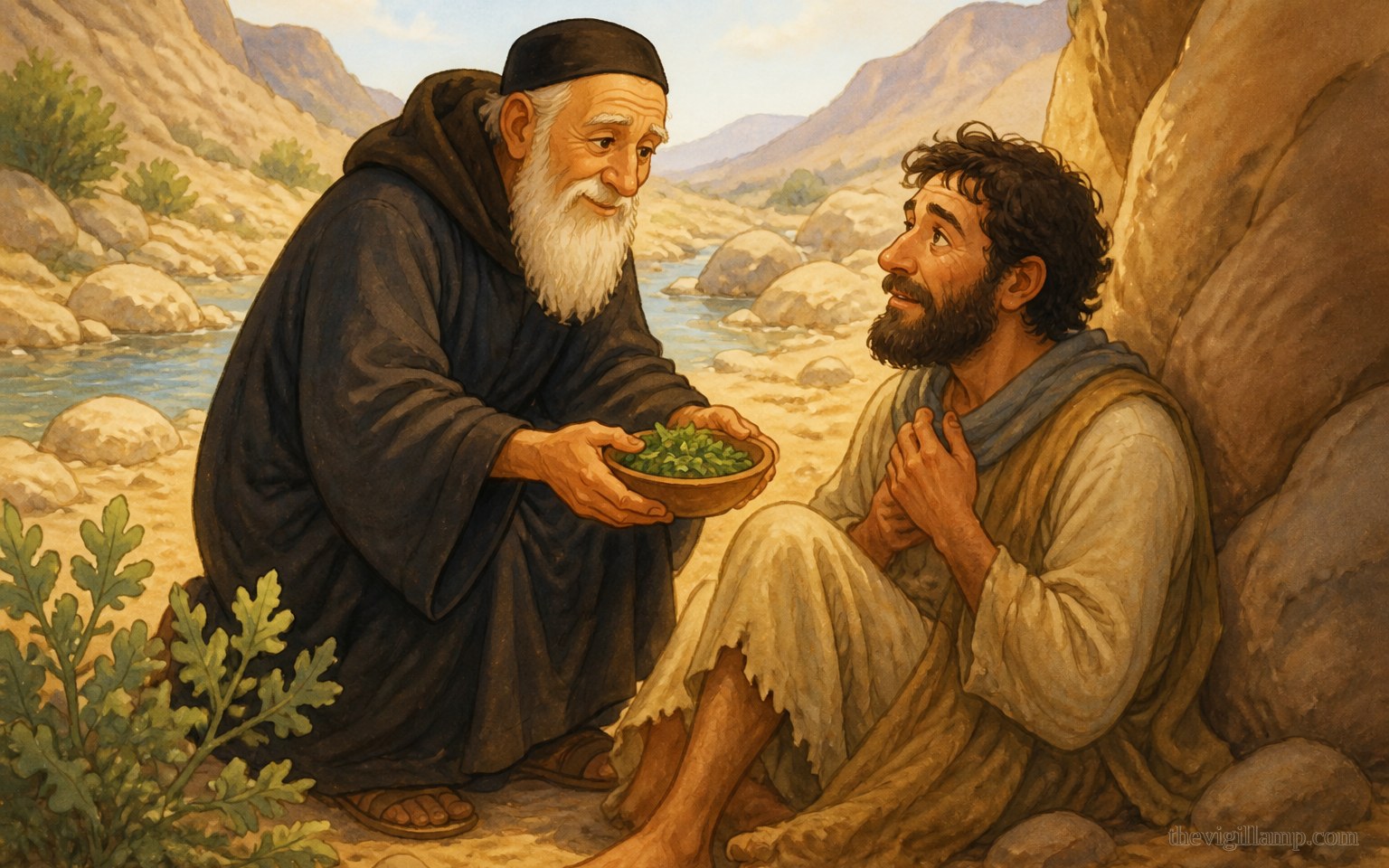
In the desert the hermits ate only bitter herbs, which were made edible by the prayers of Saint Kyriakos.
The Church tells us that. We will not turn the herbs into a recipe. We will not invent a longer prayer. He asked, and the bitter thing could be eaten.
After five years, a certain man found out about the ascetics and brought his demon-possessed son to them, and Saint Kyriakos healed him.
From that time, many people began coming to him with their needs, but he desired complete solitude, and fled to the Rouva wilderness, where he dwelt five years more.
He was not hiding from God. He was hiding from praise.
But the sick and those afflicted by demons also came to him in that wilderness, and the Saint healed them all with the Sign of the Cross and anointing them with oil.
Do you hear that? He went farther. And he still opened his hands.
In his eightieth year Saint Kyriakos fled to the remote Sousakim wilderness, near two dried up streams. According to Tradition, the holy Prophet David mentioned Sousakim: "Thou hast dried up the rivers of Etham."
After seven years, brethren of the Souka Monastery came to him, beseeching his spiritual help during a period of debilitating hunger and illness, which God allowed. They implored Saint Kyriakos to return to the Monastery, and he settled in the old cave of that house.
The house asked its old father to come home. He came. He did not take the abbot's chair. He took the old cave.
Saint Kyriakos provided great help to the Church in the struggle with the spreading heresy of Origenism.
We will not turn that argument into a lesson for this room. The Church has a short word for what he did: by prayer and by word, he brought the wayward back to the true path, and strengthened the Orthodox in their faith.
Cyril, the author of the Life of Saint Kyriakos, and a monk of the Lavra of Saint Euthymios, was a witness when Saint Kyriakos foretold the impending death of the chief heretics Nonos and Leontius, and said that soon the heresy would cease to spread.
The Most Holy Theotokos once appeared to Saint Kyriakos in a dream, along with Saints John the Baptist and John the Theologian, ordering him to preserve Orthodox doctrine in its purity. She refused to enter his cell, however, because in it was a book with the writings of the heretic Nestorius.
"My enemy is in your cell," she told him.
Those are the Church's words. We will not invent others. A book that spoke wrongly about the Lord and His Mother was in the room. She would not come in while it was there. The Church keeps that appearing on the eighth of June. This morning we only say it, the way she said it, and we go on.
At the age of ninety-nine, Saint Kyriakos went to Susakim again and lived there with his disciple John.
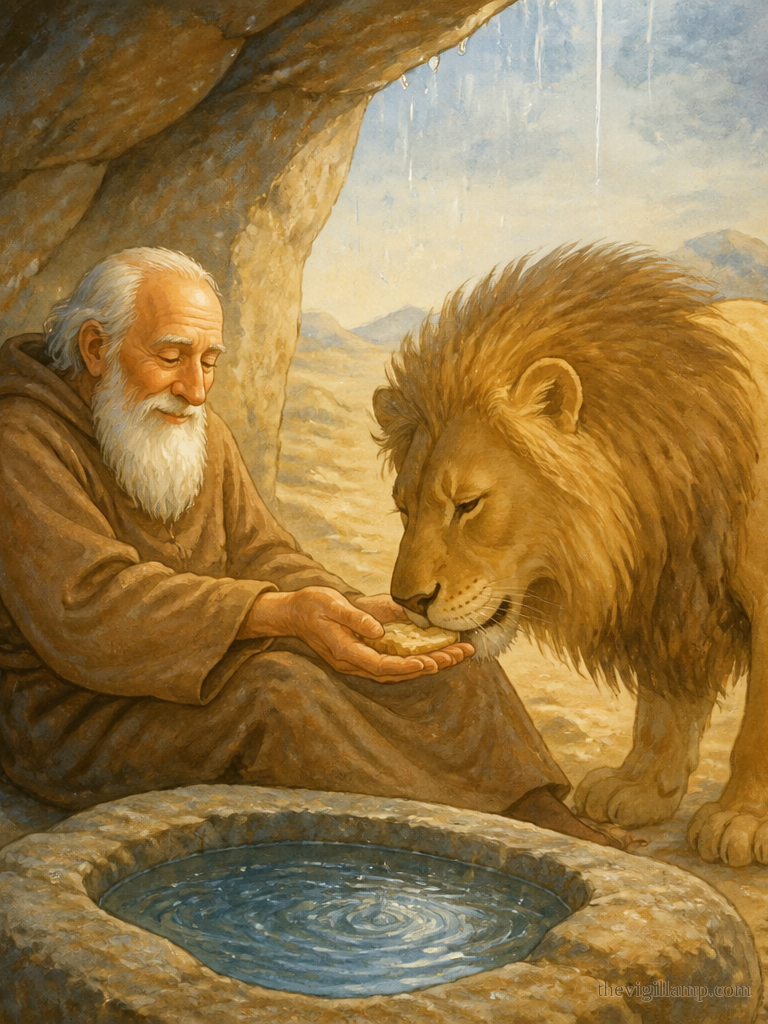
In the desert, Saint Kyriakos was served by a huge lion, which protected him from robbers. The animal did not bother the brethren, and it ate food from the Saint's hand.
Do you hear that? Not a story we made up for children. The Church kept it. A great lion, and a quiet man, and the wild thing ate from his hand.
The ascetics had stored some water in the hollow of a rock during the winter, but in the heat of summer, all the water dried up. Since there was no other source of water, Saint Kyriakos prayed, and the rain fell, filling the hollow with water.
He did not dig a river. He asked. The rain came.
Saint Kyriakos returned to the Monastery two years before his death and settled once more in that same cave.
Until the end of his life the righteous Elder preserved his courage, and prayed with fervor. He was never idle, he either prayed or he worked.
Before his blessed repose, Saint Kyriakos summoned the brethren and blessed them all.
He fell asleep in the Lord, having lived for 109 years.
The Church keeps the year 556.
One hundred and nine years. A boy who heard Follow Me. A Reader. A monk. A deacon. A priest. A canonarch. An anchorite. A man who kept walking farther, and still blessed the brethren at the end.
Do you hear what the Church is singing now? Not only that he fled. She is singing that the sacred Lavra honors him as a mighty champion.
"The sacred Lavra always honors you as a mighty champion, and celebrates your holy memory every year. Since you possess boldness with the Lord, protect us from our enemies, that we may cry to you: Rejoice, O thrice-blessed Father."
A lavra. A champion. Rejoice.
The word we heard this morning is the weekday word. The Church appointed it for this Tuesday, and it already knows his thanksgiving.
"Giving thanks always for all things unto God and the Father in the name of our Lord Jesus Christ."
Kyriakos gave thanks in a cell, and in a cave, and in a dry place where the water was gone. The bitter herbs were not a grievance. They were a supper the Lord made edible.
And the Gospel says there was a man full of leprosy, and he fell on his face and said, "Lord, if thou wilt, thou canst make me clean." And the Lord put forth His hand and touched him, and said, "I will: be thou clean." And the report went abroad, and great multitudes came together to hear, and to be healed — and He withdrew Himself into the wilderness, and prayed.
Do you hear that? The sick came. He healed them. Then He went farther into the quiet.
Kyriakos learned that same motion. The people found him. He signed them with the Cross. He anointed them with oil. Then he fled again, to Natoufa, to Rouva, to Sousakim, so that the praise would not keep him from the One he came to find.
The psalm we held in the hand is not a lectionary appointment. It is a word that already knows his life: "Lo! I have fled afar off, and lodged in the wilderness."
He fled from Corinth harbor. He fled from the rift. He fled from the crowds. He lodged in the wilderness. The Church is still finding him there.
That is why the Church will not let this Tuesday stand without this anchorite. While she is still saying, "He withdrew himself into the wilderness, and prayed," she names a man who did the same thing for ninety years after he first heard Follow Me. While she is still saying, "Giving thanks always for all things," she names a hollow of rock that the rain filled.
And today, so many hundreds of years later, on this twenty-ninth of September, we say his name once more, out loud, together — Holy Venerable Father Kyriakos — and he is praying for us still.
and a wonderworker.
O our God-bearing Father Kyriákos,
through fasting, vigil and prayer you received heavenly gifts,
healing the sick and the souls of those who hasten to you with faith.
Glory to Him Who gave you strength.
Glory to Him Who crowned you.
Glory to Him Who, through you, grants healing to all.
and celebrates your holy memory every year.
Since you possess boldness with the Lord,
protect us from our enemies, that we may cry to you:
"Rejoice, O thrice-blessed Father."
- Clear a small empty place in the room — a corner, a rug, a space with the toys pushed back. Today the Church remembers an anchorite who kept walking farther into the quiet. This is not yesterday's three lavras. It is one man, and a long silence.
- Sit still together for a slow count of ten. No talking. Kyriakos spent ten years in complete silence after his friend was sent away. The hard part is not the words. The hard part is remaining.
- Then one child says, slowly, the day's own psalm: "Lo! I have fled afar off, and lodged in the wilderness."
- That child does one small, real good work right away: clear a plate, help a little brother, give up the first turn, say something kind. He was never idle. He either prayed or he worked. We can do one true thing in this room.
- Take turns. When everyone has had a turn, sit together and each name one person you want to keep in prayer this week — the sick found him even in the desert. Write those names on scraps of paper and keep them under the lamp until next Sunday.


pray to God for us.”
on earth as it is in heaven. Give us this day our daily bread,
and forgive us our trespasses, as we forgive those who trespass against us; and lead us not into temptation,
but deliver us from the evil one. Amen.